give the amplitude, period, phase shift, and vertical shift of each function. write the equation for each…
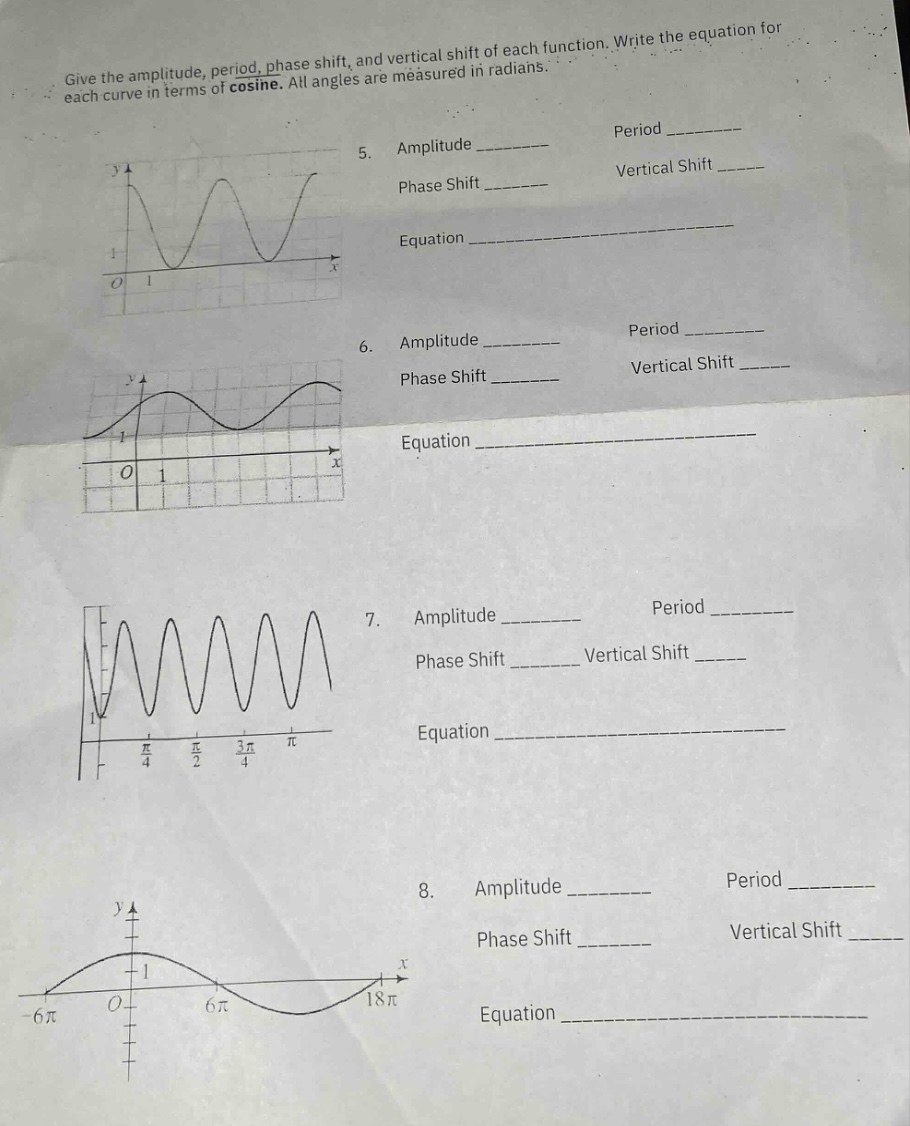
give the amplitude, period, phase shift, and vertical shift of each function. write the equation for each curve in terms of cosine. all angles are measured in radians. 5. amplitude ________ period ________ phase shift ________ vertical shift ____ equation ________ 6. amplitude ________ period ________ phase shift ________ vertical shift ____ equation ________ 7. amplitude ________ period ________ phase shift ________ vertical shift ____ equation ________ 8. amplitude ________ period ________ phase shift ________ vertical shift ____ equation ________
Answer
Explanation:
Step1: Recall general cosine - function form
The general form of a cosine - function is $y = A\cos(B(x - C))+D$, where $|A|$ is the amplitude, $T=\frac{2\pi}{|B|}$ is the period, $C$ is the phase - shift, and $D$ is the vertical shift.
Step2: Analyze graph 5
- Amplitude: The distance from the maximum (or minimum) value to the mid - line. If the mid - line is $y = 0$ and the maximum value is $y = 2$ and the minimum is $y=-2$, then $|A| = 2$.
- Period: The length of one complete cycle. If one cycle occurs from $x = 0$ to $x = 2$, then $T = 2$. Using $T=\frac{2\pi}{|B|}$, we have $2=\frac{2\pi}{|B|}$, so $|B|=\pi$.
- Phase - shift: Since the cosine function starts at its maximum value at $x = 0$, $C = 0$.
- Vertical shift: The mid - line is $y = 0$, so $D = 0$. The equation is $y = 2\cos(\pi x)$.
Step3: Analyze graph 6
- Amplitude: The mid - line is $y = 1$, the maximum value is $y = 2$ and the minimum is $y = 0$, so $|A|=1$.
- Period: One cycle occurs from $x = 0$ to $x = 4$, so $T = 4$. Using $T=\frac{2\pi}{|B|}$, we get $4=\frac{2\pi}{|B|}$, then $|B|=\frac{\pi}{2}$.
- Phase - shift: The cosine function starts at its maximum value at $x = 0$, so $C = 0$.
- Vertical shift: The mid - line is $y = 1$, so $D = 1$. The equation is $y=\cos(\frac{\pi}{2}x)+1$.
Step4: Analyze graph 7
- Amplitude: The mid - line is $y = 1$, the maximum value is $y = 3$ and the minimum is $y=-1$, so $|A| = 2$.
- Period: One cycle occurs from $x = 0$ to $x=\frac{\pi}{2}$, so $T=\frac{\pi}{2}$. Using $T=\frac{2\pi}{|B|}$, we have $\frac{\pi}{2}=\frac{2\pi}{|B|}$, then $|B| = 4$.
- Phase - shift: The cosine function starts at its maximum value at $x = 0$, so $C = 0$.
- Vertical shift: The mid - line is $y = 1$, so $D = 1$. The equation is $y = 2\cos(4x)+1$.
Step5: Analyze graph 8
- Amplitude: The mid - line is $y = 0$, the maximum value is $y = 1$ and the minimum is $y=-1$, so $|A| = 1$.
- Period: One cycle occurs from $x=-6\pi$ to $x = 6\pi$, so $T = 12\pi$. Using $T=\frac{2\pi}{|B|}$, we get $12\pi=\frac{2\pi}{|B|}$, then $|B|=\frac{1}{6}$.
- Phase - shift: The cosine function starts at its maximum value at $x=-6\pi$, so $C=-6\pi$.
- Vertical shift: The mid - line is $y = 0$, so $D = 0$. The equation is $y=\cos(\frac{1}{6}(x + 6\pi))$.
Answer:
- Amplitude: 2, Period: 2, Phase Shift: 0, Vertical Shift: 0, Equation: $y = 2\cos(\pi x)$
- Amplitude: 1, Period: 4, Phase Shift: 0, Vertical Shift: 1, Equation: $y=\cos(\frac{\pi}{2}x)+1$
- Amplitude: 2, Period: $\frac{\pi}{2}$, Phase Shift: 0, Vertical Shift: 1, Equation: $y = 2\cos(4x)+1$
- Amplitude: 1, Period: $12\pi$, Phase Shift: $-6\pi$, Vertical Shift: 0, Equation: $y=\cos(\frac{1}{6}(x + 6\pi))$