give the equations of any vertical, horizontal, or oblique asymptotes for the graph of the rational…
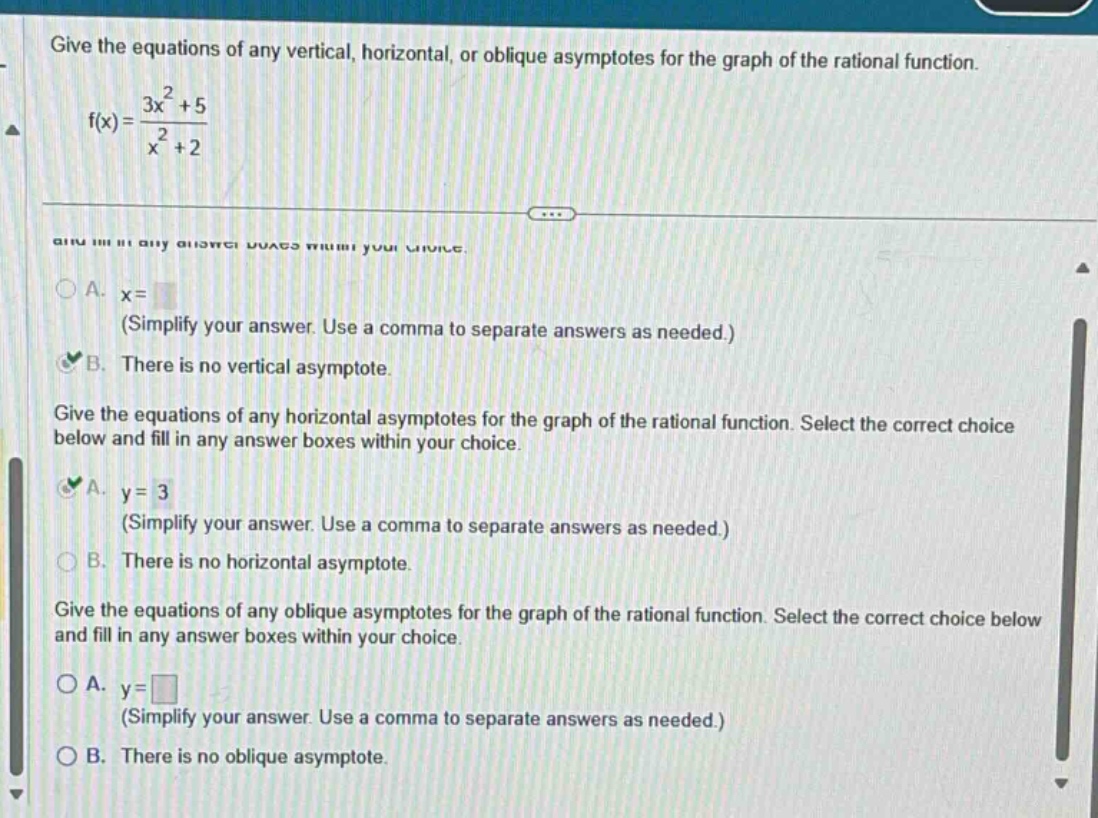
give the equations of any vertical, horizontal, or oblique asymptotes for the graph of the rational function. f(x) = (3x^2 + 5)/(x^2 + 2) give the equations of any vertical asymptotes for the graph of the rational function. select the correct choice below and fill in any answer boxes within your choice. a. x= (simplify your answer. use a comma to separate answers as needed.) b. there is no vertical asymptote. give the equations of any horizontal asymptotes for the graph of the rational function. select the correct choice below and fill in any answer boxes within your choice. a. y = 3 (simplify your answer. use a comma to separate answers as needed.) b. there is no horizontal asymptote. give the equations of any oblique asymptotes for the graph of the rational function. select the correct choice below and fill in any answer boxes within your choice. a. y= (simplify your answer. use a comma to separate answers as needed.) b. there is no oblique asymptote.
Answer
Explanation:
Step1: Find vertical asymptotes
Set the denominator equal to zero: $x^{2}+2 = 0$. Solving $x^{2}=- 2$, there are no real - valued solutions. So, there is no vertical asymptote.
Step2: Find horizontal asymptotes
For a rational function $\frac{f(x)}{g(x)}=\frac{a_nx^n+\cdots+a_0}{b_mx^m+\cdots + b_0}$, when $n = m$ (here $n = m=2$, $a_n = 3$, $b_m = 1$), the horizontal asymptote is $y=\frac{a_n}{b_m}$. So, $y=\frac{3}{1}=3$.
Step3: Find oblique asymptotes
Since the degree of the numerator is equal to the degree of the denominator, there is no oblique asymptote (oblique asymptotes occur when the degree of the numerator is exactly one more than the degree of the denominator).
Answer:
B. There is no vertical asymptote. A. $y = 3$ B. There is no oblique asymptote.