given: $f(x) = \\frac{dy}{dx}$ if $y = x^2 - \\frac{1}{2x^3}$\n\n- calculate the x-intercepts of the graph…
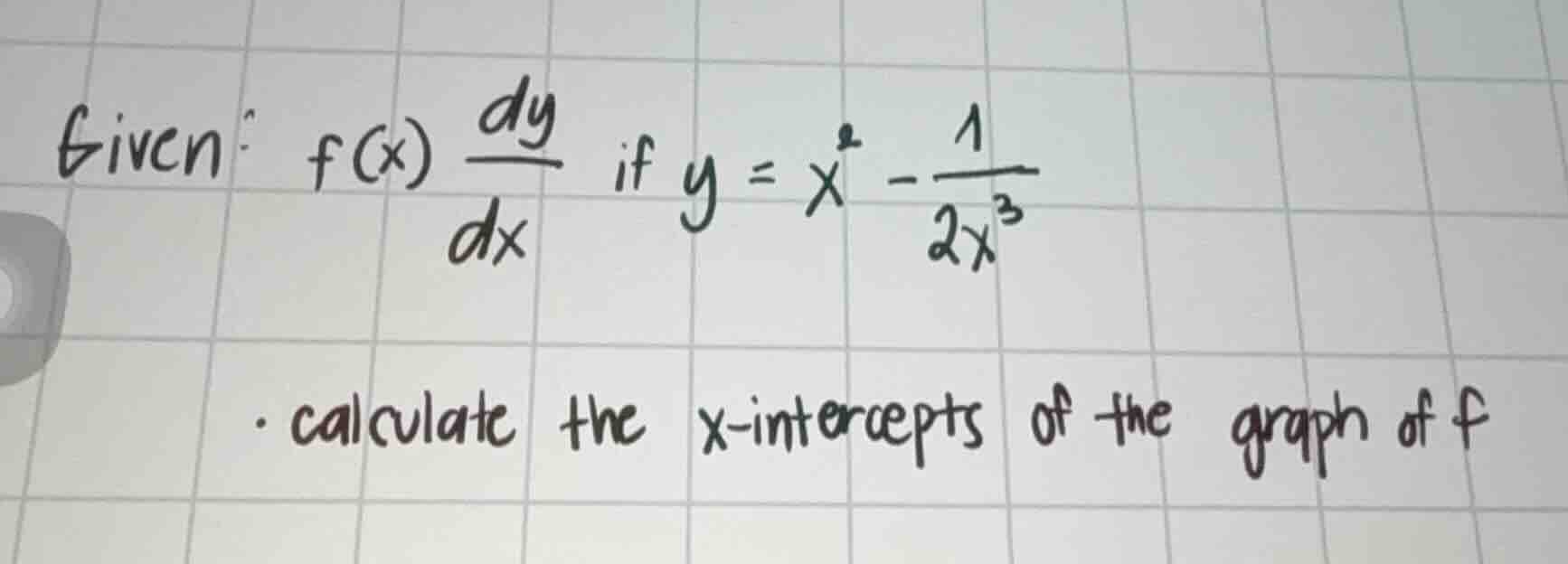
given: $f(x) = \\frac{dy}{dx}$ if $y = x^2 - \\frac{1}{2x^3}$\n\n- calculate the x-intercepts of the graph of f
Answer
Explanation:
Step1: Rewrite the function using exponents
$$y = x^2 - \frac{1}{2}x^{-3}$$
Step2: Differentiate with respect to $x$
$$f(x) = \frac{dy}{dx} = 2x - \left(-\frac{3}{2}\right)x^{-4}$$
Step3: Simplify the derivative expression
$$f(x) = 2x + \frac{3}{2x^4}$$
Step4: Set $f(x)$ to zero for x-intercepts
$$2x + \frac{3}{2x^4} = 0$$
Step5: Solve for $x$
$$2x = -\frac{3}{2x^4} \implies 4x^5 = -3 \implies x^5 = -\frac{3}{4}$$
Step6: Extract the real root
$$x = \sqrt[5]{-\frac{3}{4}}$$
Answer:
$x = -\sqrt[5]{\frac{3}{4}}$ (or approximately $-0.944$)