given the function f(x)=2x³/3 - x² + x/2 + 1/4, answer the following. f(x) has a relative maximum of…
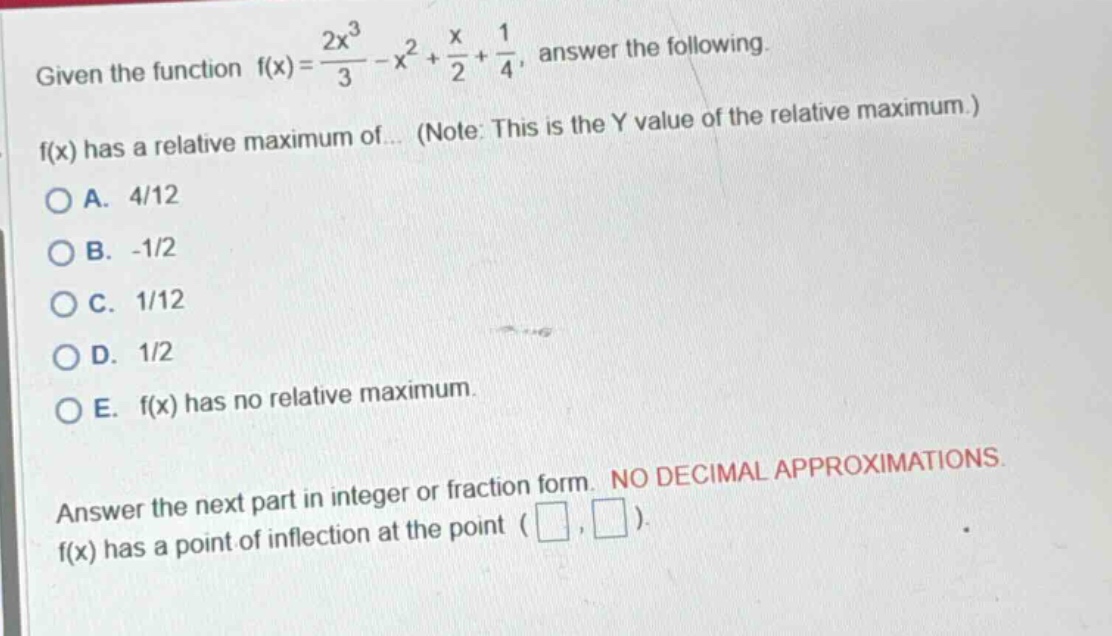
given the function f(x)=2x³/3 - x² + x/2 + 1/4, answer the following. f(x) has a relative maximum of... (note: this is the y value of the relative maximum.) a. 4/12 b. -1/2 c. 1/12 d. 1/2 e. f(x) has no relative maximum. answer the next part in integer or fraction form. no decimal approximations f(x) has a point of inflection at the point ( , )
Answer
Explanation:
Step1: Find the first - derivative
Given $f(x)=\frac{2x^{3}}{3}-x^{2}+\frac{x}{2}+\frac{1}{4}$. Using the power rule $(x^n)^\prime = nx^{n - 1}$, we have $f^\prime(x)=2x^{2}-2x+\frac{1}{2}$.
Step2: Set the first - derivative equal to zero
Set $f^\prime(x)=0$, so $2x^{2}-2x+\frac{1}{2}=0$. Multiply through by 2 to get $4x^{2}-4x + 1=0$. This is a perfect - square trinomial: $(2x - 1)^{2}=0$. Solving for $x$, we get $x=\frac{1}{2}$.
Step3: Find the second - derivative
Differentiate $f^\prime(x)=2x^{2}-2x+\frac{1}{2}$ with respect to $x$. Using the power rule, $f^{\prime\prime}(x)=4x-2$.
Step4: Determine if the critical point is a maximum or minimum
Substitute $x = \frac{1}{2}$ into $f^{\prime\prime}(x)$. $f^{\prime\prime}(\frac{1}{2})=4\times\frac{1}{2}-2=0$. We can also use the first - derivative test. Choose a value less than $\frac{1}{2}$, say $x = 0$. Then $f^\prime(0)=\frac{1}{2}>0$. Choose a value greater than $\frac{1}{2}$, say $x = 1$. Then $f^\prime(1)=2 - 2+\frac{1}{2}=\frac{1}{2}>0$. Since the sign of $f^\prime(x)$ does not change around $x=\frac{1}{2}$, the function has no relative maximum.
Step5: Find the point of inflection
Set $f^{\prime\prime}(x)=0$. So $4x-2 = 0$. Solving for $x$, we get $x=\frac{1}{2}$. Substitute $x=\frac{1}{2}$ into $f(x)$: $f(\frac{1}{2})=\frac{2}{3}\times(\frac{1}{2})^{3}-(\frac{1}{2})^{2}+\frac{1}{2}\times\frac{1}{2}+\frac{1}{4}=\frac{2}{3}\times\frac{1}{8}-\frac{1}{4}+\frac{1}{4}+\frac{1}{4}=\frac{1}{12}+\frac{1}{4}=\frac{1 + 3}{12}=\frac{1}{3}$.
Answer:
E. f(x) has no relative maximum. $(\frac{1}{2},\frac{1}{3})$