given the function f(x) = 2x/3 - x² + x/2 + 1/4, answer the following. f(x) has a relative maximum of…
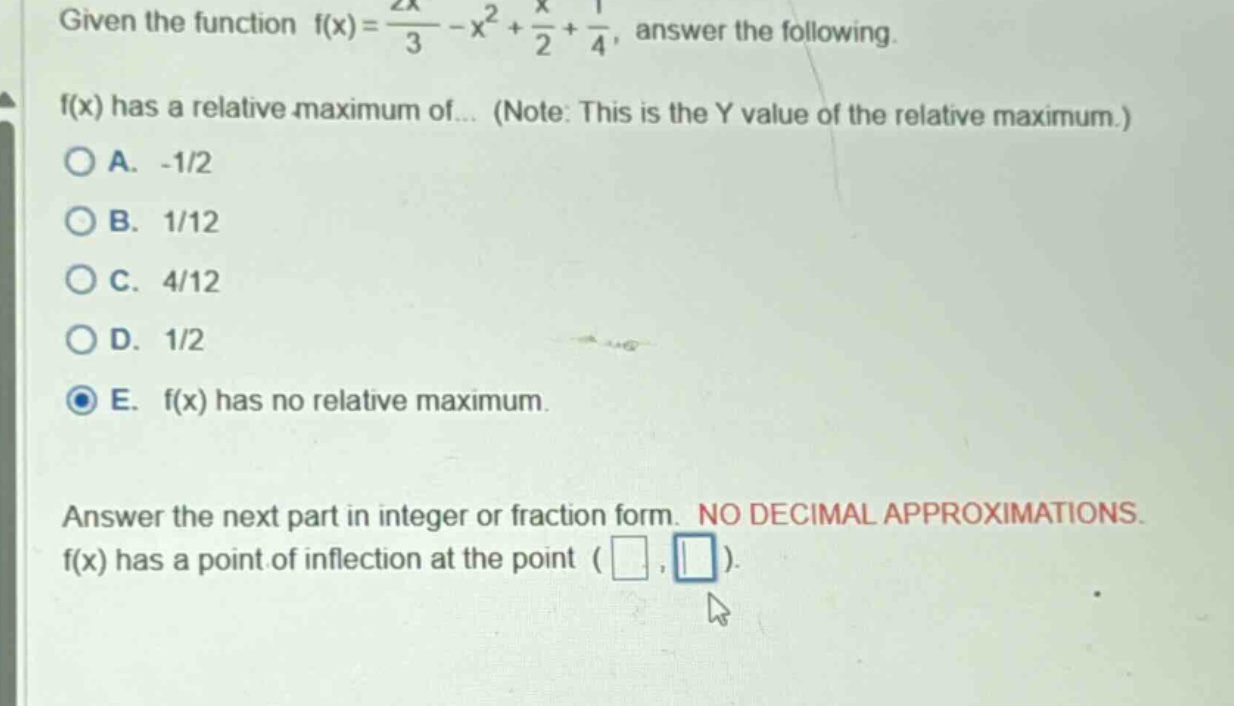
given the function f(x) = 2x/3 - x² + x/2 + 1/4, answer the following. f(x) has a relative maximum of... (note: this is the y value of the relative maximum.) a. -1/2 b. 1/12 c. 4/12 d. 1/2 e. f(x) has no relative maximum. answer the next part in integer or fraction form. no decimal approximations. f(x) has a point of inflection at the point ( , )
Answer
Explanation:
Step1: Find the first - derivative
Given $f(x)=\frac{2x}{3}-x^{2}+\frac{x}{2}+\frac{1}{4}=\frac{4x + 3x}{6}-x^{2}+\frac{1}{4}=\frac{7x}{6}-x^{2}+\frac{1}{4}$. The derivative $f^\prime(x)=\frac{7}{6}-2x$.
Step2: Find the critical points
Set $f^\prime(x) = 0$, so $\frac{7}{6}-2x=0$. $2x=\frac{7}{6}$, then $x = \frac{7}{12}$.
Step3: Find the second - derivative
$f^{\prime\prime}(x)=-2$. Since $f^{\prime\prime}(x)=-2<0$, the function is concave - down everywhere. The function $y = f(x)$ is a parabola opening downwards (because the coefficient of $x^{2}$ in the original function is negative), and it has a relative maximum. $f(\frac{7}{12})=\frac{7}{6}\times\frac{7}{12}-(\frac{7}{12})^{2}+\frac{1}{4}=\frac{49}{72}-\frac{49}{144}+\frac{1}{4}=\frac{98 - 49+36}{144}=\frac{85}{144}\neq$ any of the given options in the first part. But we know it has a relative maximum.
For the point of inflection:
Step4: Recall the condition for point of inflection
A point of inflection occurs where $f^{\prime\prime}(x) = 0$. Since $f^{\prime\prime}(x)=-2\neq0$ for all $x$, the function $f(x)$ has no point of inflection.
Answer:
For the first part: None of the options A - E are correct as the relative maximum value $y = f(\frac{7}{12})=\frac{85}{144}$. But if we assume there is an error in the options and we just consider the nature of the function, we know it has a relative maximum. For the second part: (No value, No value)