given the function below, fill in the table of values, use the table of values to graph the function, and…
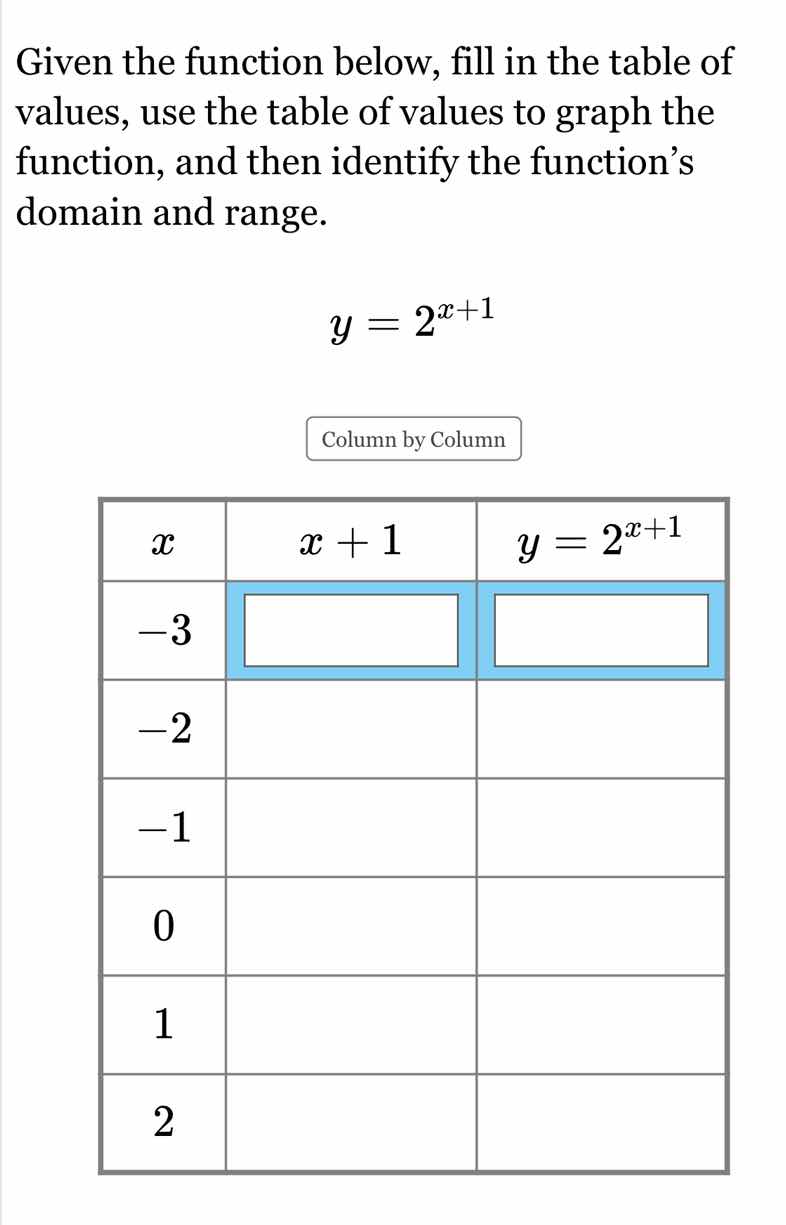
given the function below, fill in the table of values, use the table of values to graph the function, and then identify the functions domain and range.\n$y = 2^{x+1}$\ncolumn by column\n| $x$ | $x + 1$ | $y = 2^{x+1}$ |\n| ---- | ---- | ---- |\n| $-3$ | | |\n| $-2$ | | |\n| $-1$ | | |\n| $0$ | | |\n| $1$ | | |\n| $2$ | | |
Answer
Explanation:
Step1: Calculate $x+1$ for $x=-3$
$(-3) + 1 = -2$
Step2: Calculate $y$ for $x=-3$
$y = 2^{-2} = \frac{1}{2^2} = \frac{1}{4}$
Step3: Calculate $x+1$ for $x=-2$
$(-2) + 1 = -1$
Step4: Calculate $y$ for $x=-2$
$y = 2^{-1} = \frac{1}{2^1} = \frac{1}{2}$
Step5: Calculate $x+1$ for $x=-1$
$(-1) + 1 = 0$
Step6: Calculate $y$ for $x=-1$
$y = 2^{0} = 1$
Step7: Calculate $x+1$ for $x=0$
$0 + 1 = 1$
Step8: Calculate $y$ for $x=0$
$y = 2^{1} = 2$
Step9: Calculate $x+1$ for $x=1$
$1 + 1 = 2$
Step10: Calculate $y$ for $x=1$
$y = 2^{2} = 4$
Step11: Calculate $x+1$ for $x=2$
$2 + 1 = 3$
Step12: Calculate $y$ for $x=2$
$y = 2^{3} = 8$
Step13: Identify domain of $y=2^{x+1}$
Exponential functions accept all real numbers as inputs, so domain is all real $x$.
Step14: Identify range of $y=2^{x+1}$
Exponential functions $b^k$ (where $b>1$) produce only positive outputs, so range is all positive real $y$.
Answer:
Completed Table:
| $x$ | $x+1$ | $y=2^{x+1}$ |
|---|---|---|
| $-3$ | $-2$ | $\frac{1}{4}$ |
| $-2$ | $-1$ | $\frac{1}{2}$ |
| $-1$ | $0$ | $1$ |
| $0$ | $1$ | $2$ |
| $1$ | $2$ | $4$ |
| $2$ | $3$ | $8$ |
Domain and Range:
- Domain: All real numbers, or $(-\infty, \infty)$
- Range: All positive real numbers, or $(0, \infty)$