given the function, find the following: f(x)=√(x - 1) a = 1 h = 1 k = 0 endpoint (1,0) max or min: min…
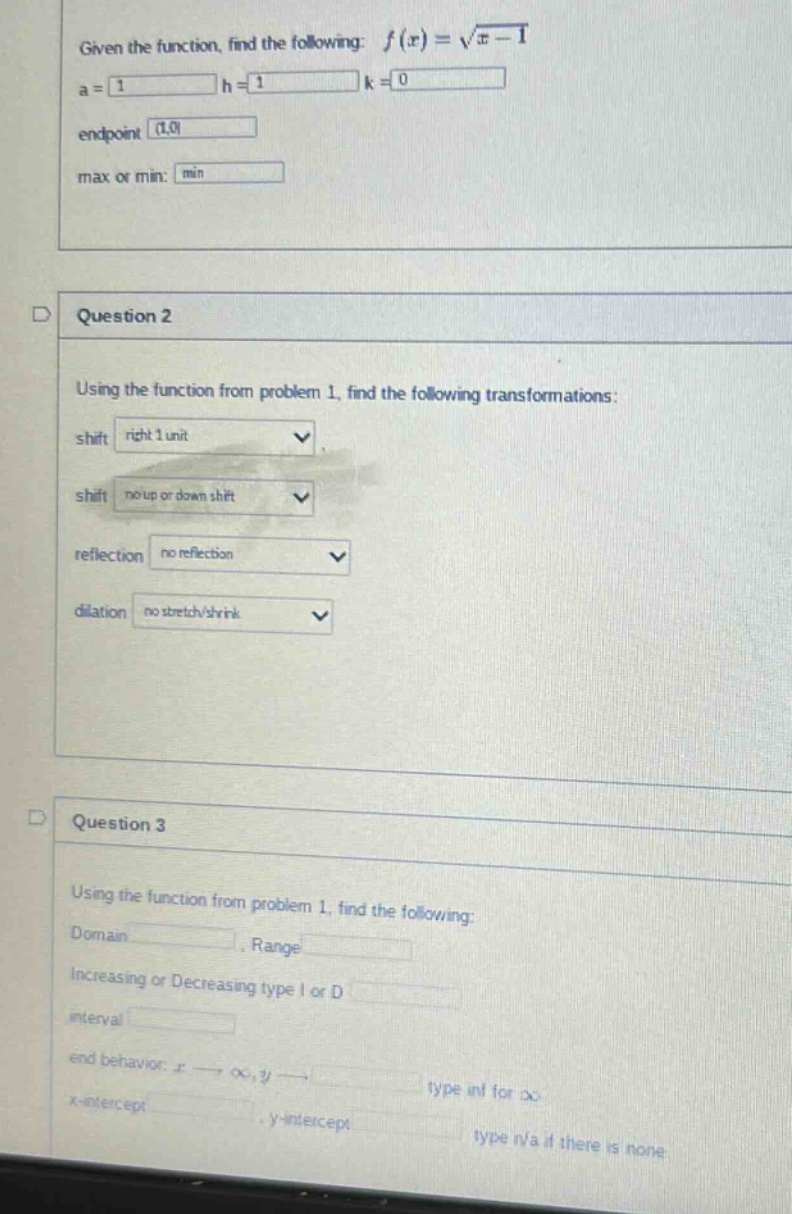
given the function, find the following: f(x)=√(x - 1) a = 1 h = 1 k = 0 endpoint (1,0) max or min: min question 2 using the function from problem 1, find the following transformations: shift right 1 unit shift no up or down shift reflection no reflection dilation no stretch/shrink question 3 using the function from problem 1, find the following: domain, range increasing or decreasing type i or d interval end behavior: x→∞,y→ type inf for ∞ x - intercept, y - intercept type n/a if there is none
Answer
Explanation:
Step1: Find the domain
For the function $f(x)=\sqrt{x - 1}$, the expression under the square - root must be non - negative. So, $x-1\geq0$, which gives $x\geq1$. Domain: $[1,\infty)$
Step2: Find the range
Since the square - root function $\sqrt{t}$ has a range of $[0,\infty)$ for $t\geq0$, and here $t = x - 1\geq0$, the range of $f(x)$ is $[0,\infty)$. Range: $[0,\infty)$
Step3: Determine increasing or decreasing
The derivative of $y=\sqrt{x - 1}=(x - 1)^{\frac{1}{2}}$ using the power rule $\frac{d}{dx}(u^n)=nu^{n - 1}\frac{du}{dx}$ where $u=x - 1$ and $n=\frac{1}{2}$ is $y'=\frac{1}{2\sqrt{x - 1}}>0$ for $x>1$. So the function is increasing. Increasing or Decreasing: I
Step4: Find the interval of increase
The function is increasing for all $x$ in its domain. So the interval is $[1,\infty)$. Interval: $[1,\infty)$
Step5: Analyze end - behavior
As $x\to\infty$, $\sqrt{x - 1}\to\infty$. End - behavior: as $x\to\infty$, $y\to\infty$
Step6: Find the x - intercept
Set $y = 0$, then $\sqrt{x - 1}=0$, which gives $x - 1=0$ and $x = 1$. x - intercept: 1
Step7: Find the y - intercept
Set $x = 0$, but $x = 0$ is not in the domain of $f(x)=\sqrt{x - 1}$. So there is no y - intercept. y - intercept: n/a
Answer:
Domain: $[1,\infty)$ Range: $[0,\infty)$ Increasing or Decreasing: I Interval: $[1,\infty)$ End - behavior: as $x\to\infty$, $y\to\infty$ x - intercept: 1 y - intercept: n/a