given the function $f(x)=\frac{2x + 4}{x + 6}$\na. state any horizontal intercepts as ordered pairs. if…
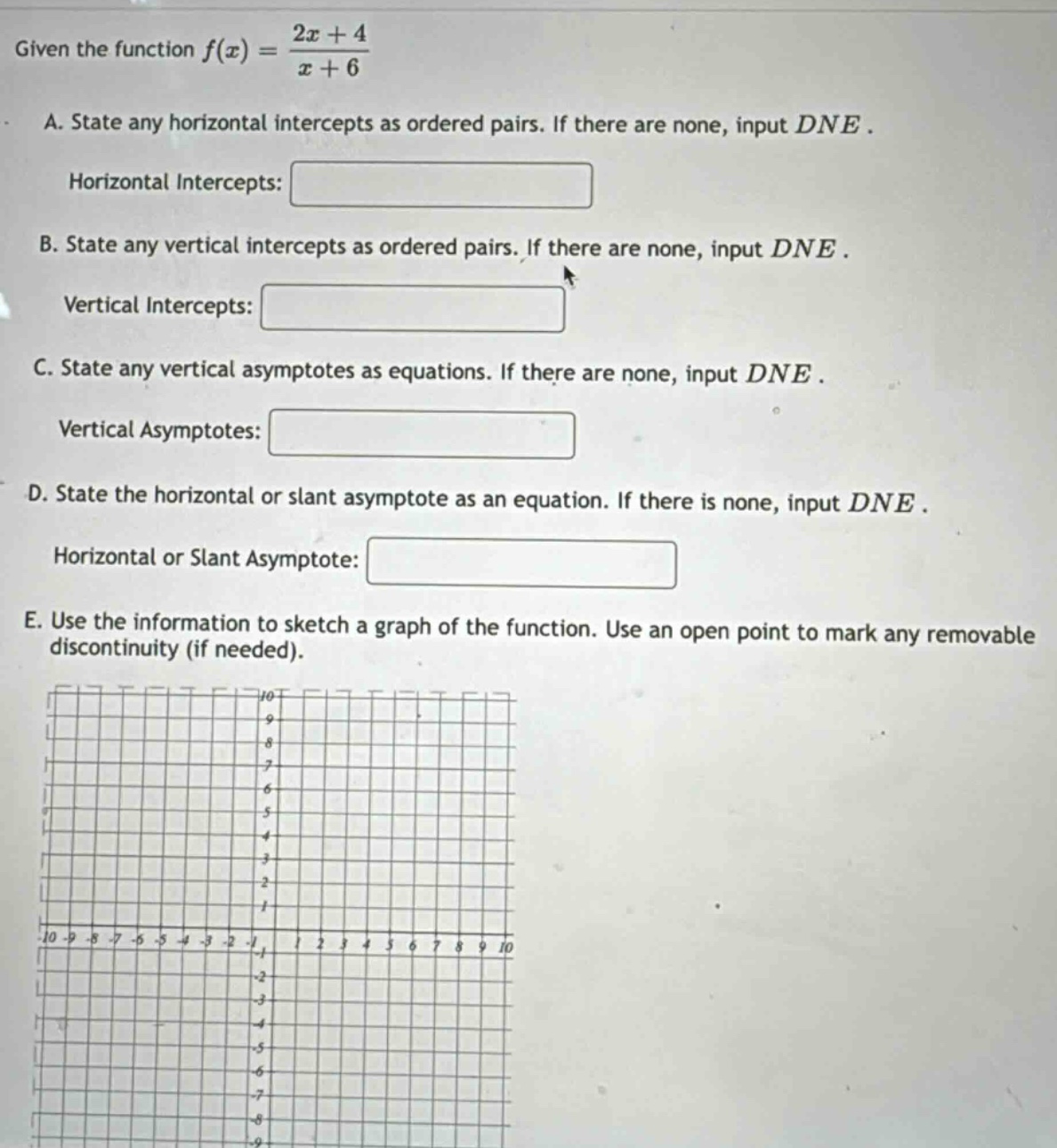
given the function $f(x)=\frac{2x + 4}{x + 6}$\na. state any horizontal intercepts as ordered pairs. if there are none, input $dne$.\nhorizontal intercepts:\n\nb. state any vertical intercepts as ordered pairs. if there are none, input $dne$.\nvertical intercepts:\n\nc. state any vertical asymptotes as equations. if there are none, input $dne$.\nvertical asymptotes:\n\nd. state the horizontal or slant asymptote as an equation. if there is none, input $dne$.\nhorizontal or slant asymptote:\n\ne. use the information to sketch a graph of the function. use an open point to mark any removable discontinuity (if needed).
Answer
Explanation:
Step1: Find horizontal intercepts
Set $y = f(x)=0$, so $\frac{2x + 4}{x + 6}=0$. A fraction is 0 when the numerator is 0 and the denominator is non - zero. Solve $2x+4 = 0$, we get $x=-2$. The horizontal intercept is $(-2,0)$.
Step2: Find vertical intercepts
Set $x = 0$, then $y=\frac{2\times0 + 4}{0+6}=\frac{4}{6}=\frac{2}{3}$. The vertical intercept is $(0,\frac{2}{3})$.
Step3: Find vertical asymptotes
Set the denominator equal to 0. Solve $x + 6=0$, we get $x=-6$. So the vertical asymptote is $x=-6$.
Step4: Find horizontal or slant asymptote
Since the degree of the numerator and the denominator are the same (both degree 1), the horizontal asymptote is $y=\frac{2}{1}=2$ (the ratio of the leading coefficients).
Answer:
A. $(-2,0)$ B. $(0,\frac{2}{3})$ C. $x=-6$ D. $y = 2$ E. To sketch the graph:
- Mark the horizontal intercept at $(-2,0)$ and the vertical intercept at $(0,\frac{2}{3})$.
- Draw a vertical dashed line at $x=-6$ for the vertical asymptote and a horizontal dashed line at $y = 2$ for the horizontal asymptote.
- Analyze the behavior of the function on either side of the vertical asymptote. As $x\to - 6^{-}$, $y\to-\infty$ and as $x\to - 6^{+}$, $y\to\infty$. As $x\to\pm\infty$, $y\to2$. There are no removable discontinuities for this function.