given the function f given by f(θ). specifically, describe the influence of the parameters 3 and π. a. the…
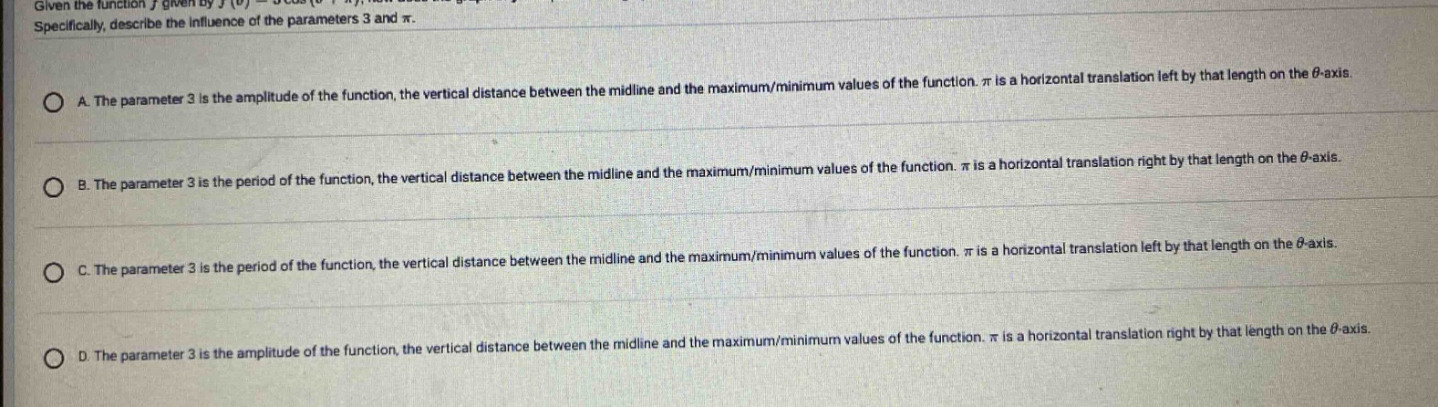
given the function f given by f(θ). specifically, describe the influence of the parameters 3 and π. a. the parameter 3 is the amplitude of the function, the vertical distance between the midline and the maximum/minimum values of the function. π is a horizontal translation left by that length on the θ - axis. b. the parameter 3 is the period of the function, the vertical distance between the midline and the maximum/minimum values of the function. π is a horizontal translation right by that length on the θ - axis. c. the parameter 3 is the period of the function, the vertical distance between the midline and the maximum/minimum values of the function. π is a horizontal translation left by that length on the θ - axis. d. the parameter 3 is the amplitude of the function, the vertical distance between the midline and the maximum/minimum values of the function. π is a horizontal translation right by that length on the θ - axis.
Answer
Brief Explanations:
For a trigonometric - like function of the form (y = A\cos(B(x - C))+D), the amplitude is given by (|A|), which represents the vertical distance between the mid - line and the maximum/minimum values of the function. Here, if the function is something like (y = 3\cos(\theta-\pi)), the amplitude is 3. The value of (C) in the general form represents a horizontal shift. When we have (\theta-\pi), it is a shift of (\pi) units to the right on the (\theta) - axis.
Answer:
D. The parameter 3 is the amplitude of the function, the vertical distance between the midline and the maximum/minimum values of the function. (\pi) is a horizontal translation right by that length on the (\theta) - axis.