given the function f graphed below, determine which of the definite integrals below has the greatest value…
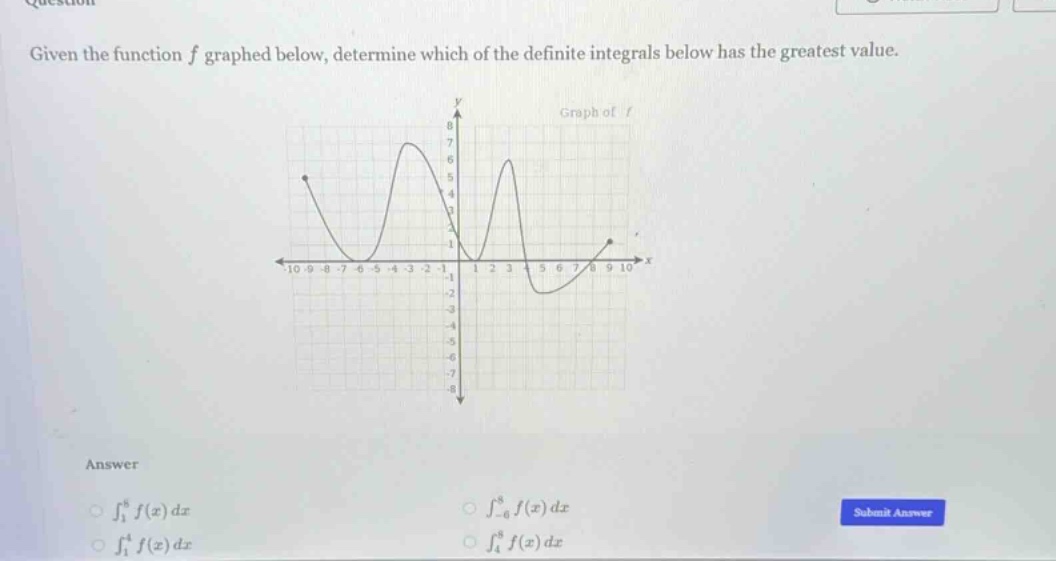
given the function f graphed below, determine which of the definite integrals below has the greatest value. answer ∫₁⁵ f(x) dx ∫₄⁸ f(x) dx ∫₁⁴ f(x) dx ∫₋₆⁸ f(x) dx
Answer
Answer:
We need to analyze the definite - integrals based on the area under the curve of the function (y = f(x)) over the given intervals. The value of a definite integral (\int_{a}^{b}f(x)dx) is equal to the net - signed area between the curve (y = f(x)), the (x) - axis, and the lines (x=a) and (x = b). Positive areas (above the (x) - axis) contribute positively to the integral value, and negative areas (below the (x) - axis) contribute negatively.
Let's consider each integral:
- For (\int_{1}^{6}f(x)dx):
- The interval ([1,6]) contains parts of the curve both above and below the (x) - axis. The positive and negative areas will partially cancel each other out.
- For (\int_{- 6}^{8}f(x)dx):
- The interval ([-6,8]) includes a large portion of the curve. There are significant positive and negative areas. The negative areas in the left - hand side and some in the right - hand side will subtract from the positive areas.
- For (\int_{1}^{4}f(x)dx):
- The interval ([1,4]) lies mostly above the (x) - axis. The area between (x = 1) and (x = 4) is mostly positive. There is a small negative part near (x = 4), but the overall area is positive.
- For (\int_{4}^{8}f(x)dx):
- The interval ([4,8]) contains a negative part of the curve (below the (x) - axis) for a significant portion of the interval. So, this integral will have a negative value.
Since (\int_{4}^{8}f(x)dx<0), and (\int_{1}^{6}f(x)dx) and (\int_{-6}^{8}f(x)dx) have positive and negative areas that cancel each other out to some extent, while (\int_{1}^{4}f(x)dx) has mostly positive area, the definite integral with the greatest value is (\int_{1}^{4}f(x)dx).
Explanation:
Step1: Recall integral as net - signed area
The definite integral (\int_{a}^{b}f(x)dx) is the net - signed area between (y = f(x)) and (x) - axis from (x=a) to (x = b).
Step2: Analyze (\int_{1}^{6}f(x)dx)
Has positive and negative areas, partial cancellation.
Step3: Analyze (\int_{-6}^{8}f(x)dx)
Large interval with significant positive and negative areas, more cancellation.
Step4: Analyze (\int_{1}^{4}f(x)dx)
Mostly positive area, small negative part near (x = 4).
Step5: Analyze (\int_{4}^{8}f(x)dx)
Mostly negative area, integral value is negative. So, the integral with the greatest value is (\int_{1}^{4}f(x)dx).