8. given the graph of g(x) to the right, select the true statement. a. g(x) has an absolute maximum at the…
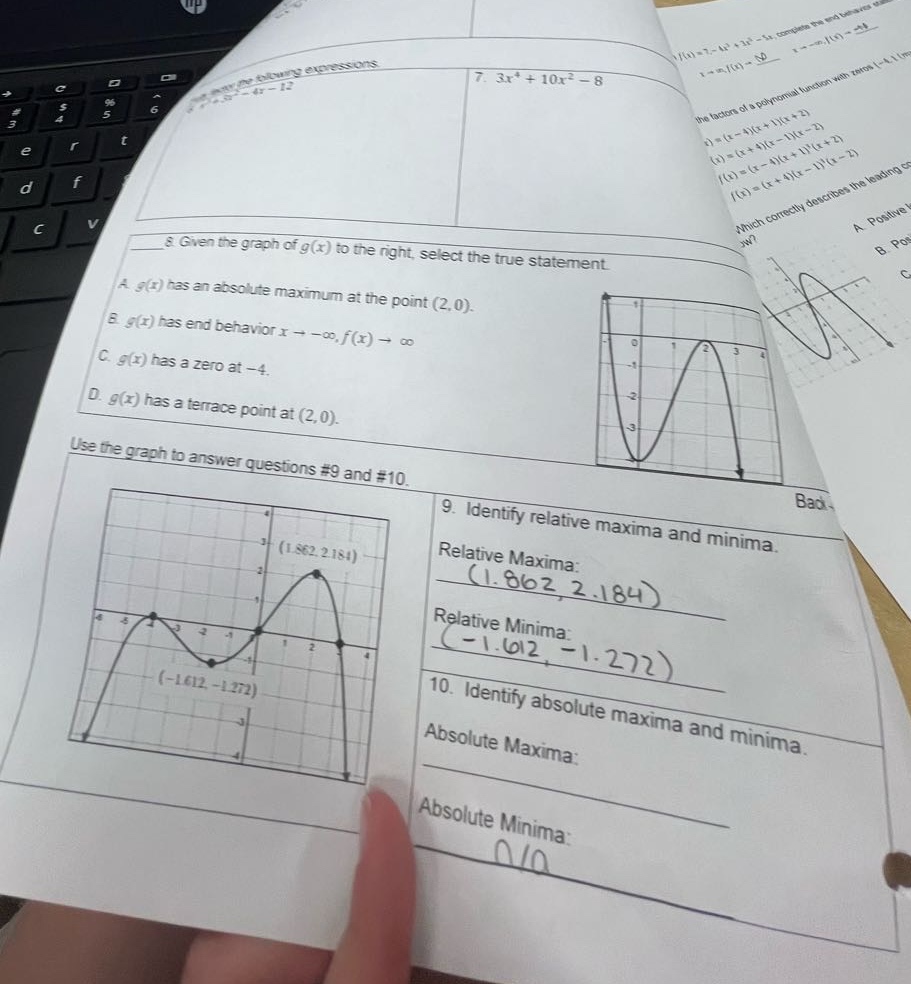
8. given the graph of g(x) to the right, select the true statement. a. g(x) has an absolute maximum at the point (2,0). b. g(x) has end - behavior x→−∞,f(x)→∞ c. g(x) has a zero at - 4. d. g(x) has a terrace point at (2,0). use the graph to answer questions #9 and #10. 9. identify relative maxima and minima. relative maxima: (1.862,2.184) relative minima: (-1.612,-1.272) 10. identify absolute maxima and minima. absolute maxima: absolute minima:
Answer
Explanation:
Step1: Analyze option A
An absolute - maximum is the highest point on the entire graph. From the graph of (g(x)), we can't be sure that ((2,0)) is the absolute maximum as we don't know the behavior of the function outside the shown domain.
Step2: Analyze option B
The end - behavior (x\rightarrow-\infty,f(x)\rightarrow\infty) is not evident from the graph as the left - hand side of the graph is not extended to show what happens as (x) goes to negative infinity.
Step3: Analyze option C
A zero of a function is a value of (x) for which (y = 0). When (x=-4), the graph of (g(x)) intersects the (x) - axis, so (g(x)) has a zero at (x = - 4).
Step4: Analyze option D
There is no such thing as a "terrace point" in standard function analysis. It is a non - existent term in this context.
Answer:
C. (g(x)) has a zero at (-4).