1. given the graph below,\na. 4 write a sine equation that models the graph. explain your reasoning for each…
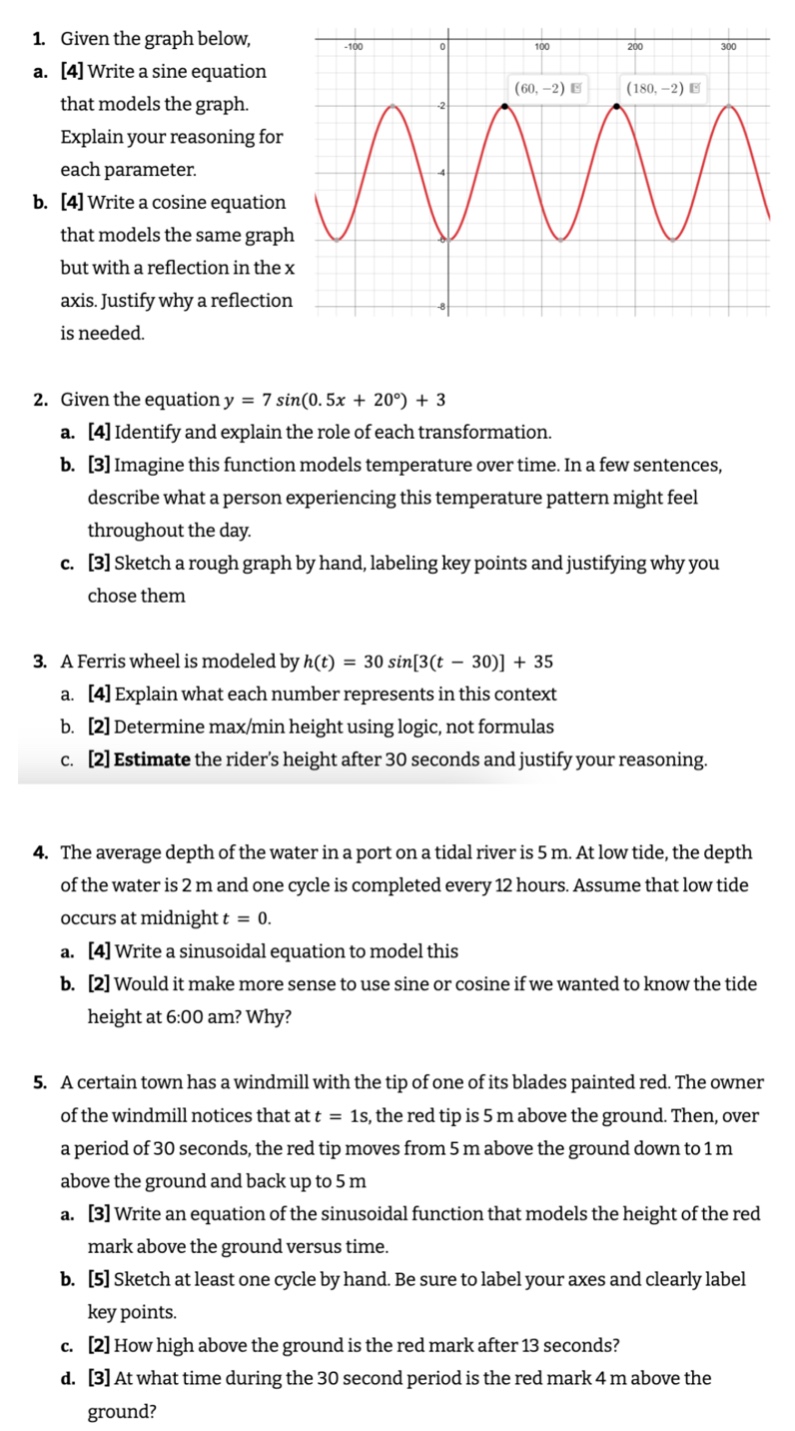
1. given the graph below,\na. 4 write a sine equation that models the graph. explain your reasoning for each parameter.\nb. 4 write a cosine equation that models the same graph but with a reflection in the x - axis. justify why a reflection is needed.\n2. given the equation y = 7 sin(0.5x + 20°) + 3\na. 4 identify and explain the role of each transformation.\nb. 3 imagine this function models temperature over time. in a few sentences, describe what a person experiencing this temperature pattern might feel throughout the day.\nc. 3 sketch a rough graph by hand, labeling key points and justifying why you chose them\n3. a ferris wheel is modeled by h(t)=30 sin3(t - 30) + 35\na. 4 explain what each number represents in this context\nb. 2 determine max/min height using logic, not formulas\nc. 2 estimate the riders height after 30 seconds and justify your reasoning.\n4. the average depth of the water in a port on a tidal river is 5 m. at low tide, the depth of the water is 2 m and one cycle is completed every 12 hours. assume that low tide occurs at midnight t = 0.\na. 4 write a sinusoidal equation to model this\nb. 2 would it make more sense to use sine or cosine if we wanted to know the tide height at 6:00 am? why?\n5. a certain town has a windmill with the tip of one of its blades painted red. the owner of the windmill notices that at t = 1s, the red tip is 5 m above the ground. then, over a period of 30 seconds, the red tip moves from 5 m above the ground down to 1 m above the ground and back up to 5 m\na. 3 write an equation of the sinusoidal function that models the height of the red mark above the ground versus time.\nb. 5 sketch at least one cycle by hand. be sure to label your axes and clearly label key points.\nc. 2 how high above the ground is the red mark after 13 seconds?\nd. 3 at what time during the 30 - second period is the red mark 4 m above the ground?
Answer
1. a.
Explanation:
Step1: Determine the amplitude
The amplitude $A$ is half the vertical distance between the maximum and minimum values. The maximum value is - 2 and the minimum is - 6. So $A=\frac{(-2)-(-6)}{2}=\frac{4}{2} = 2$.
Step2: Determine the vertical shift
The mid - line is the average of the maximum and minimum values. $D=\frac{(-2)+(-6)}{2}=-4$.
Step3: Determine the period
The period $T$ is the horizontal distance between two consecutive maximums. Here $T = 180 - 60=120$. Then the frequency $B=\frac{2\pi}{T}=\frac{2\pi}{120}=\frac{\pi}{60}$.
Step4: Determine the phase shift
For a sine function $y = A\sin(B(x - C))+D$, we can assume $C = 0$ (since there is no obvious horizontal shift from the standard sine - wave starting point). The sine equation is $y = 2\sin(\frac{\pi}{60}x)-4$.
1. b.
The general form of a cosine function is $y = A\cos(B(x - C))+D$. To reflect a cosine function in the $x$ - axis, we change the sign of $A$. The amplitude $A = 2$, $B=\frac{\pi}{60}$, $D=-4$ and we can assume $C = 0$. The cosine function with a reflection in the $x$ - axis is $y=-2\cos(\frac{\pi}{60}x)-4$. A reflection is needed because the cosine function starts at its maximum or minimum value, and to match the given graph's orientation (starting from the mid - line and going down), we need to flip it over the $x$ - axis.
2. a.
For the equation $y = 7\sin(0.5x + 20^{\circ})+3$:
- The amplitude $A = 7$. It represents the maximum deviation of the function from its mid - line. So the temperature varies 7 units above and below the mid - line temperature.
- The coefficient of $x$ is $B = 0.5$. The period $T=\frac{2\pi}{B}=\frac{2\pi}{0.5}=4\pi$. In the context of time, it determines how long it takes for the temperature pattern to repeat.
- The phase shift $C=- \frac{20^{\circ}}{0.5}=-40^{\circ}$. It shifts the sine function horizontally. In terms of time, it represents a time - shift of the temperature pattern.
- The vertical shift $D = 3$. It represents the mid - line of the temperature function. So the average temperature around which the temperature fluctuates is 3.
2. b.
The mid - line temperature is 3. The amplitude is 7, so the temperature varies from $3 - 7=-4$ to $3 + 7 = 10$. A person would experience a temperature that starts at a value determined by the phase shift, then fluctuates between cold (around - 4) and warm (around 10) throughout the day, with the pattern repeating every $T = 4\pi$ units of time (if $x$ represents time).
2. c.
- Key points for $y = 7\sin(0.5x + 20^{\circ})+3$:
- Mid - line: $y = 3$.
- Maximum: $y=3 + 7=10$.
- Minimum: $y=3 - 7=-4$.
- To find the $x$ - values of key points, we set $0.5x+20^{\circ}=0^{\circ},90^{\circ},180^{\circ},270^{\circ},360^{\circ}$.
- For $0.5x+20^{\circ}=0^{\circ}$, $x=-40^{\circ}$.
- For $0.5x+20^{\circ}=90^{\circ}$, $x = 140^{\circ}$.
- For $0.5x+20^{\circ}=180^{\circ}$, $x = 320^{\circ}$.
- For $0.5x+20^{\circ}=270^{\circ}$, $x = 500^{\circ}$.
- For $0.5x+20^{\circ}=360^{\circ}$, $x = 680^{\circ}$. We choose these points because they represent the starting point, maximum, mid - line crossing, minimum, and the end of one period of the sine function.
3. a.
For the Ferris wheel equation $h(t)=30\sin[3(t - 30)]+35$:
- $A = 30$: The amplitude represents the radius of the Ferris wheel (the maximum height above and below the mid - height).
- $B = 3$: The coefficient of $(t - 30)$ is related to the angular speed of the Ferris wheel. The period $T=\frac{2\pi}{B}=\frac{2\pi}{3}$, which means the Ferris wheel makes a full rotation in $\frac{2\pi}{3}$ units of time.
- $C = 30$: The phase shift represents the time at which the Ferris wheel starts its motion (or a reference time).
- $D = 35$: The vertical shift represents the mid - height of the Ferris wheel above the ground.
3. b.
The maximum height occurs when $\sin[3(t - 30)] = 1$. So $h_{max}=30\times1 + 35=65$. The minimum height occurs when $\sin[3(t - 30)]=-1$. So $h_{min}=30\times(-1)+35 = 5$.
3. c.
When $t = 30$, $h(30)=30\sin[3(30 - 30)]+35=30\sin(0)+35=35$. The reasoning is that when $t = 30$, the argument of the sine function is 0, and $\sin(0)=0$, so the height of the rider is at the mid - height of the Ferris wheel.
4. a.
The average depth $D = 5$, the amplitude $A=5 - 2 = 3$, the period $T = 12$, so $B=\frac{2\pi}{T}=\frac{\pi}{6}$. Since low - tide occurs at $t = 0$, for a sine function we need a phase shift. The general form of a sine function is $y=A\sin(B(t - C))+D$. When $t = 0$, $y = 2$. So $2=3\sin(-\frac{\pi}{6}C)+5$. Then $\sin(-\frac{\pi}{6}C)= - 1$, and $C = 3$. The sinusoidal equation is $y = 3\sin(\frac{\pi}{6}(t - 3))+5$.
4. b.
At 6:00 am, $t = 6$. For a sine function $y = 3\sin(\frac{\pi}{6}(6 - 3))+5=3\sin(\frac{\pi}{2})+5=8$. For a cosine function, we can write $y=3\cos(\frac{\pi}{6}(t))+5$. When $t = 6$, $y=3\cos(\pi)+5=2$. It makes more sense to use a cosine function because at $t = 6$ (6:00 am), which is half - way through the 12 - hour cycle, a cosine function (starting at its maximum or minimum) can more directly model the fact that at $t = 6$ we are at the opposite state of low - tide (high - tide if low - tide is at $t = 0$).
5. a.
The mid - line $D=\frac{5 + 1}{2}=3$, the amplitude $A=5 - 3 = 2$, the period $T = 30$, so $B=\frac{2\pi}{T}=\frac{\pi}{15}$. When $t = 1$, $y = 5$. Using the sine function $y=A\sin(B(t - C))+D$, we have $5=2\sin(\frac{\pi}{15}(1 - C))+3$. Then $\sin(\frac{\pi}{15}(1 - C)) = 1$. $\frac{\pi}{15}(1 - C)=\frac{\pi}{2}$, and $C=-6.5$. The equation is $y = 2\sin(\frac{\pi}{15}(t+6.5))+3$.
5. b.
- The $x$ - axis is labeled as time ($t$) in seconds and the $y$ - axis is labeled as height ($h$) in meters.
- Mid - line: $y = 3$.
- Maximum: $y=3 + 2=5$.
- Minimum: $y=3 - 2=1$.
- Key points: When $t=-6.5$, $y = 3$ (starting at mid - line). When $t=-6.5+\frac{15}{2}=1.5$, $y = 5$ (maximum). When $t=-6.5 + 15=8.5$, $y = 3$ (mid - line). When $t=-6.5+\frac{45}{2}=15.5$, $y = 1$ (minimum). When $t=-6.5 + 30=23.5$, $y = 3$ (mid - line).
5. c.
When $t = 13$, $y = 2\sin(\frac{\pi}{15}(13 + 6.5))+3=2\sin(\frac{\pi}{15}\times19.5)+3$. $\frac{\pi}{15}\times19.5=\frac{19.5\pi}{15}=1.3\pi$. $\sin(1.3\pi)\approx - 0.588$. So $y=2\times(-0.588)+3=3 - 1.176 = 1.824$ m.
5. d.
Set $y = 4$. Then $4=2\sin(\frac{\pi}{15}(t+6.5))+3$. $\sin(\frac{\pi}{15}(t+6.5))=\frac{1}{2}$. $\frac{\pi}{15}(t+6.5)=\frac{\pi}{6}+2k\pi$ or $\frac{\pi}{15}(t+6.5)=\frac{5\pi}{6}+2k\pi$. For $\frac{\pi}{15}(t+6.5)=\frac{\pi}{6}$, $t+6.5=\frac{15}{6}=2.5$, $t=-4$ (not in our 30 - second period). For $\frac{\pi}{15}(t+6.5)=\frac{5\pi}{6}$, $t+6.5=\frac{75}{6}=12.5$, $t = 6$. Also, considering the period, $\frac{\pi}{15}(t+6.5)=\frac{\pi}{6}+2\pi$ gives $t+6.5=\frac{15}{6}+30$, $t\approx26$. So the red mark is 4 m above the ground at $t = 6$ s and $t\approx26$ s within the 30 - second period.