for the given logarithmic function, complete parts a through c.\na. determine 3 points that lie on the graph…
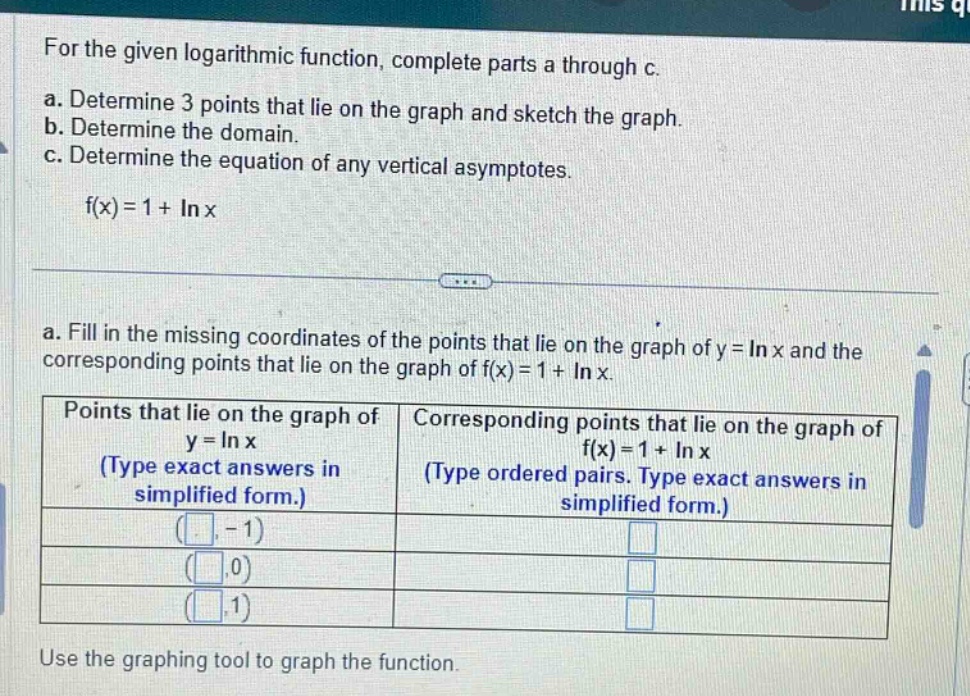
for the given logarithmic function, complete parts a through c.\na. determine 3 points that lie on the graph and sketch the graph.\nb. determine the domain.\nc. determine the equation of any vertical asymptotes.\nf(x)=1 + ln x\na. fill in the missing coordinates of the points that lie on the graph of y = ln x and the corresponding points that lie on the graph of f(x)=1 + ln x.\npoints that lie on the graph of y = ln x (type exact answers in simplified form.) | corresponding points that lie on the graph of f(x)=1 + ln x (type ordered pairs. type exact answers in simplified form.)\n(□,-1)\n(□,0)\n(□,1)\nuse the graphing tool to graph the function.
Answer
Explanation:
Step1: Recall the property of $y = \ln x$
For $y=\ln x$, when $y = - 1$, we solve $\ln x=-1$. By the definition of the natural - logarithm ($y = \ln x$ means $x = e^{y}$), we have $x = e^{-1}=\frac{1}{e}$. For the function $f(x)=1+\ln x$, when $x=\frac{1}{e}$, $f(\frac{1}{e})=1+\ln\frac{1}{e}=1 - 1=0$. So the point on $y = \ln x$ is $(\frac{1}{e},-1)$ and the corresponding point on $f(x)=1+\ln x$ is $(\frac{1}{e},0)$.
Step2: When $y = 0$ in $y=\ln x$
If $\ln x = 0$, then $x = e^{0}=1$ (since $y=\ln x$ is equivalent to $x = e^{y}$). For the function $f(x)=1+\ln x$, when $x = 1$, $f(1)=1+\ln1=1+0 = 1$. So the point on $y=\ln x$ is $(1,0)$ and the corresponding point on $f(x)=1+\ln x$ is $(1,1)$.
Step3: When $y = 1$ in $y=\ln x$
If $\ln x=1$, then $x = e^{1}=e$. For the function $f(x)=1+\ln x$, when $x = e$, $f(e)=1+\ln e=1 + 1=2$. So the point on $y=\ln x$ is $(e,1)$ and the corresponding point on $f(x)=1+\ln x$ is $(e,2)$.
Step4: Determine the domain of $f(x)=1+\ln x$
The domain of the natural - logarithm function $y = \ln x$ is $(0,\infty)$. Since $f(x)=1+\ln x$ is a transformation of $y=\ln x$, the domain of $f(x)$ is also $(0,\infty)$.
Step5: Find the vertical asymptote
The vertical asymptote of the natural - logarithm function $y=\ln x$ is $x = 0$. The function $f(x)=1+\ln x$ is a vertical shift of $y=\ln x$ by 1 unit up, so the vertical asymptote of $f(x)$ is also $x = 0$.
Answer:
| Points that lie on the graph of $y=\ln x$ | Corresponding points that lie on the graph of $f(x)=1+\ln x$ |
|---|---|
| $(\frac{1}{e},-1)$ | $(\frac{1}{e},0)$ |
| $(1,0)$ | $(1,1)$ |
| $(e,1)$ | $(e,2)$ |
| Domain: $(0,\infty)$ | |
| Vertical asymptote: $x = 0$ |