given that ( f(x) ) is the original function, what is true about the transformation, ( g(x) )?\n( g(x) ) is…
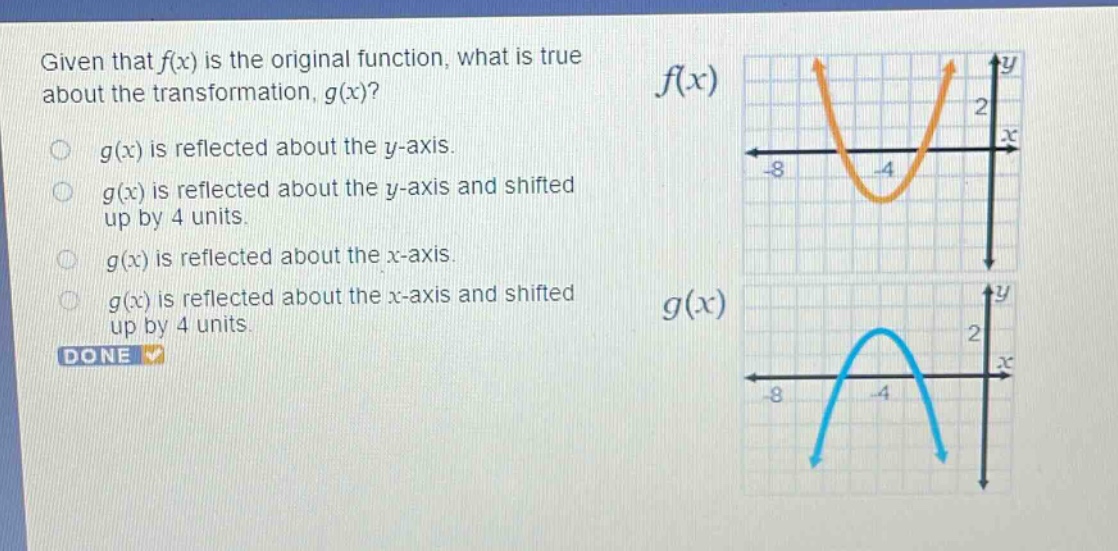
given that ( f(x) ) is the original function, what is true about the transformation, ( g(x) )?\n( g(x) ) is reflected about the ( y )-axis.\n( g(x) ) is reflected about the ( y )-axis and shifted up by 4 units.\n( g(x) ) is reflected about the ( x )-axis.\n( g(x) ) is reflected about the ( x )-axis and shifted up by 4 units.
Answer
Brief Explanations:
Para determinar la transformación de (f(x)) a (g(x)), se observa que la parábola (f(x)) abre hacia arriba y (g(x)) abre hacia abajo. Esto significa que hay una reflexión sobre el eje (x). No hay desplazamiento vertical visible (las posiciones relativas en el eje (y) no indican un desplazamiento de 4 unidades hacia arriba).
Answer:
C. (g(x)) is reflected about the (x) - axis.