given the rational function $f(x)=\frac{2x^{2}}{x^{2}-1}$\na) analyze and graph the function using algorithm…
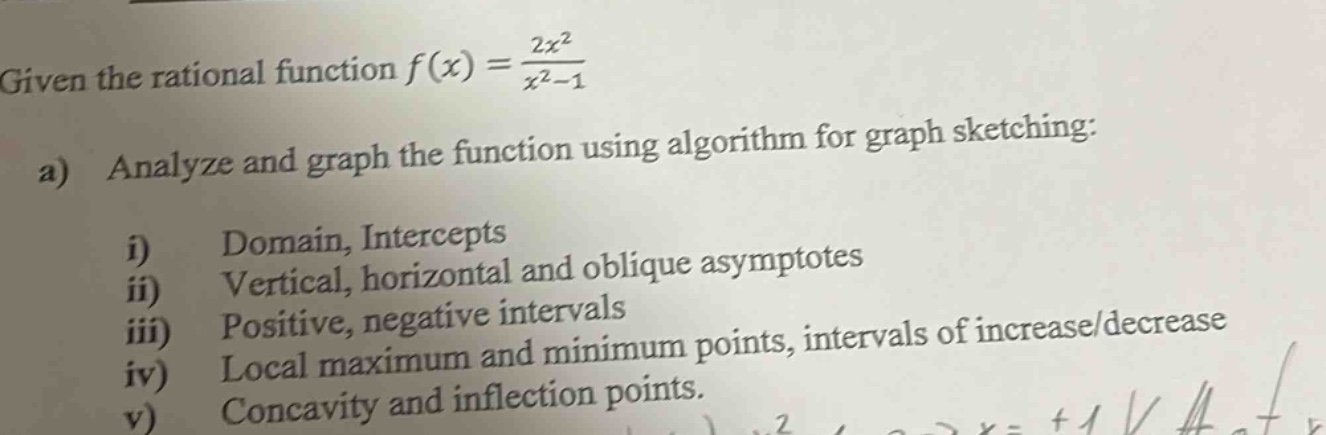
given the rational function $f(x)=\frac{2x^{2}}{x^{2}-1}$\na) analyze and graph the function using algorithm for graph sketching:\ni) domain, intercepts\nii) vertical, horizontal and oblique asymptotes\niii) positive, negative intervals\niv) local maximum and minimum points, intervals of increase/decrease\nv) concavity and inflection points.
Answer
Explanation:
Step1: Find the domain
The denominator cannot be zero. So, $x^{2}-1\neq0$, which gives $(x - 1)(x + 1)\neq0$. Thus, $x\neq\pm1$. The domain is $(-\infty,-1)\cup(-1,1)\cup(1,\infty)$.
Step2: Find the intercepts
- x - intercept: Set $y = f(x)=0$. Then $\frac{2x^{2}}{x^{2}-1}=0$, which implies $2x^{2}=0$, so $x = 0$.
- y - intercept: Set $x = 0$. Then $y=\frac{2\times0^{2}}{0^{2}-1}=0$.
Step3: Find the asymptotes
- Vertical asymptotes: Set the denominator equal to zero. $x^{2}-1 = 0$, so $x=1$ and $x=-1$ are vertical asymptotes.
- Horizontal asymptotes: Since the degree of the numerator and denominator are the same (both degree 2), we find the limit as $x\to\pm\infty$. $\lim_{x\to\pm\infty}\frac{2x^{2}}{x^{2}-1}=\lim_{x\to\pm\infty}\frac{2}{1-\frac{1}{x^{2}}}=2$. So $y = 2$ is a horizontal asymptote. There are no oblique asymptotes as the degree of the numerator is not one more than the degree of the denominator.
Step4: Find positive and negative intervals
We consider the sign of $y=\frac{2x^{2}}{x^{2}-1}$. The critical points (where the numerator or denominator is zero) are $x=-1,0,1$. We can test intervals:
- For $x\in(-\infty,-1)$, let $x=-2$. Then $y=\frac{2\times(-2)^{2}}{(-2)^{2}-1}=\frac{8}{3}>0$.
- For $x\in(-1,0)$, let $x =-\frac{1}{2}$. Then $y=\frac{2\times(-\frac{1}{2})^{2}}{(-\frac{1}{2})^{2}-1}=-\frac{2}{3}<0$.
- For $x\in(0,1)$, let $x=\frac{1}{2}$. Then $y=\frac{2\times(\frac{1}{2})^{2}}{(\frac{1}{2})^{2}-1}=-\frac{2}{3}<0$.
- For $x\in(1,\infty)$, let $x = 2$. Then $y=\frac{2\times2^{2}}{2^{2}-1}=\frac{8}{3}>0$. The function is positive on $(-\infty,-1)\cup(1,\infty)$ and negative on $(-1,1)$.
Step5: Find local maxima and minima and intervals of increase/decrease
First, find the derivative using the quotient - rule. If $y=\frac{2x^{2}}{x^{2}-1}$, then $y'=\frac{4x(x^{2}-1)-2x^{2}(2x)}{(x^{2}-1)^{2}}=\frac{4x^{3}-4x - 4x^{3}}{(x^{2}-1)^{2}}=-\frac{4x}{(x^{2}-1)^{2}}$. Set $y' = 0$, then $x = 0$.
- For $x\in(-\infty,-1)$, $y'<0$, the function is decreasing.
- For $x\in(-1,0)$, $y'>0$, the function is increasing.
- For $x\in(0,1)$, $y'<0$, the function is decreasing.
- For $x\in(1,\infty)$, $y'<0$, the function is decreasing. So, there is a local maximum at $x = 0$ and $y(0)=0$.
Step6: Find concavity and inflection points
Find the second - derivative using the quotient - rule on $y'=-\frac{4x}{(x^{2}-1)^{2}}$. $y''=\frac{-4(x^{2}-1)^{2}+4x\times2(x^{2}-1)\times2x}{(x^{2}-1)^{4}}=\frac{-4(x^{2}-1)+16x^{2}}{(x^{2}-1)^{3}}=\frac{-4x^{2}+4 + 16x^{2}}{(x^{2}-1)^{3}}=\frac{12x^{2}+4}{(x^{2}-1)^{3}}$. The second - derivative is never zero (since $12x^{2}+4>0$ for all real $x$), but it is undefined at $x=\pm1$.
- For $x\in(-\infty,-1)$, $y''>0$, the function is concave up.
- For $x\in(-1,1)$, $y''<0$, the function is concave down.
- For $x\in(1,\infty)$, $y''>0$, the function is concave up. There are no inflection points as the function is not continuous at $x=\pm1$.
To graph the function:
- Plot the intercept at $(0,0)$.
- Draw the vertical asymptotes $x = 1$ and $x=-1$ and the horizontal asymptote $y = 2$.
- Use the information about positive/negative intervals, increasing/decreasing intervals and concavity to sketch the curve.
Answer:
Domain: $(-\infty,-1)\cup(-1,1)\cup(1,\infty)$; x - intercept: $x = 0$; y - intercept: $y = 0$; Vertical asymptotes: $x = 1,x=-1$; Horizontal asymptote: $y = 2$; Positive intervals: $(-\infty,-1)\cup(1,\infty)$; Negative intervals: $(-1,1)$; Local maximum at $(0,0)$; Decreasing intervals: $(-\infty,-1),(0,1),(1,\infty)$; Increasing interval: $(-1,0)$; Concave up intervals: $(-\infty,-1),(1,\infty)$; Concave down interval: $(-1,1)$; No inflection points.