4. given (f(\theta)=2 - cos\theta). which of the following intervals contains all values of (\theta) for…
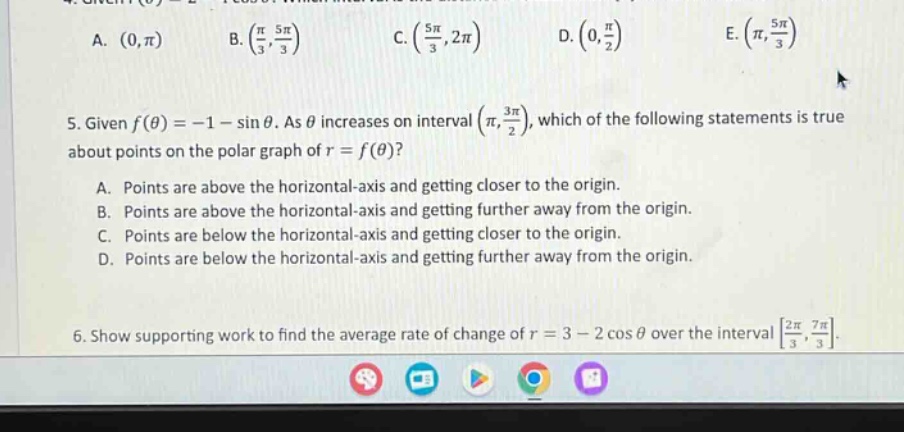
4. given (f(\theta)=2 - cos\theta). which of the following intervals contains all values of (\theta) for which (f(\theta)geq1)? a. ((0,pi)) b. ((\frac{pi}{3},\frac{5pi}{3})) c. ((\frac{5pi}{3},2pi)) d. ((0,\frac{pi}{2})) e. ((pi,\frac{5pi}{3})) 5. given (f(\theta)= - 1-sin\theta). as (\theta) increases on interval ((pi,\frac{3pi}{2})), which of the following statements is true about points on the polar graph of (r = f(\theta))? a. points are above the horizontal - axis and getting closer to the origin. b. points are above the horizontal - axis and getting further away from the origin. c. points are below the horizontal - axis and getting closer to the origin. d. points are below the horizontal - axis and getting further away from the origin. 6. show supporting work to find the average rate of change of (r = 3-2cos\theta) over the interval (\frac{2pi}{3},\frac{7pi}{3}).
Answer
Explanation:
Step1: Recall average - rate - of - change formula
The average rate of change of a function $y = f(x)$ over the interval $[a,b]$ is $\frac{f(b)-f(a)}{b - a}$. For the polar function $r = 3-2\cos\theta$ over the interval $[\frac{2\pi}{3},\frac{7\pi}{3}]$, we have $a=\frac{2\pi}{3}$, $b = \frac{7\pi}{3}$, and $r(\theta)=3 - 2\cos\theta$.
Step2: Calculate $r(b)$ and $r(a)$
First, find $r(\frac{7\pi}{3})$: $r(\frac{7\pi}{3})=3-2\cos(\frac{7\pi}{3})=3 - 2\cos(2\pi+\frac{\pi}{3})=3-2\cos(\frac{\pi}{3})=3 - 2\times\frac{1}{2}=3 - 1=2$. Next, find $r(\frac{2\pi}{3})$: $r(\frac{2\pi}{3})=3-2\cos(\frac{2\pi}{3})=3-2\times(-\frac{1}{2})=3 + 1=4$.
Step3: Calculate the average rate of change
The average rate of change is $\frac{r(\frac{7\pi}{3})-r(\frac{2\pi}{3})}{\frac{7\pi}{3}-\frac{2\pi}{3}}$. Substitute the values of $r(\frac{7\pi}{3})$ and $r(\frac{2\pi}{3})$: $\frac{2 - 4}{\frac{7\pi}{3}-\frac{2\pi}{3}}=\frac{-2}{\frac{5\pi}{3}}=-\frac{6}{5\pi}$.
Answer:
$-\frac{6}{5\pi}$