given the values in the table on the left come from a continuous function, which intervals must contain an x…
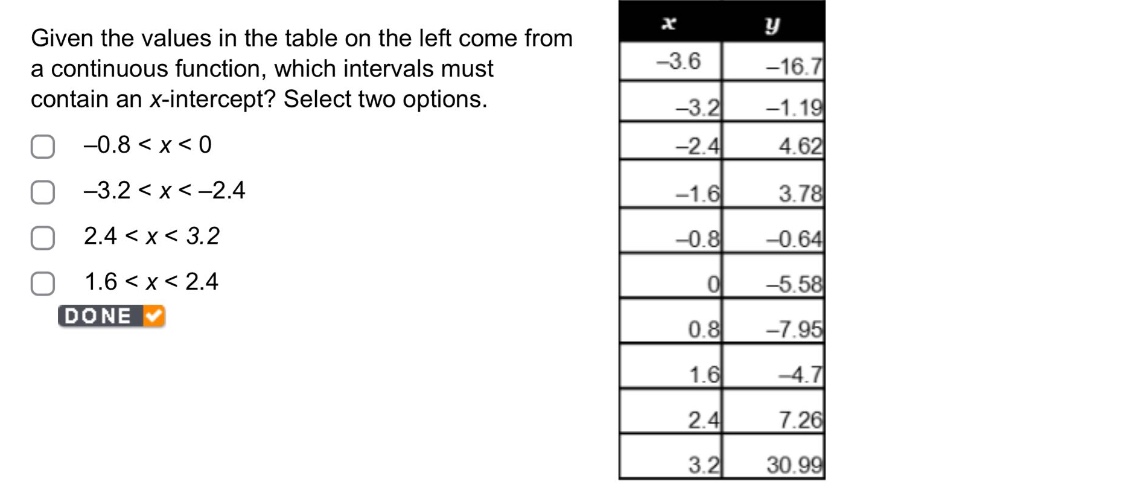
given the values in the table on the left come from a continuous function, which intervals must contain an x - intercept? select two options.\n-0.8 < x < 0\n-3.2 < x < -2.4\n2.4 < x < 3.2\n1.6 < x < 2.4
Answer
Explanation:
Step1: Recall Intermediate - Value Theorem
If a function $y = f(x)$ is continuous on an interval $[a,b]$, and $f(a)$ and $f(b)$ have opposite signs, then there must be at least one $c\in(a,b)$ such that $f(c)=0$ (an x - intercept).
Step2: Check intervals for sign - change
For the interval $-3.2\lt x\lt - 2.4$: When $x=-3.2$, $y = - 1.19$ (negative) and when $x=-2.4$, $y = 4.62$ (positive). Since the function is continuous, there must be an x - intercept in the interval $-3.2\lt x\lt -2.4$. For the interval $1.6\lt x\lt2.4$: When $x = 1.6$, $y=-4.7$ (negative) and when $x = 2.4$, $y = 7.26$ (positive). Since the function is continuous, there must be an x - intercept in the interval $1.6\lt x\lt2.4$. For the interval $-0.8\lt x\lt0$: $y$ is negative at both $x=-0.8$ and $x = 0$, no sign - change. For the interval $2.4\lt x\lt3.2$: $y$ is positive at both $x = 2.4$ and $x = 3.2$, no sign - change.
Answer:
-3.2 < x < -2.4, 1.6 < x < 2.4