a grain silo consists of a cylindrical concrete tower surmounted by a metal hemispherical dome. the metal in…
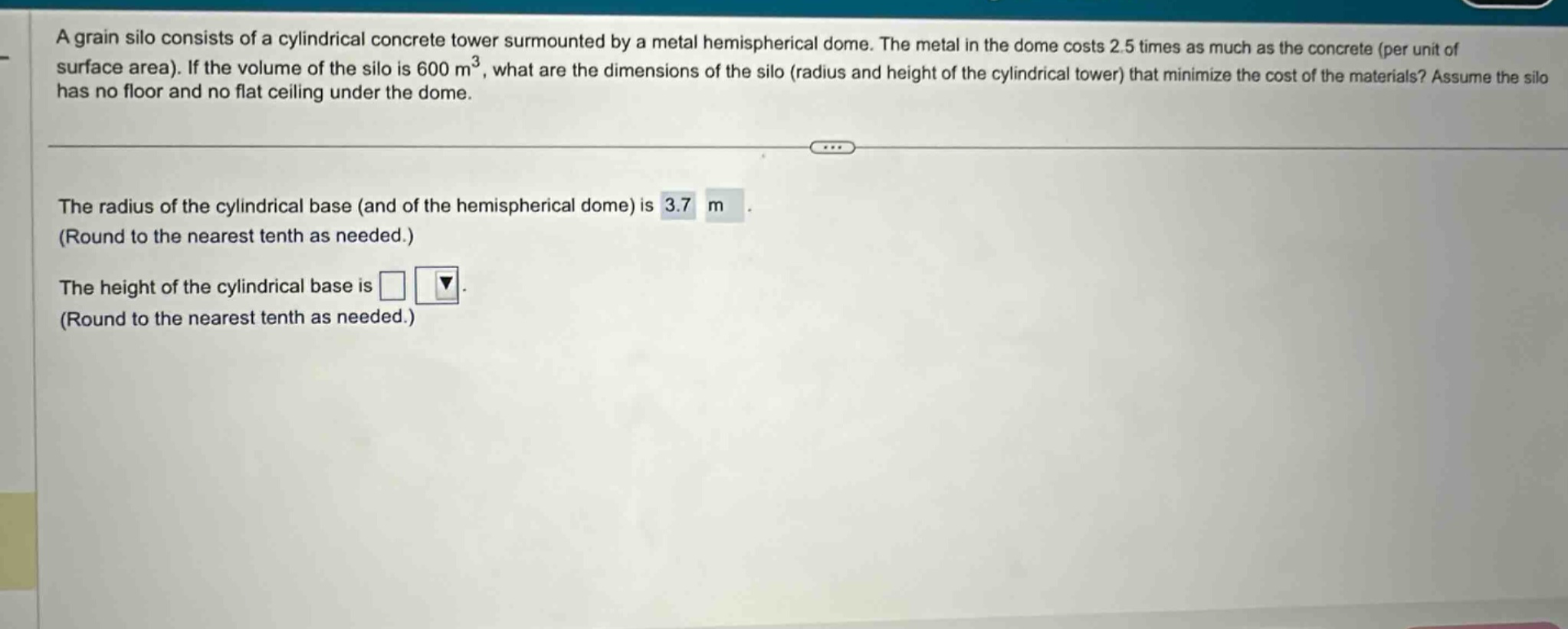
a grain silo consists of a cylindrical concrete tower surmounted by a metal hemispherical dome. the metal in the dome costs 2.5 times as much as the concrete (per unit of surface area). if the volume of the silo is 600 m³, what are the dimensions of the silo (radius and height of the cylindrical tower) that minimize the cost of the materials? assume the silo has no floor and no flat ceiling under the dome. the radius of the cylindrical base (and of the hemispherical dome) is 3.7 m. (round to the nearest tenth as needed.) the height of the cylindrical base is. (round to the nearest tenth as needed.)
Answer
Explanation:
Step1: Write volume formula
The volume of the silo $V = \pi r^{2}h+\frac{2}{3}\pi r^{3}$, and $V = 600$. So, $600=\pi r^{2}h+\frac{2}{3}\pi r^{3}$, and we can express $h$ in terms of $r$ as $h=\frac{600 - \frac{2}{3}\pi r^{3}}{\pi r^{2}}=\frac{600}{\pi r^{2}}-\frac{2}{3}r$.
Step2: Write cost - function
Let the cost per unit area of concrete be $1$, then the cost per unit area of metal is $2.5$. The surface - area of the cylindrical part is $A_{c}=2\pi rh$ and the surface - area of the hemispherical part is $A_{h}=2\pi r^{2}$. The cost function $C = 2\pi rh+2.5\times(2\pi r^{2})=2\pi r\left(\frac{600}{\pi r^{2}}-\frac{2}{3}r\right)+5\pi r^{2}$. Simplify the cost function: [ \begin{align*} C&=\frac{1200}{r}-\frac{4}{3}\pi r^{2}+5\pi r^{2}\ &=\frac{1200}{r}+\left(5\pi-\frac{4}{3}\pi\right)r^{2}\ &=\frac{1200}{r}+\frac{11}{3}\pi r^{2} \end{align*} ]
Step3: Differentiate the cost function
Differentiate $C(r)$ with respect to $r$: $C^\prime(r)=-\frac{1200}{r^{2}}+\frac{22}{3}\pi r$. Set $C^\prime(r) = 0$ to find the critical points: [ \begin{align*} -\frac{1200}{r^{2}}+\frac{22}{3}\pi r&=0\ \frac{1200}{r^{2}}&=\frac{22}{3}\pi r\ 1200\times3&=22\pi r^{3}\ r^{3}&=\frac{3600}{22\pi}=\frac{1800}{11\pi}\ r&\approx3.7 \end{align*} ]
Step4: Find the height
Substitute $r = 3.7$ into the formula for $h$: [ \begin{align*} h&=\frac{600}{\pi\times(3.7)^{2}}-\frac{2}{3}\times3.7\ &=\frac{600}{\pi\times13.69}-\frac{7.4}{3}\ &\approx\frac{600}{43.08}-\frac{7.4}{3}\ &\approx13.9 - 2.5\ &\approx11.4 \end{align*} ]
Answer:
$11.4$