if the graph of f(x)=4e^0.1x is blue, then the graph of f(x)=4(1 + 0.1/0.5)^0.5x is ___. a. green b. not…
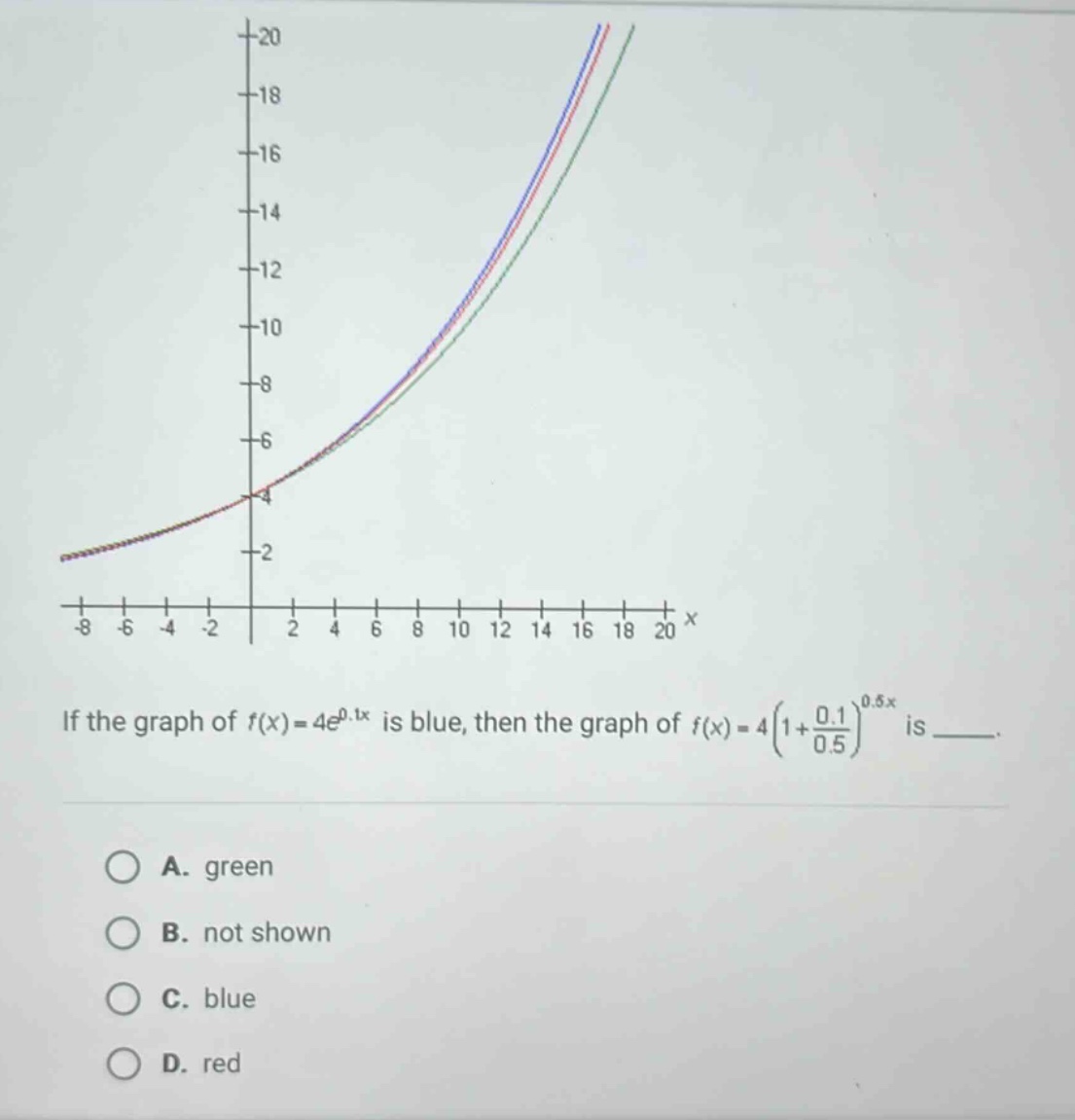
if the graph of f(x)=4e^0.1x is blue, then the graph of f(x)=4(1 + 0.1/0.5)^0.5x is ___. a. green b. not shown c. blue d. red
Answer
Explanation:
Step1: Recall compound - interest and exponential - growth formulas
The function $y = ae^{bx}$ is a continuous - growth exponential function. The function $y=a(1 + \frac{r}{n})^{nx}$ is a compound - growth function. As $n\rightarrow\infty$, $a(1+\frac{r}{n})^{nx}\rightarrow ae^{rx}$. Here, for $y = 4(1+\frac{0.1}{0.5})^{0.5x}$, we have $a = 4$, $r=0.1$ and $n = 0.5$.
Step2: Analyze the graphs
The function $f(x)=4e^{0.1x}$ and $f(x)=4(1 + \frac{0.1}{0.5})^{0.5x}$ are both exponential - growth functions. When we compare the two functions, we know that the function $y = 4(1+\frac{0.1}{0.5})^{0.5x}$ is a non - continuous (compound) growth approximation of the continuous growth function $y = 4e^{0.1x}$. By observing the graph, we can see that the red graph represents $f(x)=4(1+\frac{0.1}{0.5})^{0.5x}$.
Answer:
D. red