which is the graph of y = -cos(x) - 2?
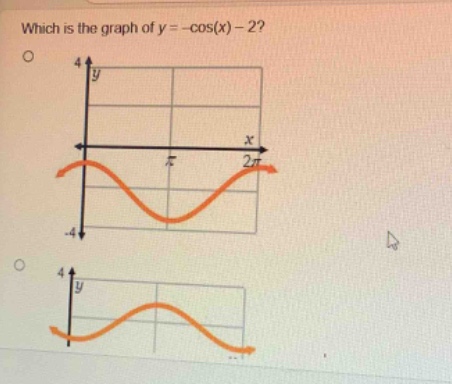
which is the graph of y = -cos(x) - 2?
Answer
- Recall the properties of the cosine - function (y = A\cos(Bx - C)+D):
- The general form of a cosine - function is (y = A\cos(Bx - C)+D), where for the function (y=-\cos(x)-2), we have (A=-1), (B = 1), (C = 0), and (D=-2).
- The amplitude of the function (y = A\cos(Bx - C)+D) is given by (|A|). Here, (|A| = | - 1|=1).
- The period of the function (y=\cos(Bx)) is (T=\frac{2\pi}{|B|}). Since (B = 1), the period of (y =-\cos(x)-2) is (T=\frac{2\pi}{|1|}=2\pi).
- The vertical shift of the function is determined by (D). Here, (D=-2), which means the graph of (y = \cos(x)) is shifted downwards by 2 units.
- The negative sign in front of (\cos(x)) (i.e., (A=-1)) reflects the graph of (y = \cos(x)) about the (x) - axis.
- Analyze the key - points of the standard cosine function (y=\cos(x)) and transform them:
- The key - points of (y = \cos(x)) are:
- When (x = 0), (y=\cos(0)=1); for (y =-\cos(x)-2), when (x = 0), (y=-\cos(0)-2=-1 - 2=-3).
- When (x=\frac{\pi}{2}), (y=\cos(\frac{\pi}{2}) = 0); for (y =-\cos(x)-2), when (x=\frac{\pi}{2}), (y=-\cos(\frac{\pi}{2})-2=0 - 2=-2).
- When (x=\pi), (y=\cos(\pi)=-1); for (y =-\cos(x)-2), when (x=\pi), (y=-(-1)-2=-1).
- When (x=\frac{3\pi}{2}), (y=\cos(\frac{3\pi}{2}) = 0); for (y =-\cos(x)-2), when (x=\frac{3\pi}{2}), (y=-\cos(\frac{3\pi}{2})-2=0 - 2=-2).
- When (x = 2\pi), (y=\cos(2\pi)=1); for (y =-\cos(x)-2), when (x = 2\pi), (y=-\cos(2\pi)-2=-1 - 2=-3).
- The key - points of (y = \cos(x)) are:
- Sketch the graph:
- Start with the graph of (y = \cos(x)), which has a maximum value of (y = 1) at (x = 2k\pi,k\in\mathbb{Z}), a minimum value of (y=-1) at (x=(2k + 1)\pi,k\in\mathbb{Z}), and crosses the (x) - axis at (x=(2k + 1)\frac{\pi}{2},k\in\mathbb{Z}).
- Reflect the graph of (y = \cos(x)) about the (x) - axis to get the graph of (y=-\cos(x)).
- Then, shift the graph of (y =-\cos(x)) downwards by 2 units to get the graph of (y=-\cos(x)-2). The maximum value of (y =-\cos(x)-2) is (-1) (when (\cos(x)=-1)), and the minimum value is (-3) (when (\cos(x)=1)).
Since you haven't provided the full set of options, we can't directly pick an option. But the graph of (y =-\cos(x)-2) is a cosine - type graph with amplitude 1, period (2\pi), reflected about the (x) - axis, and shifted down 2 units.
If we assume the options are standard cosine - type graphs:
Answer:
The graph that has a period of (2\pi), is reflected about the (x) - axis compared to (y = \cos(x)), and is shifted down 2 units. The maximum value of the graph is (-1) and the minimum value is (-3).
Explanation:
Step1: Identify amplitude and period
Amplitude (|A| = 1), period (T = 2\pi).
Step2: Consider reflection
Reflected about (x) - axis due to (A=-1).
Step3: Consider vertical shift
Shifted down 2 units due to (D=-2).