graph y = 6 cos (π/4 x) - 2 in the interactive widget. note that one moveable point always defines an…
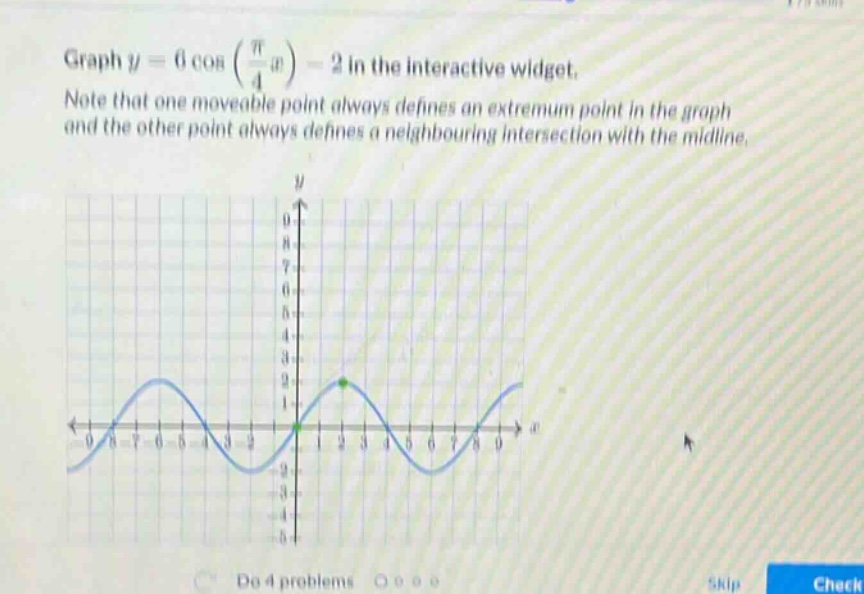
graph y = 6 cos (π/4 x) - 2 in the interactive widget. note that one moveable point always defines an extremum point in the graph and the other point always defines a neighbouring intersection with the midline.
Answer
Explanation:
Step1: Identify the general form of cosine function
The general form of a cosine - function is $y = A\cos(Bx - C)+D$. For the function $y = 6\cos(\frac{\pi}{4}x)-2$, we have $A = 6$, $B=\frac{\pi}{4}$, $C = 0$, and $D=-2$.
Step2: Find the amplitude
The amplitude $|A|$ gives the maximum distance from the mid - line. Here, $|A|=6$.
Step3: Find the period
The period of the cosine function $y = A\cos(Bx - C)+D$ is $T=\frac{2\pi}{|B|}$. Substituting $B = \frac{\pi}{4}$, we get $T=\frac{2\pi}{\frac{\pi}{4}}=8$.
Step4: Find the mid - line
The mid - line of the function is given by $y = D$. So, the mid - line is $y=-2$.
Step5: Find key points
- Maximum points: $\cos(\frac{\pi}{4}x)=1$, then $\frac{\pi}{4}x = 2k\pi$, $x = 8k$. When $k = 0$, $x = 0$ and $y=6\times1 - 2=4$.
- Minimum points: $\cos(\frac{\pi}{4}x)=-1$, then $\frac{\pi}{4}x=(2k + 1)\pi$, $x = 4+8k$. When $k = 0$, $x = 4$ and $y=6\times(-1)-2=-8$.
- Intersection with mid - line: $\cos(\frac{\pi}{4}x)=0$, then $\frac{\pi}{4}x=(2k + 1)\frac{\pi}{2}$, $x = 2+8k$ and $y=-2$.
To graph the function, plot the key points (maximum, minimum, and mid - line intersection points) and connect them with a smooth cosine - like curve with a period of 8 and an amplitude of 6 centered around $y=-2$.
Answer:
Graph the function $y = 6\cos(\frac{\pi}{4}x)-2$ using the key points: maximums at $(8k,4)$, minimums at $(4 + 8k,-8)$, and mid - line intersections at $(2+8k,-2)$ for integer values of $k$, with a period of 8 and mid - line $y=-2$.