the graph of the derivative f of a function f is shown. (a) on what intervals is f increasing? (enter your…
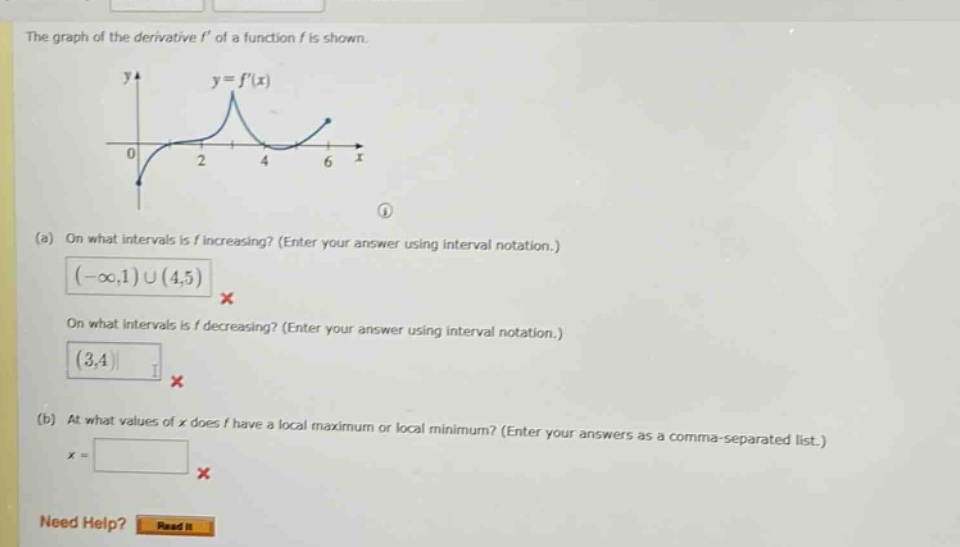
the graph of the derivative f of a function f is shown. (a) on what intervals is f increasing? (enter your answer using interval notation.) (-∞,1)∪(4,5) x on what intervals is f decreasing? (enter your answer using interval notation.) (3,4) x (b) at what values of x does f have a local maximum or local minimum? (enter your answers as a comma - separated list.) x = x need help? read it
Answer
Explanation:
Step1: Recall increasing - decreasing property
A function $y = f(x)$ is increasing when $f'(x)>0$ and decreasing when $f'(x)<0$.
Step2: Find intervals of increase
Looking at the graph of $y = f'(x)$, $f'(x)>0$ on the intervals $(0, 2)$ and $(4, 6)$. So the function $f(x)$ is increasing on the intervals $(0, 2)\cup(4, 6)$.
Step3: Find intervals of decrease
$f'(x)<0$ on the intervals $(-\infty,0)$ and $(2, 4)$. So the function $f(x)$ is decreasing on the intervals $(-\infty,0)\cup(2, 4)$.
Step4: Recall local - extrema property
Local maxima and minima occur where $f'(x)$ changes sign. $f'(x)$ changes from positive to negative at $x = 2$, so $f(x)$ has a local maximum at $x = 2$. $f'(x)$ changes from negative to positive at $x=0$ and $x = 4$, so $f(x)$ has local minima at $x = 0$ and $x = 4$.
Answer:
(a) Increasing intervals: $(0, 2)\cup(4, 6)$; Decreasing intervals: $(-\infty,0)\cup(2, 4)$ (b) $x=0,2,4$