the graph of a derivative f is shown to the right. use the information in the graph to determine where f is…
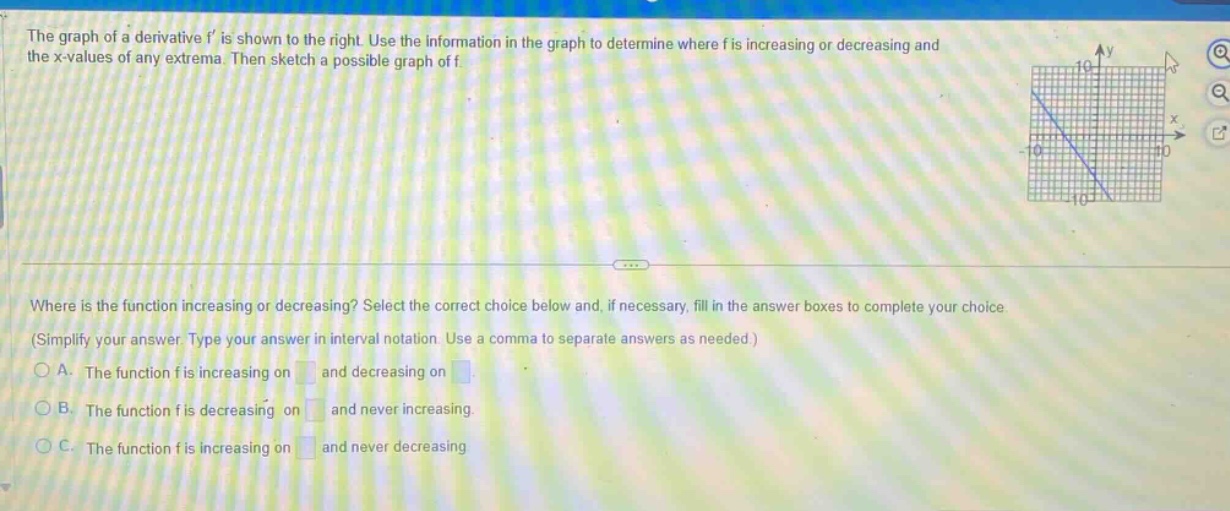
the graph of a derivative f is shown to the right. use the information in the graph to determine where f is increasing or decreasing and the x - values of any extrema. then sketch a possible graph of f. where is the function increasing or decreasing? select the correct choice below and, if necessary, fill in the answer boxes to complete your choice. (simplify your answer. type your answer in interval notation. use a comma to separate answers as needed.) a. the function f is increasing on and decreasing on. b. the function f is decreasing on and never increasing. c. the function f is increasing on and never decreasing
Answer
Explanation:
Step1: Recall the relationship between $f'$ and $f$
If $f'(x)>0$, $f$ is increasing. If $f'(x)<0$, $f$ is decreasing.
Step2: Analyze the sign of $f'$ from the graph
From the graph of $f'$, we can see that $f'(x)<0$ for all $x$ - values in the domain shown.
Answer:
B. The function f is decreasing on $(-\infty,\infty)$ and never increasing.