graph the equation shown below by transforming the given graph of the parent function. \n$y = (-x)^3$
graph the equation shown below by transforming the given graph of the parent function. \n$y = (-x)^3$
Answer
Explanation:
Step1: Analyze the parent function
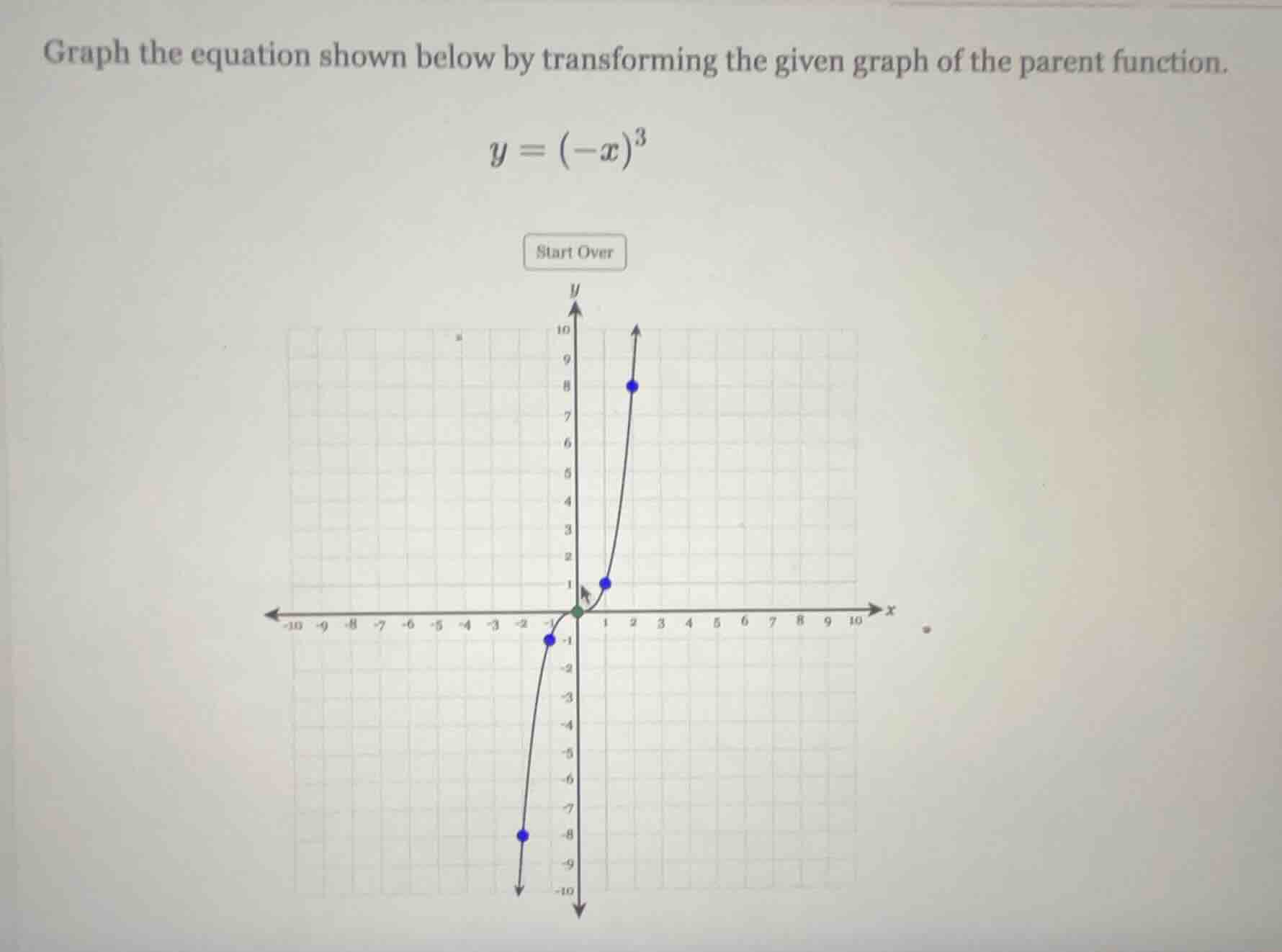
The parent function of a cubic function is ( y = x^3 ). Its graph is symmetric about the origin (odd function), increasing throughout the domain.
Step2: Analyze the transformation
For the function ( y = (-x)^3 ), we can simplify it: ( y = (-x)^3=-x^3 ) (since ((-a)^n=-a^n) when (n) is odd). The transformation from ( y = x^3 ) to ( y=-x^3 ) is a reflection over the (y)-axis (or equivalently, a reflection over the (x)-axis for odd functions, but in this case, replacing (x) with (-x) gives a reflection over the (y)-axis).
Step3: Determine key points transformation
- For the parent function ( y = x^3 ), let's take some key points:
- When (x = -2), (y=(-2)^3=-8)
- When (x=-1), (y = (-1)^3=-1)
- When (x = 0), (y=0^3 = 0)
- When (x = 1), (y=1^3=1)
- When (x = 2), (y=2^3 = 8)
- For the function ( y=(-x)^3=-x^3 ), we substitute (x) with (-x) in terms of the input - output relationship. So if we have a point ((x,y)) on (y = x^3), the corresponding point on (y=(-x)^3) will be ((-x,y)) (since (y = (-(-x))^3=x^3) wait, no, let's recast. Let's compute (y = (-x)^3) for the same (x) values:
- When (x=-2), (y=(-(-2))^3=2^3 = 8)
- When (x=-1), (y=(-(-1))^3=1^3 = 1)
- When (x = 0), (y=(-0)^3=0)
- When (x = 1), (y=(-1)^3=-1)
- When (x = 2), (y=(-2)^3=-8)
So the graph of (y = (-x)^3) is the reflection of (y = x^3) over the (y)-axis. To graph it, we can take the points of the parent function (y = x^3) (like ((-2,-8)), ((-1,-1)), ((0,0)), ((1,1)), ((2,8))) and reflect them over the (y)-axis. The reflected points will be ((2,-8)), ((1,-1)), ((0,0)), ((-1,1)), ((-2,8)). Then we plot these points and draw the curve.
Answer:
To graph (y = (-x)^3), reflect the graph of the parent function (y=x^3) over the (y)-axis. The key points transformation: for a point ((x,y)) on (y = x^3), the corresponding point on (y=(-x)^3) is ((-x,y)) (or by calculating (y = (-x)^3) directly for (x) values, we get points like ((-2,8)), ((-1,1)), ((0,0)), ((1,-1)), ((2,-8)) which are the reflection of ((2,8)), ((1,1)), ((0,0)), ((-1,-1)), ((-2,-8)) over the (y)-axis). Then plot these points and draw the cubic curve.