graph the equation shown below by transforming the given graph of the parent function. \n$y = \\frac{1}{2}…
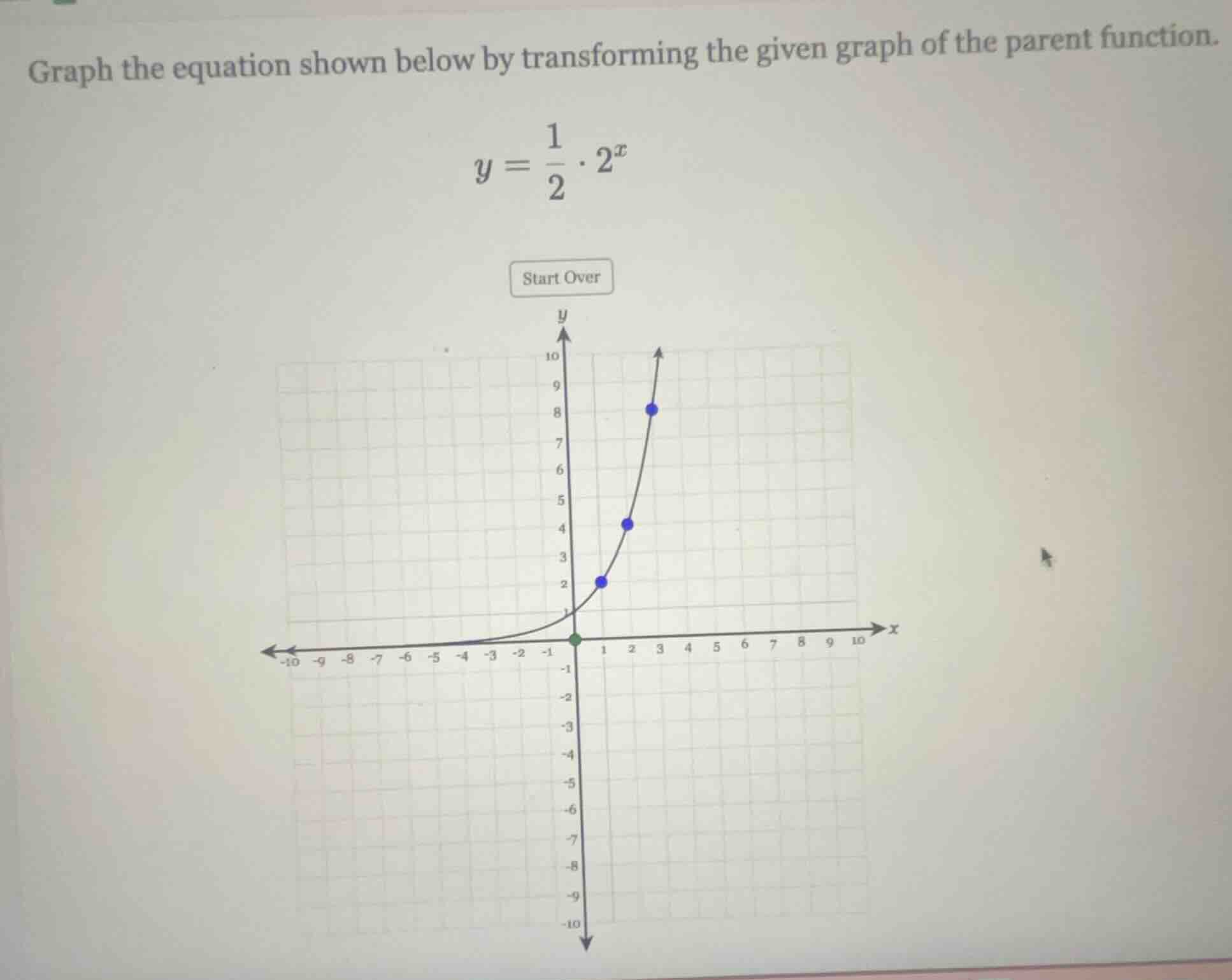
graph the equation shown below by transforming the given graph of the parent function. \n$y = \\frac{1}{2} \\cdot 2^x$
Answer
Explanation:
Step1: Identify the parent function
The parent function here is ( y = 2^x ), which is an exponential function. The given function is ( y=\frac{1}{2}\cdot2^x ).
Step2: Analyze the transformation
The transformation from ( y = 2^x ) to ( y=\frac{1}{2}\cdot2^x ) is a vertical compression by a factor of ( \frac{1}{2} ). For a function ( y = a\cdot f(x) ), if ( 0 < a < 1 ), it is a vertical compression. Here ( a=\frac{1}{2} ), so we take each point on the graph of ( y = 2^x ) and multiply its ( y )-coordinate by ( \frac{1}{2} ).
- For the point ( (0, 1) ) on ( y = 2^x ), after compression: ( y=\frac{1}{2}\cdot1=\frac{1}{2} ), so the point becomes ( (0,\frac{1}{2}) ).
- For the point ( (1, 2) ) on ( y = 2^x ), after compression: ( y=\frac{1}{2}\cdot2 = 1 ), so the point becomes ( (1, 1) ).
- For the point ( (2, 4) ) on ( y = 2^x ), after compression: ( y=\frac{1}{2}\cdot4=2 ), so the point becomes ( (2, 2) ).
- For the point ( (3, 8) ) on ( y = 2^x ), after compression: ( y=\frac{1}{2}\cdot8 = 4 ), so the point becomes ( (3, 4) ).
Then we plot these new points ( (0,\frac{1}{2}) ), ( (1, 1) ), ( (2, 2) ), ( (3, 4) ) and draw the curve, which should have the same shape as the parent exponential function but vertically compressed.
Answer:
To graph ( y=\frac{1}{2}\cdot2^x ), vertically compress the graph of ( y = 2^x ) by a factor of ( \frac{1}{2} ) (multiply ( y )-coordinates of points on ( y = 2^x ) by ( \frac{1}{2} )) and plot the transformed points (e.g., ( (0,\frac{1}{2}) ), ( (1, 1) ), ( (2, 2) ), ( (3, 4) )) to draw the curve.