graph exactly one cycle of the function $f(x)=-12cos(x)+3$. identify the maximum, minimum, and period of the…
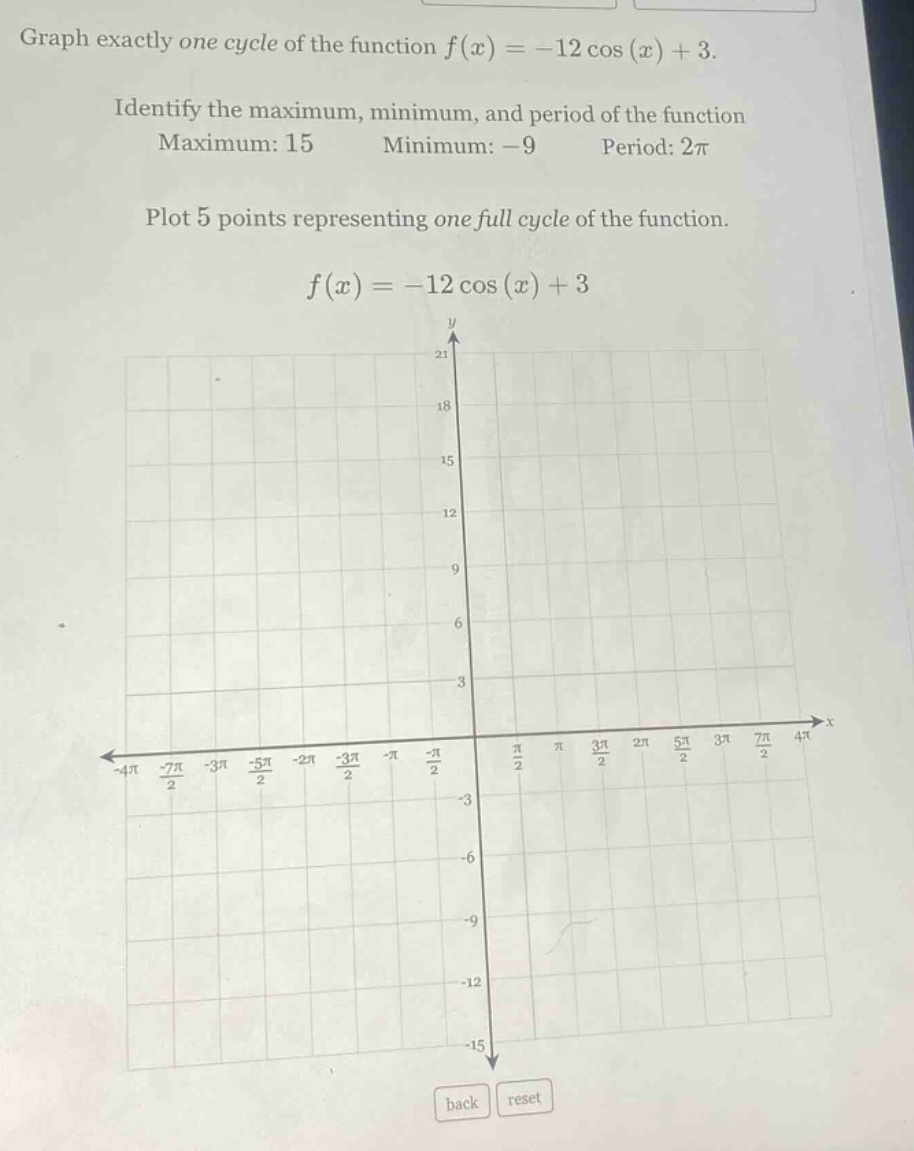
graph exactly one cycle of the function $f(x)=-12cos(x)+3$. identify the maximum, minimum, and period of the function. maximum: 15 minimum: -9 period: $2pi$. plot 5 points representing one full cycle of the function. $f(x)=-12cos(x)+3$
Answer
Explanation:
Step1: Recall cosine - function properties
The general form of a cosine function is $y = A\cos(Bx - C)+D$. For $f(x)=- 12\cos(x)+3$, $A=-12$, $B = 1$, $C = 0$, $D = 3$. The period of $y=\cos(x)$ is $T=\frac{2\pi}{|B|}$, so the period of $f(x)$ is $\frac{2\pi}{|1|}=2\pi$. The maximum value of $\cos(x)$ is $1$ and the minimum is $-1$.
Step2: Find the maximum of $f(x)$
When $\cos(x)=-1$, $f(x)=-12\times(-1)+3=12 + 3=15$.
Step3: Find the minimum of $f(x)$
When $\cos(x)=1$, $f(x)=-12\times1+3=-12 + 3=-9$.
Step4: Select $x$ - values for one - cycle
For one - cycle of $y = \cos(x)$ with period $2\pi$, we can choose $x = 0,\frac{\pi}{2},\pi,\frac{3\pi}{2},2\pi$.
Step5: Calculate $y$ - values
When $x = 0$: $f(0)=-12\cos(0)+3=-12\times1 + 3=-9$. When $x=\frac{\pi}{2}$: $f(\frac{\pi}{2})=-12\cos(\frac{\pi}{2})+3=-12\times0+3 = 3$. When $x=\pi$: $f(\pi)=-12\cos(\pi)+3=-12\times(-1)+3=15$. When $x=\frac{3\pi}{2}$: $f(\frac{3\pi}{2})=-12\cos(\frac{3\pi}{2})+3=-12\times0+3 = 3$. When $x = 2\pi$: $f(2\pi)=-12\cos(2\pi)+3=-12\times1+3=-9$.
The five points are $(0,-9),(\frac{\pi}{2},3),(\pi,15),(\frac{3\pi}{2},3),(2\pi,-9)$.
Answer:
The five points for one - cycle are $(0,-9),(\frac{\pi}{2},3),(\pi,15),(\frac{3\pi}{2},3),(2\pi,-9)$