graph the exponential function.\n\n$f(x)=(\\frac{4}{3})^{x}$\n\nplot five points on the graph of the…
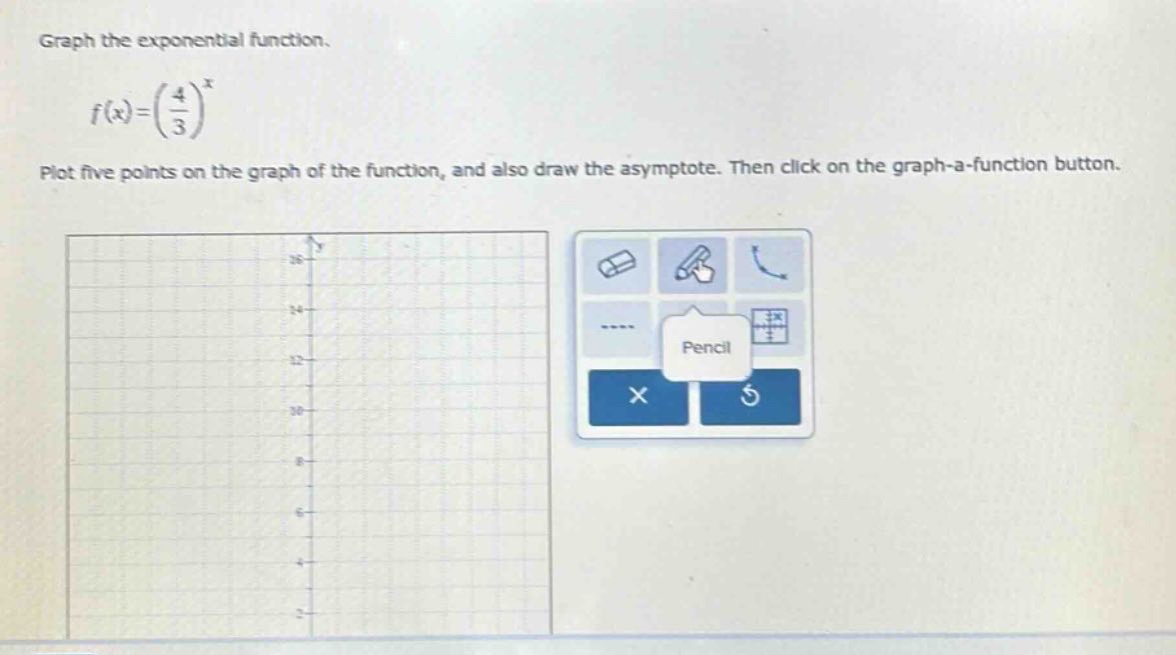
graph the exponential function.\n\n$f(x)=(\\frac{4}{3})^{x}$\n\nplot five points on the graph of the function, and also draw the asymptote. then click on the graph - a - function button.
Answer
Explanation:
Step1: Find the value of ( f(x) ) when ( x = - 2 )
Substitute ( x=-2 ) into ( f(x)=\left(\frac{4}{3}\right)^{x} ), we get ( f(-2)=\left(\frac{4}{3}\right)^{-2}=\left(\frac{3}{4}\right)^{2}=\frac{9}{16} = 0.5625 )
Step2: Find the value of ( f(x) ) when ( x=-1 )
Substitute ( x = - 1 ) into ( f(x)=\left(\frac{4}{3}\right)^{x} ), we get ( f(-1)=\left(\frac{4}{3}\right)^{-1}=\frac{3}{4}=0.75 )
Step3: Find the value of ( f(x) ) when ( x = 0 )
Substitute ( x = 0 ) into ( f(x)=\left(\frac{4}{3}\right)^{x} ), we get ( f(0)=\left(\frac{4}{3}\right)^{0}=1 ) (since ( a^{0}=1,a\neq0 ))
Step4: Find the value of ( f(x) ) when ( x = 1 )
Substitute ( x = 1 ) into ( f(x)=\left(\frac{4}{3}\right)^{x} ), we get ( f(1)=\frac{4}{3}\approx1.33 )
Step5: Find the value of ( f(x) ) when ( x = 2 )
Substitute ( x = 2 ) into ( f(x)=\left(\frac{4}{3}\right)^{x} ), we get ( f(2)=\left(\frac{4}{3}\right)^{2}=\frac{16}{9}\approx1.78 )
For an exponential function of the form ( y = a^{x}(a>0,a\neq1) ), the horizontal asymptote is ( y = 0 )
Answer:
The five points are ((-2,0.5625),(-1,0.75),(0,1),(1,\frac{4}{3}),(2,\frac{16}{9})) and the horizontal asymptote is ( y = 0 ). Plot these points and draw the curve approaching ( y = 0 ) as ( x\to-\infty ) and increasing as ( x) increases.