graph the exponential function.\n\n$f(x)=-\\left(\\frac{3}{5}\\right)^x$\n\nplot five points on the graph of…
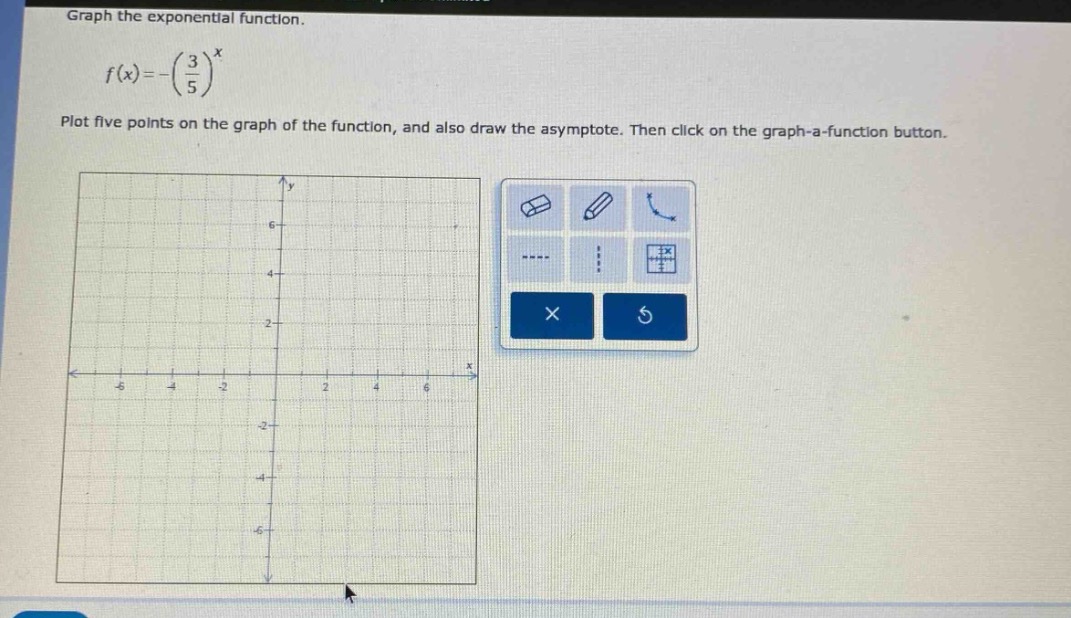
graph the exponential function.\n\n$f(x)=-\\left(\\frac{3}{5}\\right)^x$\n\nplot five points on the graph of the function, and also draw the asymptote. then click on the graph - a - function button.
Answer
Answer:
- Points:
- When (x = - 2), (f(-2)=-\left(\frac{3}{5}\right)^{-2}=-\frac{25}{9}\approx - 2.78). The point is ((-2,-\frac{25}{9})).
- When (x=-1), (f(-1)=-\left(\frac{3}{5}\right)^{-1}=-\frac{5}{3}\approx - 1.67). The point is ((-1,-\frac{5}{3})).
- When (x = 0), (f(0)=-\left(\frac{3}{5}\right)^{0}=-1). The point is ((0, - 1)).
- When (x = 1), (f(1)=-\frac{3}{5}=-0.6). The point is ((1,-0.6)).
- When (x = 2), (f(2)=-\left(\frac{3}{5}\right)^{2}=-\frac{9}{25}=-0.36). The point is ((2,-0.36)).
- Asymptote: The horizontal - asymptote is (y = 0).
Explanation:
Step1: Recall the general form of an exponential function
The general form of an exponential function is (y = a\cdot b^{x}), where in our case (a=-1) and (b = \frac{3}{5}).
Step2: Find points by substituting (x) - values
For (x=-2), (f(-2)=-(\frac{3}{5})^{-2}=- \frac{1}{(\frac{3}{5})^{2}}=-\frac{25}{9}) using the rule (a^{-n}=\frac{1}{a^{n}}). For (x = - 1), (f(-1)=-(\frac{3}{5})^{-1}=-\frac{5}{3}) using (a^{-n}=\frac{1}{a^{n}}). For (x = 0), any non - zero number to the power of (0) is (1), so (f(0)=-1). For (x = 1), (f(1)=-\frac{3}{5}). For (x = 2), (f(2)=-(\frac{3}{5})^{2}=-\frac{9}{25}).
Step3: Determine the asymptote
For an exponential function of the form (y = a\cdot b^{x}) with (|b|\lt1) (here (b=\frac{3}{5})), as (x\rightarrow\infty), (b^{x}\rightarrow0). So (y = 0) is the horizontal asymptote.