graph the exponential function $g(x)=\\left(\\frac{1}{3}\\right)^{x + 3}$. to do this, plot two points on…
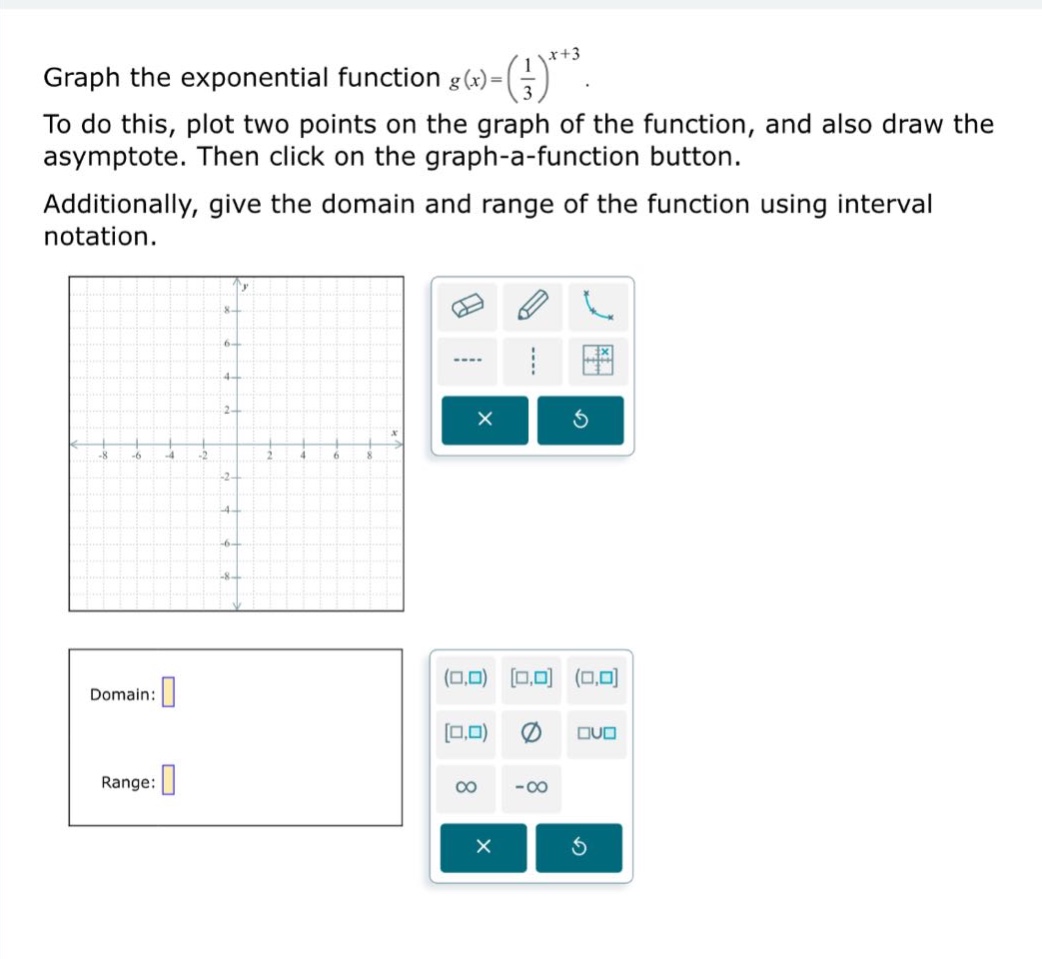
graph the exponential function $g(x)=\\left(\\frac{1}{3}\\right)^{x + 3}$. to do this, plot two points on the graph of the function, and also draw the asymptote. then click on the graph - a - function button. additionally, give the domain and range of the function using interval notation. domain: range:
Answer
Explanation:
Step1: Find two points
Let (x=- 3), then (g(-3)=\left(\frac{1}{3}\right)^{-3 + 3}=\left(\frac{1}{3}\right)^{0}=1). Let (x=-2), then (g(-2)=\left(\frac{1}{3}\right)^{-2 + 3}=\frac{1}{3}). So two points are ((-3,1)) and ((-2,\frac{1}{3})).
Step2: Determine the asymptote
For an exponential - function of the form (y = a^{x + h}+k), in the function (g(x)=\left(\frac{1}{3}\right)^{x + 3}), as (x\to+\infty), (g(x)\to0). So the horizontal asymptote is (y = 0).
Step3: Find the domain
The domain of an exponential function (y = a^{x+h}+k) is all real numbers. In interval notation, the domain of (g(x)) is ((-\infty,\infty)).
Step4: Find the range
Since the horizontal asymptote is (y = 0) and the function (g(x)=\left(\frac{1}{3}\right)^{x + 3}>0) for all (x\in R), the range in interval notation is ((0,\infty)).
Answer:
Domain: ((-\infty,\infty)) Range: ((0,\infty)) Points to plot: ((-3,1)) and ((-2,\frac{1}{3})), Asymptote: (y = 0)