graph the exponential function g(x)=-(1/2)^x - 3. to do this, plot two points on the graph of the function…
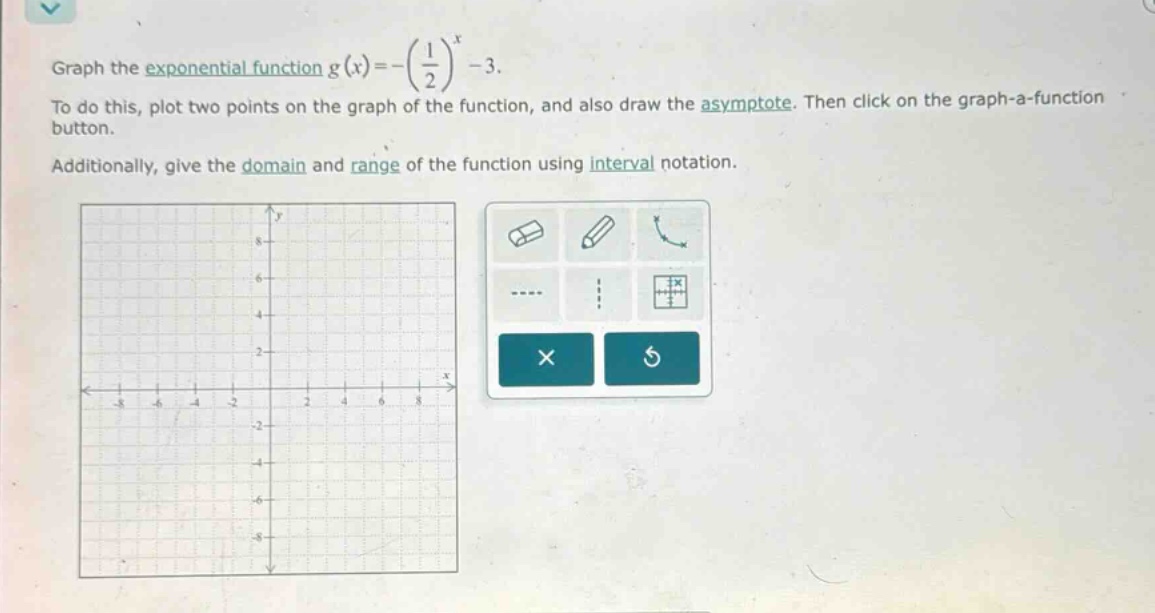
graph the exponential function g(x)=-(1/2)^x - 3. to do this, plot two points on the graph of the function, and also draw the asymptote. then click on the graph - a - function button. additionally, give the domain and range of the function using interval notation.
Answer
Explanation:
Step1: Find two points
When (x = 0), (g(0)=-\left(\frac{1}{2}\right)^{0}-3=-1 - 3=-4). So one - point is ((0, - 4)). When (x = 1), (g(1)=-\left(\frac{1}{2}\right)^{1}-3=-\frac{1}{2}-3=-\frac{1 + 6}{2}=-\frac{7}{2}=-3.5). So another point is ((1,-3.5)).
Step2: Determine the asymptote
For an exponential function of the form (y = a\cdot b^{x}+k), in the function (g(x)=-\left(\frac{1}{2}\right)^{x}-3), (a=-1), (b = \frac{1}{2}), (k=-3). The horizontal asymptote is (y = k=-3).
Step3: Find the domain
The domain of an exponential function (y = a\cdot b^{x}+k) is all real numbers. In interval notation, the domain is ((-\infty,\infty)).
Step4: Find the range
Since (b=\frac{1}{2}\in(0,1)), (\left(\frac{1}{2}\right)^{x}>0) for all (x\in R). Then (-\left(\frac{1}{2}\right)^{x}<0), and (-\left(\frac{1}{2}\right)^{x}-3<-3). The range in interval notation is ((-\infty,-3)).
Answer:
Two points: ((0, - 4)) and ((1,-3.5)); Asymptote: (y=-3); Domain: ((-\infty,\infty)); Range: ((-\infty,-3))