graph the exponential function ( g(x)=-2^{x}+3 ).\nto do this, plot two points on the graph of the function…
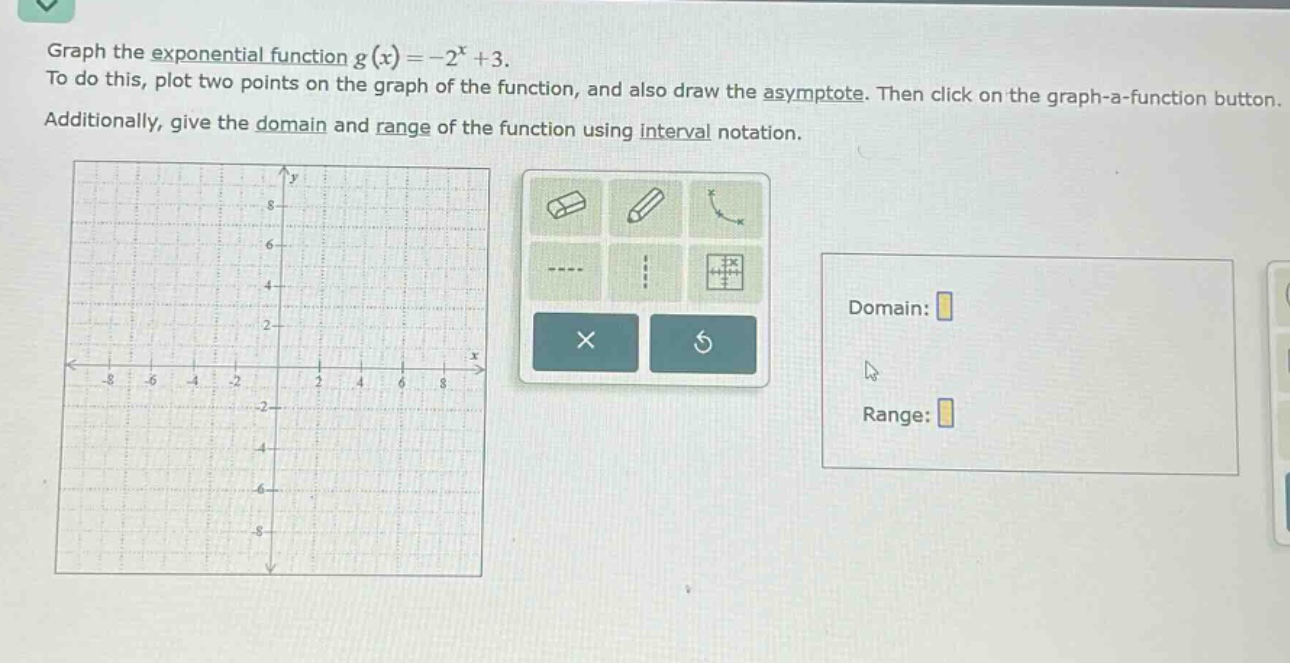
graph the exponential function ( g(x)=-2^{x}+3 ).\nto do this, plot two points on the graph of the function, and also draw the asymptote. then click on the graph - a - function button.\nadditionally, give the domain and range of the function using interval notation.\ndomain:\nrange:
Answer
Explanation:
Step 1: Identify the horizontal asymptote
The parent function (2^x) has an asymptote at (y = 0). Reflecting over the (x)-axis ((-2^x)) and shifting up 3 units gives an asymptote at (y = 3).
Step 2: Plot key points
For (x = 0): (g(0) = -2^0 + 3 = -1 + 3 = 2) → point ((0, 2)).
For (x = 1): (g(1) = -2^1 + 3 = -2 + 3 = 1) → point ((1, 1)).
Step 3: Determine the domain
Exponential functions have no restrictions on (x), so the domain is all real numbers.
Step 4: Determine the range
Since (-2^x < 0), adding 3 gives (-2^x + 3 < 3). The range is all real numbers less than 3.
Answer:
Domain: ((-\infty, \infty))
Range: ((-\infty, 3))