graph the exponential function. g(x)=2/3 e^x - 4 - 2 plot two points on the graph of the function, and also…
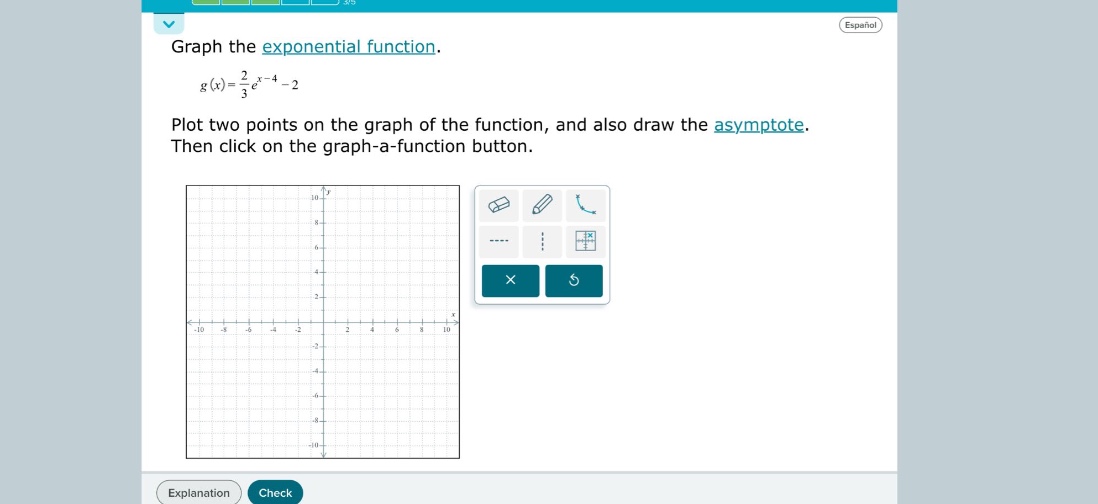
graph the exponential function. g(x)=2/3 e^x - 4 - 2 plot two points on the graph of the function, and also draw the asymptote. then click on the graph - a - function button.
Answer
Answer:
To find two - points on the graph of the function (g(x)=\frac{2}{3}e^{x - 4}-2):
- Point 1: Let (x = 4)
- Substitute (x = 4) into the function (g(x)=\frac{2}{3}e^{x - 4}-2).
- (g(4)=\frac{2}{3}e^{4 - 4}-2=\frac{2}{3}e^{0}-2).
- Since (e^{0}=1), then (g(4)=\frac{2}{3}\times1 - 2=\frac{2}{3}-2=\frac{2 - 6}{3}=-\frac{4}{3}). So the point is ((4,-\frac{4}{3})).
- Point 2: Let (x = 5)
- Substitute (x = 5) into the function (g(x)=\frac{2}{3}e^{x - 4}-2).
- (g(5)=\frac{2}{3}e^{5 - 4}-2=\frac{2}{3}e^{1}-2=\frac{2e}{3}-2\approx\frac{2\times2.718}{3}-2=\frac{5.436}{3}-2 = 1.812-2=-0.188). So the point is ((5,\frac{2e}{3}-2)\approx(5, - 0.188)).
For the asymptote of the exponential function (y = a\cdot e^{bx - c}+d), the horizontal asymptote is (y = d). In the function (g(x)=\frac{2}{3}e^{x - 4}-2), the horizontal asymptote is (y=-2).
To graph the function:
- Plot the two points ((4,-\frac{4}{3})) and ((5,\frac{2e}{3}-2)) on the coordinate - plane.
- Draw the horizontal asymptote (y = - 2) as a dashed line.
- Sketch the exponential curve that approaches the asymptote and passes through the two plotted points.
Explanation:
Step1: Find the first point
Substitute (x = 4) into (g(x)=\frac{2}{3}e^{x - 4}-2).
Step2: Calculate (g(4))
Use (e^{0}=1) to get (g(4)=\frac{2}{3}-2=-\frac{4}{3}).
Step3: Find the second point
Substitute (x = 5) into (g(x)=\frac{2}{3}e^{x - 4}-2).
Step4: Calculate (g(5))
Use (e\approx2.718) to approximate (g(5)=\frac{2e}{3}-2).
Step5: Determine the asymptote
For (y=\frac{2}{3}e^{x - 4}-2), the asymptote is (y=-2) (since for (y = a\cdot e^{bx - c}+d), asymptote is (y = d)).
Step6: Graph the function
Plot points and draw asymptote and curve.