this is the graph of an exponential function.\nwrite an equation for the function in the form $f(x) =…
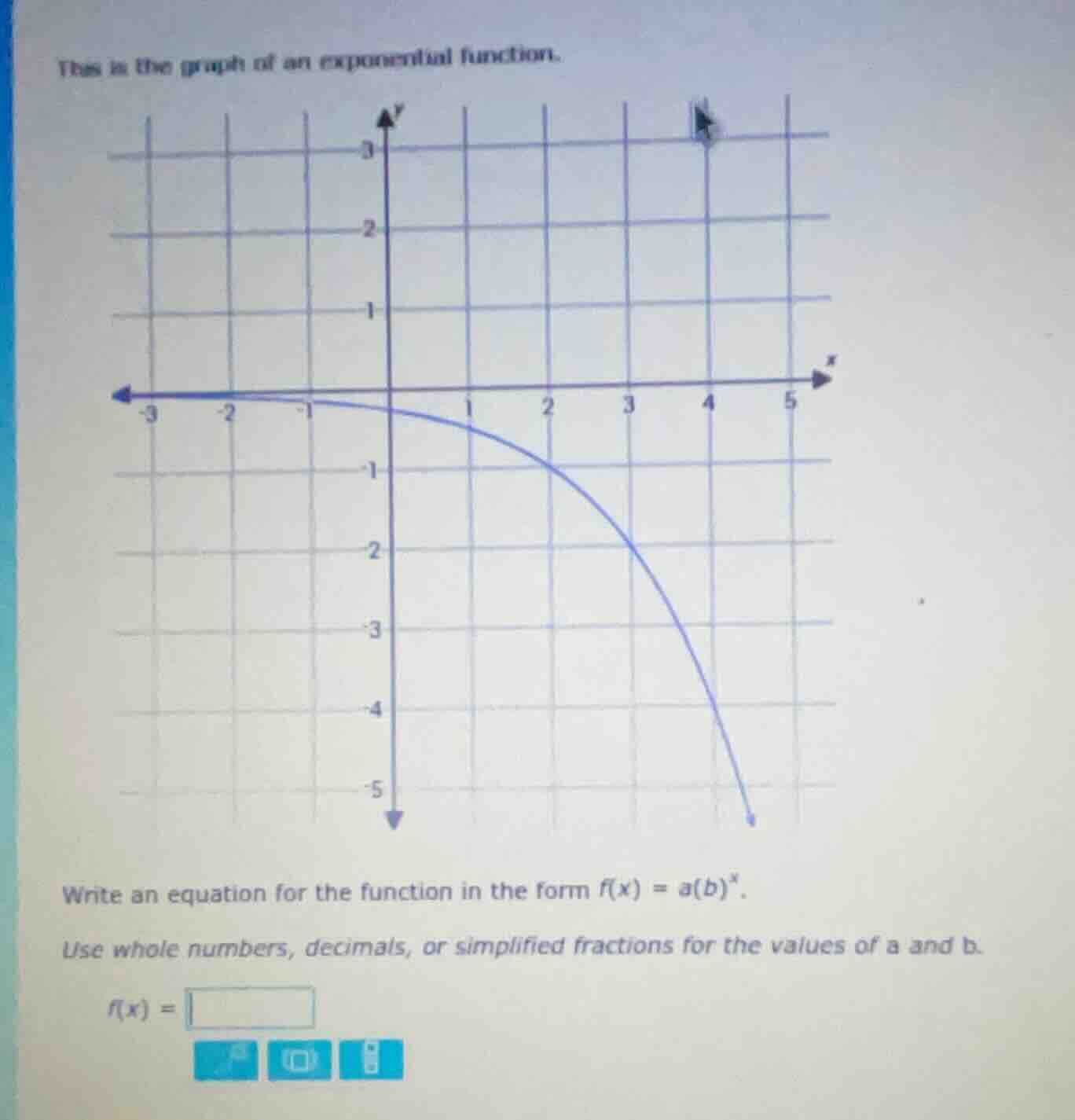
this is the graph of an exponential function.\nwrite an equation for the function in the form $f(x) = a(b)^x$.\nuse whole numbers, decimals, or simplified fractions for the values of a and b.\n$f(x) = \\square$
Answer
Explanation:
Step1: Identify y-intercept (a)
The y-intercept is where $x=0$. From the graph, when $x=0$, $f(0)=-0.5$. For $f(x)=a(b)^x$, $f(0)=a(b)^0=a$, so $a=-0.5=-\frac{1}{2}$.
Step2: Use another point to find b
Pick the point $(2, -1)$. Substitute $x=2$, $f(2)=-1$, $a=-\frac{1}{2}$ into the function: $$-1 = -\frac{1}{2}(b)^2$$ Multiply both sides by $-2$: $$2 = b^2$$ Take the positive root (since exponential base $b>0, b\neq1$): $$b=\sqrt{2}$$ Verify with another point, e.g., $(1, -\frac{\sqrt{2}}{2})$: $$f(1)=-\frac{1}{2}(\sqrt{2})^1=-\frac{\sqrt{2}}{2}$$ This matches the graph's trend.
Answer:
$f(x) = -\frac{1}{2}(\sqrt{2})^x$