graph the following function. state the domain and range. is the function increasing or decreasing?\n$f(x) =…
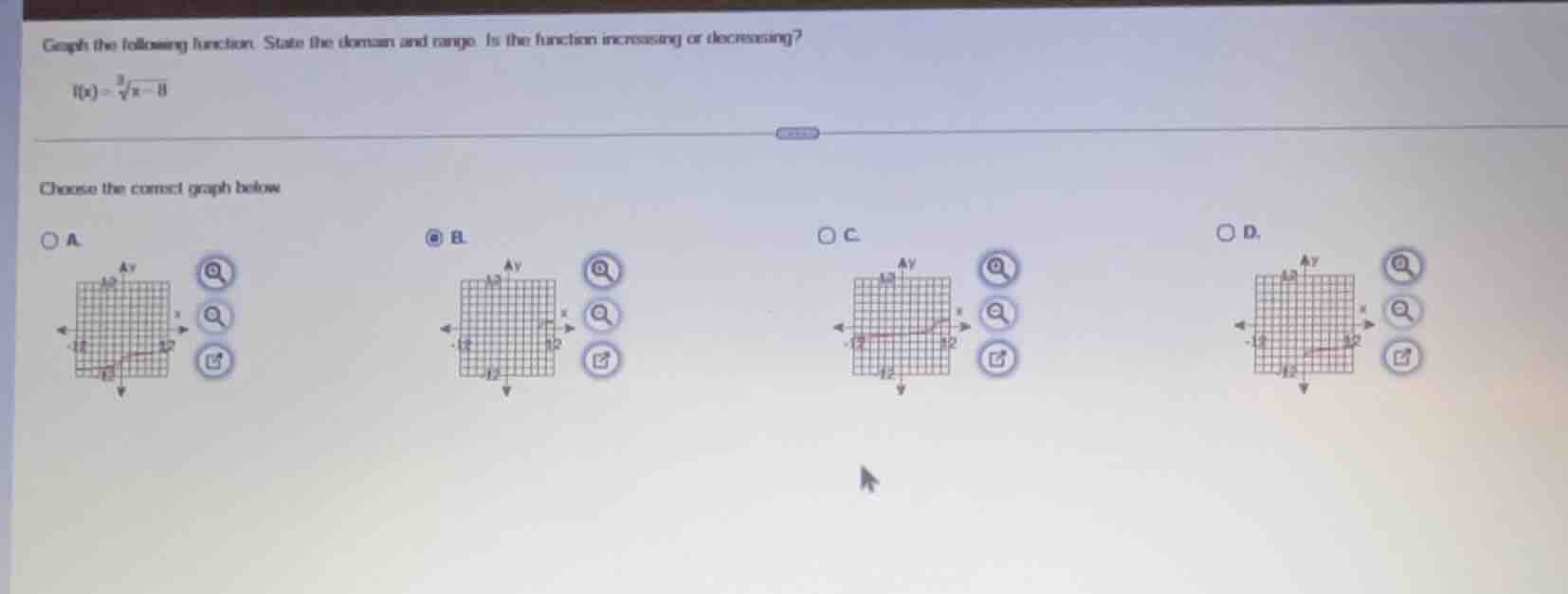
graph the following function. state the domain and range. is the function increasing or decreasing?\n$f(x) = \\sqrt3{x - 8}$\n\nchoose the correct graph below\n\\(\\bigcirc\\) a.\n\\(\\bigcirc\\) b.\n\\(\\bigcirc\\) c.\n\\(\\bigcirc\\) d.
Answer
Explanation:
Step 1: Analyze the function ( f(x)=\sqrt[3]{x - 8} )
The cube - root function ( y = \sqrt[3]{u}) has a domain of all real numbers ((u\in\mathbb{R})) and a range of all real numbers ((y\in\mathbb{R})). For the function ( f(x)=\sqrt[3]{x - 8}), if we let ( u=x - 8), then the domain of ( f(x)) is all real numbers because we can take the cube - root of any real number. To find the domain, we solve for ( x) in the expression inside the cube - root. Since there are no restrictions (unlike square - root functions where the expression inside must be non - negative), the domain of ( f(x)=\sqrt[3]{x - 8}) is ( (-\infty,\infty)) (all real numbers). The range of a cube - root function ( y=\sqrt[3]{x - 8}) is also all real numbers because as ( x) takes on all real values, ( x - 8) takes on all real values, and the cube - root of all real values is also all real values.
Step 2: Analyze the end - behavior and monotonicity
The derivative of the function ( y = \sqrt[3]{x-8}=(x - 8)^{\frac{1}{3}}) using the power rule (\frac{d}{dx}(x^n)=nx^{n - 1}) is (y^\prime=\frac{1}{3}(x - 8)^{-\frac{2}{3}}=\frac{1}{3(x - 8)^{\frac{2}{3}}}=\frac{1}{3\sqrt[3]{(x - 8)^2}}). The derivative (y^\prime) is positive for all (x\neq8) (because the denominator (3\sqrt[3]{(x - 8)^2}) is always positive for (x\neq8), and the numerator is 1). At (x = 8), the function is continuous (since the limit as (x\rightarrow8) of (\sqrt[3]{x - 8}) is 0 and (f(8)=\sqrt[3]{8 - 8}=0)) and the derivative does not exist (it has a vertical tangent at (x = 8)). So the function (f(x)=\sqrt[3]{x - 8}) is an increasing function for all real numbers (x).
Step 3: Analyze the graph of the function
The parent function of (y=\sqrt[3]{x}) has a point at ((0,0)) and passes through ((1,1)) and ((- 1,-1)). The function (y=\sqrt[3]{x - 8}) is a horizontal shift of the parent function (y = \sqrt[3]{x}) to the right by 8 units. So the graph of (y=\sqrt[3]{x - 8}) passes through the point ((8,0)) (when (x = 8), (y=\sqrt[3]{8 - 8}=0)). As (x\rightarrow\infty), (y=\sqrt[3]{x - 8}\rightarrow\infty) and as (x\rightarrow-\infty), (y=\sqrt[3]{x - 8}\rightarrow-\infty). The function is increasing, so as (x) increases, (y) increases.
Now, let's analyze the options:
- Option A: The graph should be a shifted cube - root graph. The cube - root graph has a shape that passes through the point corresponding to the shift. Since our function is (y=\sqrt[3]{x - 8}), the key point is ((8,0)). The graph of an increasing cube - root function shifted right by 8 units will have the correct shape. The function is increasing, so as (x) increases, (y) increases.
- Option B: If the graph is not increasing (or has the wrong shape for a cube - root function), it can be eliminated.
- Option C: The shape of the graph does not match the shape of a cube - root function. A cube - root function has a more "pointed" shape near the point of the shift and is symmetric in a different way than a function that might be misrepresented here.
- Option D: The graph does not have the correct shape for an increasing cube - root function shifted right by 8 units.
Step 4: State the domain, range, and monotonicity
- Domain: The domain of (f(x)=\sqrt[3]{x - 8}) is all real numbers, so the domain is ((-\infty,\infty)) (or (\mathbb{R})).
- Range: The range of (f(x)=\sqrt[3]{x - 8}) is all real numbers, so the range is ((-\infty,\infty)) (or (\mathbb{R})).
- Monotonicity: The function (f(x)=\sqrt[3]{x - 8}) is an increasing function because its derivative (where it exists) is positive and the function is continuous everywhere.
Answer:
- Correct graph: Option A (assuming the visual of Option A matches the graph of (y = \sqrt[3]{x-8}) which is an increasing cube - root function shifted right by 8 units).
- Domain: ((-\infty,\infty))
- Range: ((-\infty,\infty))
- The function is increasing.