graph the following function over a two - period interval. give the period and the amplitude.\ny = sin…
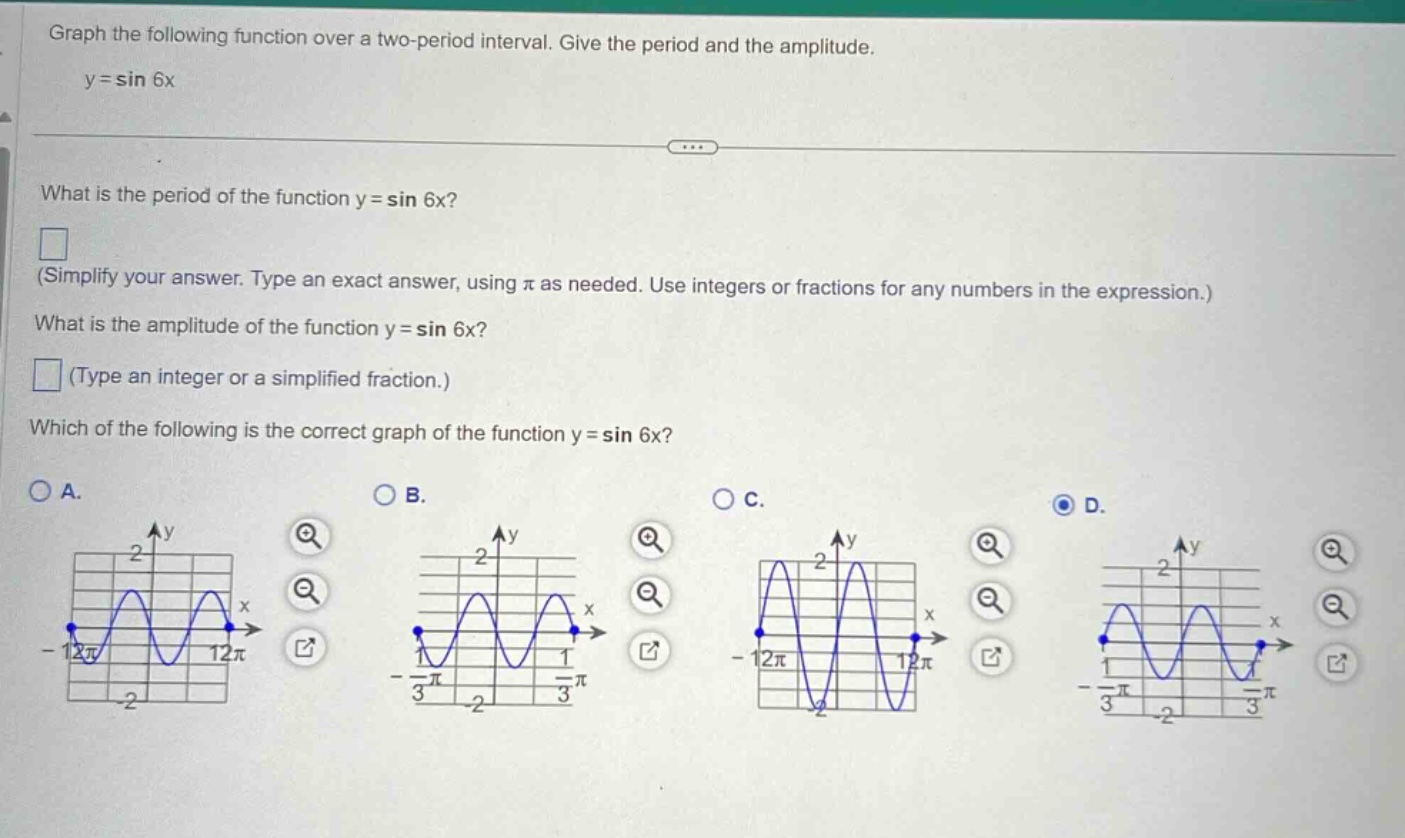
graph the following function over a two - period interval. give the period and the amplitude.\ny = sin 6x\nwhat is the period of the function y = sin 6x?\n(simplify your answer. type an exact answer, using π as needed. use integers or fractions for any numbers in the expression.)\nwhat is the amplitude of the function y = sin 6x?\n(type an integer or a simplified fraction.)\nwhich of the following is the correct graph of the function y = sin 6x?\na.\nb.\nc.\nd.
Answer
Explanation:
Step1: Recall period formula
For $y = A\sin(Bx + C)+D$, the period $T=\frac{2\pi}{|B|}$. Here $B = 6$, so $T=\frac{2\pi}{6}=\frac{\pi}{3}$.
Step2: Recall amplitude formula
For $y = A\sin(Bx + C)+D$, the amplitude is $|A|$. Here $A = 1$, so the amplitude is $1$.
Step3: Analyze graph
The period is $\frac{\pi}{3}$, and in a two - period interval $x\in[0,\frac{2\pi}{3}]$. The function $y=\sin(6x)$ oscillates between $- 1$ and $1$.
Answer:
Period: $\frac{\pi}{3}$ Amplitude: $1$ Graph: (Without seeing the actual visual details of the options, we can't determine the exact graph choice. But the graph should have a period of $\frac{\pi}{3}$ and amplitude of $1$. If you can provide more details about the graphs, we can further determine the correct option.)