the graph of $f(x)=\frac{4}{x^{2}-2x - 3}$ is shown. for which values of $x$ is $f(x)$ decreasing? (1…
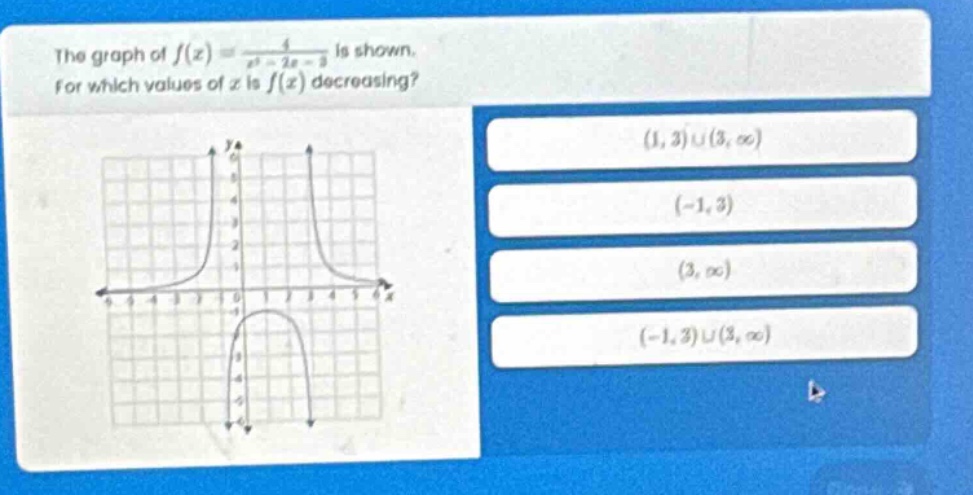
the graph of $f(x)=\frac{4}{x^{2}-2x - 3}$ is shown. for which values of $x$ is $f(x)$ decreasing? (1, 3)∪(3, ∞) (-1, 3) (3, ∞) (-1, 3)∪(3, ∞)
Answer
Explanation:
Step1: Recall decreasing - function property
A function $y = f(x)$ is decreasing when $f'(x)<0$. First, factor the denominator of $f(x)=\frac{4}{x^{2}-2x - 3}=\frac{4}{(x - 3)(x+1)}$. The vertical asymptotes are $x=-1$ and $x = 3$.
Step2: Analyze the graph
By observing the graph of the function $y = f(x)$, we can see that as $x$ increases, the $y$-values of the function are going down (decreasing). The function is decreasing on the intervals $(-1,3)\cup(3,\infty)$.
Answer:
$(-1,3)\cup(3,\infty)$