for the graph of $f(x)=\frac{1}{4}(x - 5)^{3}+6$ identify the key features as follows:\ndomain…
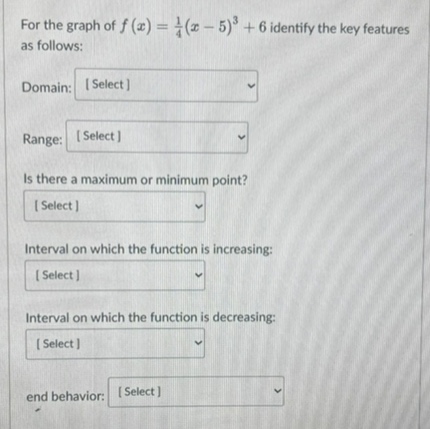
for the graph of $f(x)=\frac{1}{4}(x - 5)^{3}+6$ identify the key features as follows:\ndomain: select\nrange: select\nis there a maximum or minimum point? select\ninterval on which the function is increasing: select\ninterval on which the function is decreasing: select\nend behavior: select
Answer
Explanation:
Step1: Determine domain
For any polynomial function like $f(x)=\frac{1}{4}(x - 5)^3+6$, the domain is all real numbers since we can substitute any real - value for $x$. The domain of $y = f(x)$ is $(-\infty,\infty)$.
Step2: Determine range
Since the function is a cubic function (degree 3) and the leading coefficient $\frac{1}{4}>0$, the range is also all real numbers. The range of $y = f(x)$ is $(-\infty,\infty)$.
Step3: Check for max/min
A cubic function of the form $y=a(x - h)^3 + k$ ($a\neq0$) has no maximum or minimum points. For $f(x)=\frac{1}{4}(x - 5)^3+6$, there is no maximum or minimum point.
Step4: Find increasing interval
The derivative of $f(x)$ is $f^\prime(x)=\frac{3}{4}(x - 5)^2$. Since $(x - 5)^2\geq0$ for all real $x$ and $\frac{3}{4}>0$, $f^\prime(x)\geq0$ for all $x$. The function is increasing on $(-\infty,\infty)$.
Step5: Find decreasing interval
Since $f^\prime(x)\geq0$ for all $x$, the function is never decreasing. The decreasing interval is $\varnothing$ (the empty set).
Step6: Determine end - behavior
As $x\to-\infty$, $y=\frac{1}{4}(x - 5)^3+6\to-\infty$ because the leading term $\frac{1}{4}(x - 5)^3$ dominates and has a positive leading coefficient and odd degree. As $x\to\infty$, $y=\frac{1}{4}(x - 5)^3+6\to\infty$.
Answer:
Domain: $(-\infty,\infty)$ Range: $(-\infty,\infty)$ Is there a maximum or minimum point?: No Interval on which the function is increasing: $(-\infty,\infty)$ Interval on which the function is decreasing: $\varnothing$ End - behavior: As $x\to-\infty,y\to-\infty$; as $x\to\infty,y\to\infty$