the graph of $f(x) = \\frac{1}{2}(2.5)^x$ and its reflection across the x-axis, $g(x)$, are shown. what is…
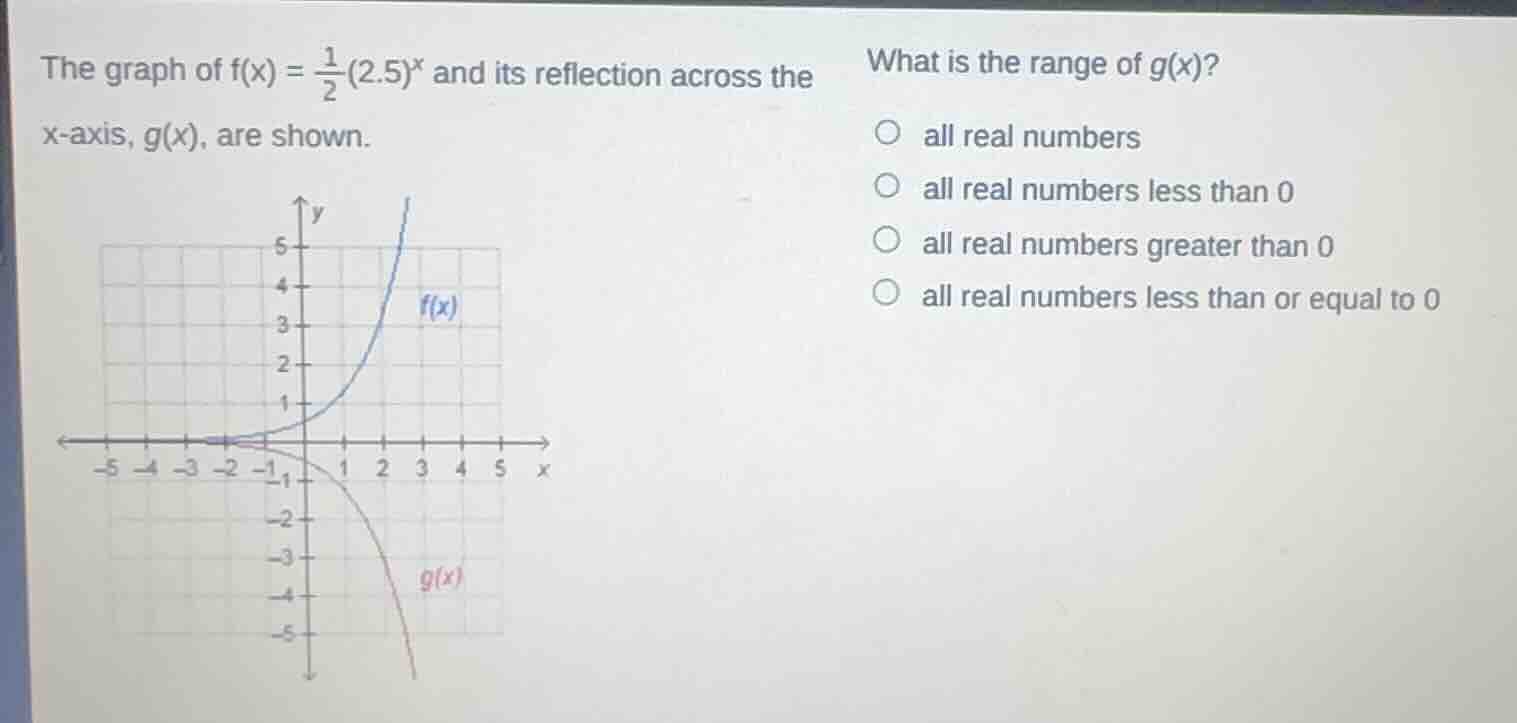
the graph of $f(x) = \\frac{1}{2}(2.5)^x$ and its reflection across the x-axis, $g(x)$, are shown. what is the range of $g(x)$? \\bigcirc all real numbers \\bigcirc all real numbers less than 0 \\bigcirc all real numbers greater than 0 \\bigcirc all real numbers less than or equal to 0
Answer
Explanation:
Step1: Analyze the original function's range
The function ( f(x)=\frac{1}{2}(2.5)^x ) is an exponential function. For an exponential function ( a^x ) where ( a > 1 ), the range of ( f(x)=k\cdot a^x ) (here ( k=\frac{1}{2}>0 )) is all real numbers greater than ( 0 ), because ( (2.5)^x>0 ) for all real ( x ), and multiplying by ( \frac{1}{2} ) (a positive constant) still keeps the result positive. So the range of ( f(x) ) is ( y>0 ).
Step2: Analyze the reflection across the x - axis
When we reflect a function ( y = f(x) ) across the ( x ) - axis, the new function ( g(x) ) is given by ( g(x)=-f(x) ). So if ( f(x)=\frac{1}{2}(2.5)^x ), then ( g(x)=-\frac{1}{2}(2.5)^x ).
Since the range of ( f(x) ) is ( y > 0 ), when we multiply by ( - 1 ), the inequality sign flips. So the range of ( g(x) ) is ( y<0 ). We can also see from the graph that the graph of ( g(x) ) is below the ( x ) - axis (where ( y = 0 )), so all the ( y ) - values of ( g(x) ) are less than ( 0 ).
Answer:
all real numbers less than 0