graph the function y = 2x^4 + 4x^3 = 2x^3(x + 2) by identifying the domain and any symmetries, finding the…
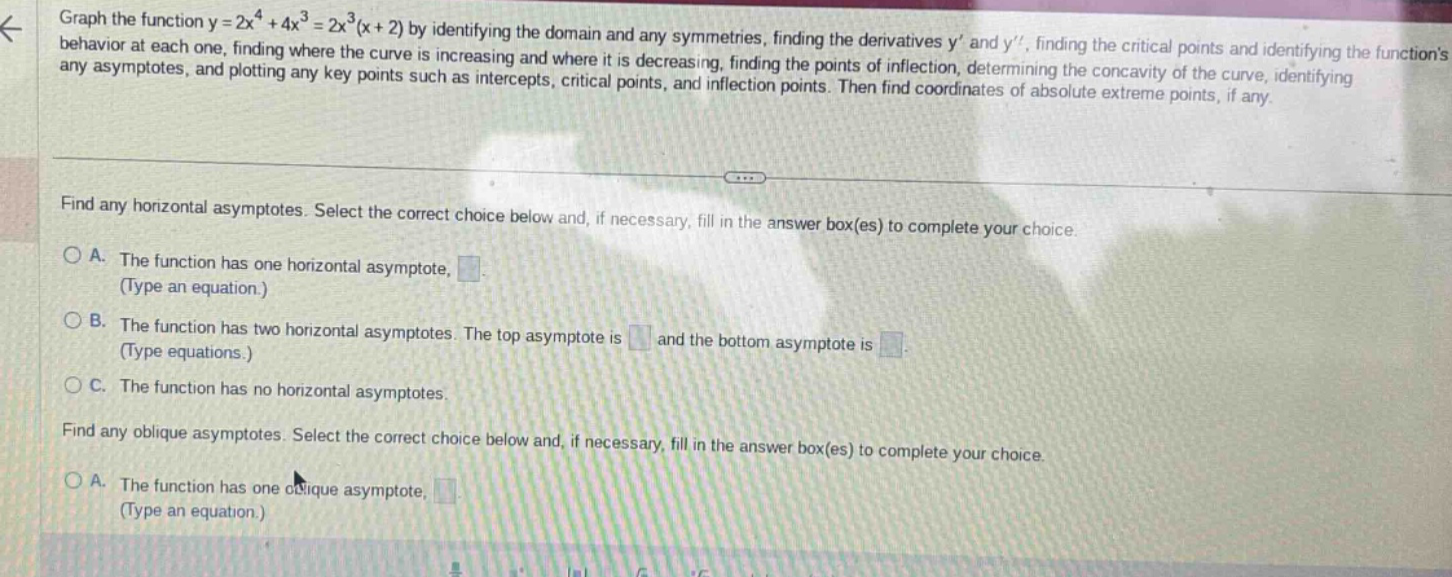
graph the function y = 2x^4 + 4x^3 = 2x^3(x + 2) by identifying the domain and any symmetries, finding the derivatives y and y, finding the critical points and identifying the functions behavior at each one, finding where the curve is increasing and where it is decreasing, finding the points of inflection, determining the concavity of the curve, identifying any asymptotes, and plotting any key points such as intercepts, critical points, and inflection points. then find coordinates of absolute extreme points, if any. find any horizontal asymptotes. select the correct choice below and, if necessary, fill in the answer box(es) to complete your choice. a. the function has one horizontal asymptote, (type an equation.) b. the function has two horizontal asymptotes. the top asymptote is and the bottom asymptote is (type equations.) c. the function has no horizontal asymptotes. find any oblique asymptotes. select the correct choice below and, if necessary, fill in the answer box(es) to complete your choice. a. the function has one oblique asymptote, (type an equation.)
Answer
Explanation:
Step1: Recall the definition of horizontal asymptotes
For a function (y = f(x)), we find (\lim_{x\rightarrow\pm\infty}f(x)). Given (y = 2x^{4}+4x^{3}=2x^{3}(x + 2)), as (x\rightarrow\pm\infty), the degree of the polynomial is (n = 4) and the leading - coefficient (a=2>0). (\lim_{x\rightarrow\infty}(2x^{4}+4x^{3})=\infty) and (\lim_{x\rightarrow-\infty}(2x^{4}+4x^{3})=\infty).
Step2: Determine the horizontal asymptotes
Since (\lim_{x\rightarrow\pm\infty}(2x^{4}+4x^{3})) is not a finite value, the function has no horizontal asymptotes.
Step3: Recall the definition of oblique asymptotes
A rational function (y=\frac{f(x)}{g(x)}) has an oblique asymptote when the degree of (f(x)) is one more than the degree of (g(x)). Our function (y = 2x^{4}+4x^{3}) is a polynomial function, not a rational function in the form (\frac{f(x)}{g(x)}) where (\text{deg}(f)-\text{deg}(g)=1). For a non - rational polynomial function of degree (n\geq2), there are no oblique asymptotes.
Answer:
C. The function has no horizontal asymptotes. The function has no oblique asymptotes.