graph the function y = 2x^4 + 4x^3 = 2x^3(x + 2) by identifying the domain and any symmetries, finding the…
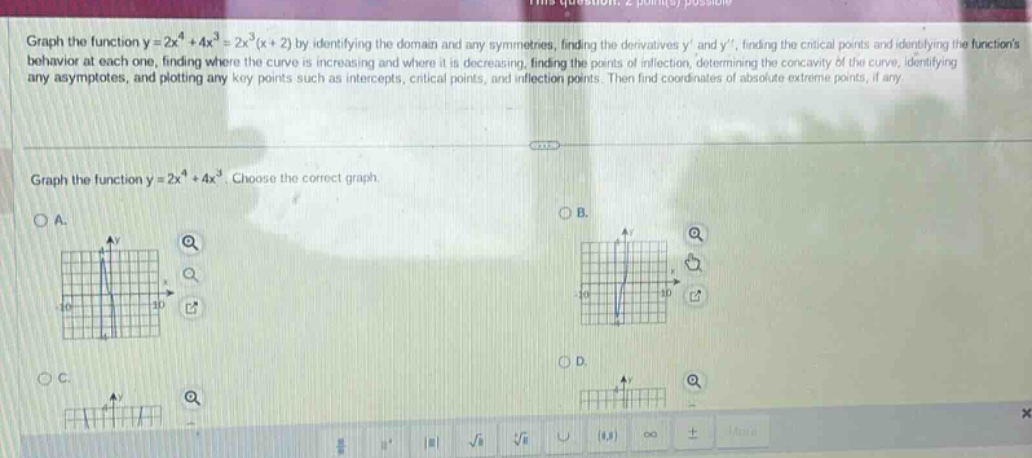
graph the function y = 2x^4 + 4x^3 = 2x^3(x + 2) by identifying the domain and any symmetries, finding the derivatives y and y, finding the critical points and identifying the functions behavior at each one, finding where the curve is increasing and where it is decreasing, finding the points of inflection, determining the concavity of the curve, identifying any asymptotes, and plotting any key points such as intercepts, critical points, and inflection points. then find coordinates of absolute extreme points, if any. graph the function y = 2x^4 + 4x^3. choose the correct graph. oa. ob. oc. od.
Answer
Answer:
- Domain:
- The function (y = 2x^{4}+4x^{3}=2x^{3}(x + 2)) is a polynomial function. The domain of a polynomial function is all real - numbers, i.e., ((-\infty,\infty)).
- Symmetries:
- Replace (x) with (-x): (y=2(-x)^{4}+4(-x)^{3}=2x^{4}-4x^{3}). Since (y(-x)\neq y(x)) and (y(-x)\neq - y(x)), the function has no symmetry about the (y) - axis or the origin.
- First - derivative:
- Using the power rule ((x^{n})^\prime=nx^{n - 1}), if (y = 2x^{4}+4x^{3}), then (y^\prime=8x^{3}+12x^{2}=4x^{2}(2x + 3)).
- Critical points:
- Set (y^\prime = 0), so (4x^{2}(2x + 3)=0).
- (4x^{2}=0) gives (x = 0) and (2x+3 = 0) gives (x=-\frac{3}{2}).
- Set (y^\prime = 0), so (4x^{2}(2x + 3)=0).
- Increasing and decreasing intervals:
- Consider the intervals ((-\infty,-\frac{3}{2})), ((-\frac{3}{2},0)), and ((0,\infty)).
- For (x\in(-\infty,-\frac{3}{2})), let (x=-2). Then (y^\prime=4(-2)^{2}[2(-2)+3]=16(-1)=-16\lt0), so the function is decreasing on ((-\infty,-\frac{3}{2})).
- For (x\in(-\frac{3}{2},0)), let (x =-\frac{1}{2}). Then (y^\prime=4(-\frac{1}{2})^{2}[2(-\frac{1}{2})+3]=1\times2 = 2\gt0), so the function is increasing on ((-\frac{3}{2},0)).
- For (x\in(0,\infty)), let (x = 1). Then (y^\prime=4(1)^{2}(2\times1 + 3)=4\times5 = 20\gt0), so the function is increasing on ((0,\infty)).
- Consider the intervals ((-\infty,-\frac{3}{2})), ((-\frac{3}{2},0)), and ((0,\infty)).
- Second - derivative:
- Differentiate (y^\prime=8x^{3}+12x^{2}) with respect to (x). Using the power rule, (y^{\prime\prime}=24x^{2}+24x=24x(x + 1)).
- Inflection points:
- Set (y^{\prime\prime}=0), so (24x(x + 1)=0). This gives (x = 0) and (x=-1).
- Concavity:
- Consider the intervals ((-\infty,-1)), ((-1,0)), and ((0,\infty)).
- For (x\in(-\infty,-1)), let (x=-2). Then (y^{\prime\prime}=24(-2)(-2 + 1)=48\gt0), so the function is concave up on ((-\infty,-1)).
- For (x\in(-1,0)), let (x=-\frac{1}{2}). Then (y^{\prime\prime}=24(-\frac{1}{2})(-\frac{1}{2}+1)=-6\lt0), so the function is concave down on ((-1,0)).
- For (x\in(0,\infty)), let (x = 1). Then (y^{\prime\prime}=24(1)(1 + 1)=48\gt0), so the function is concave up on ((0,\infty)).
- Consider the intervals ((-\infty,-1)), ((-1,0)), and ((0,\infty)).
- Asymptotes:
- Since it is a polynomial function, there are no vertical or horizontal asymptotes.
- Intercepts:
- x - intercepts: Set (y = 0), so (2x^{3}(x + 2)=0). This gives (x = 0) and (x=-2).
- y - intercept: Set (x = 0), then (y = 0).
- Extreme points:
- Since the function changes from decreasing to increasing at (x=-\frac{3}{2}), (y(-\frac{3}{2})=2(-\frac{3}{2})^{4}+4(-\frac{3}{2})^{3}=2\times\frac{81}{16}-4\times\frac{27}{8}=\frac{81}{8}-\frac{108}{8}=-\frac{27}{8}).
- At (x = 0), the function does not change from increasing to decreasing or vice - versa (the derivative has a double root at (x = 0)), so it is not a local extreme.
- As (x\to\pm\infty), (y\to\infty) since the leading term (2x^{4}) has a positive leading coefficient and an even degree. So the absolute minimum is ((-\frac{3}{2},-\frac{27}{8})) and there is no absolute maximum.
To choose the correct graph, we use the information about intercepts ((x=-2,0) and (y = 0)), the behavior at critical points ((x =-\frac{3}{2}) is a local minimum), and concavity.
Explanation:
Step1: Find the domain
Polynomial, domain is ((-\infty,\infty)).
Step2: Check for symmetries
Substitute (-x), no symmetry.
Step3: Calculate the first - derivative
Use power rule, (y^\prime=8x^{3}+12x^{2}).
Step4: Find critical points
Set (y^\prime = 0), solve (4x^{2}(2x + 3)=0).
Step5: Determine increasing and decreasing intervals
Test points in sub - intervals of the domain.
Step6: Calculate the second - derivative
Differentiate (y^\prime), (y^{\prime\prime}=24x^{2}+24x).
Step7: Find inflection points
Set (y^{\prime\prime}=0), solve (24x(x + 1)=0).
Step8: Determine concavity
Test points in sub - intervals for (y^{\prime\prime}).
Step9: Check for asymptotes
No asymptotes for polynomial.
Step10: Find intercepts
Set (x = 0) for y - intercept, (y = 0) for x - intercepts.
Step11: Find extreme points
Analyze behavior at critical points.