graph the function y = 2x^4 + 4x^3 = 2x^3(x + 2) by identifying the domain and any symmetries, finding the…
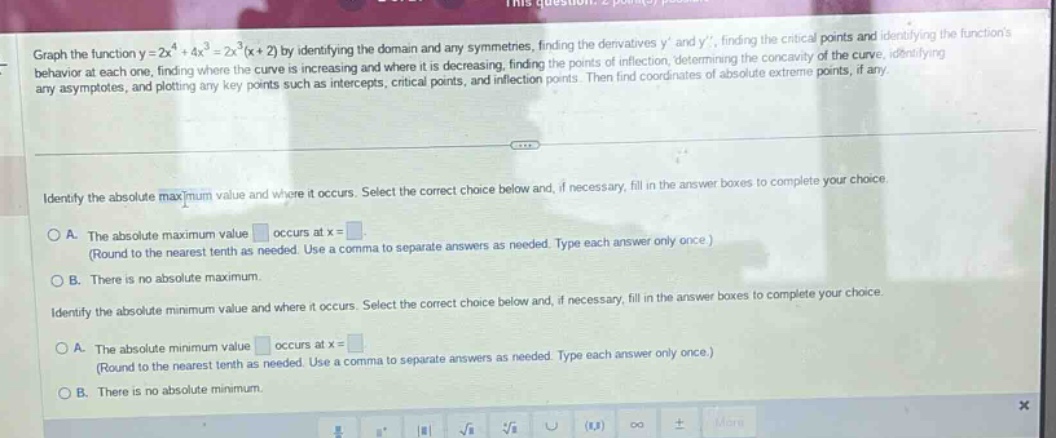
graph the function y = 2x^4 + 4x^3 = 2x^3(x + 2) by identifying the domain and any symmetries, finding the derivatives y and y, finding the critical points and identifying the functions behavior at each one, finding where the curve is increasing and where it is decreasing, finding the points of inflection, determining the concavity of the curve, identifying any asymptotes, and plotting any key points such as intercepts, critical points, and inflection points. then find coordinates of absolute extreme points, if any. identify the absolute maximum value and where it occurs. select the correct choice below and, if necessary, fill in the answer boxes to complete your choice. a. the absolute maximum value occurs at x = (round to the nearest tenth as needed. use a comma to separate answers as needed. type each answer only once.) b. there is no absolute maximum. identify the absolute minimum value and where it occurs. select the correct choice below and, if necessary, fill in the answer boxes to complete your choice. a. the absolute minimum value occurs at x = (round to the nearest tenth as needed. use a comma to separate answers as needed. type each answer only once.) b. there is no absolute minimum.
Answer
Answer:
- For absolute - maximum:
- B. There is no absolute maximum.
- For absolute - minimum:
- First, rewrite the function (y = 2x^{4}+4x^{3}=2x^{3}(x + 2)).
- Find the first - derivative using the power rule ((x^{n})^\prime=nx^{n - 1}).
- (y^\prime=8x^{3}+12x^{2}=4x^{2}(2x + 3)).
- Set (y^\prime = 0), then (4x^{2}(2x + 3)=0). The critical points are (x = 0) and (x=-\frac{3}{2}).
- Find the second - derivative (y^{\prime\prime}=24x^{2}+24x=24x(x + 1)).
- Evaluate (y^{\prime\prime}) at the critical points:
- When (x = 0), (y^{\prime\prime}(0)=0), the second - derivative test is inconclusive.
- When (x=-\frac{3}{2}), (y^{\prime\prime}(-\frac{3}{2})=24\times(-\frac{3}{2})\times(-\frac{3}{2}+1)=24\times(-\frac{3}{2})\times(-\frac{1}{2}) = 18>0). So the function has a local minimum at (x =-\frac{3}{2}).
- Calculate (y(-\frac{3}{2})=2\times(-\frac{3}{2})^{4}+4\times(-\frac{3}{2})^{3}=2\times\frac{81}{16}+4\times(-\frac{27}{8})=\frac{81}{8}-\frac{27}{2}=\frac{81 - 108}{8}=-\frac{27}{8}=- 3.4).
- As (x\to\pm\infty), (y = 2x^{4}+4x^{3}\to+\infty) since the leading term (2x^{4}) has a positive coefficient and an even degree.
- A. The absolute minimum value (-3.4) occurs at (x = - 1.5).
- Evaluate (y^{\prime\prime}) at the critical points:
Explanation:
Step1: Find the first - derivative
Using the power rule ((x^{n})^\prime=nx^{n - 1}), for (y = 2x^{4}+4x^{3}), (y^\prime=8x^{3}+12x^{2}=4x^{2}(2x + 3)).
Step2: Find critical points
Set (y^\prime = 0), so (4x^{2}(2x + 3)=0). Solving gives (x = 0) and (x=-\frac{3}{2}).
Step3: Find the second - derivative
Differentiate (y^\prime): (y^{\prime\prime}=24x^{2}+24x=24x(x + 1)).
Step4: Use the second - derivative test
Evaluate (y^{\prime\prime}) at critical points. (y^{\prime\prime}(0)=0), (y^{\prime\prime}(-\frac{3}{2}) = 18>0), so (x =-\frac{3}{2}) is a local - minimum point.
Step5: Analyze end - behavior
Since the leading term of (y = 2x^{4}+4x^{3}) is (2x^{4}) ((a = 2>0), (n = 4) even), as (x\to\pm\infty), (y\to+\infty). So (x =-\frac{3}{2}) is the absolute - minimum point with (y(-\frac{3}{2})=-3.4), and there is no absolute maximum.