5. the graph of the function f, consisting of three line - segments, is given above. let g(x)=∫1^x f(t)dt…
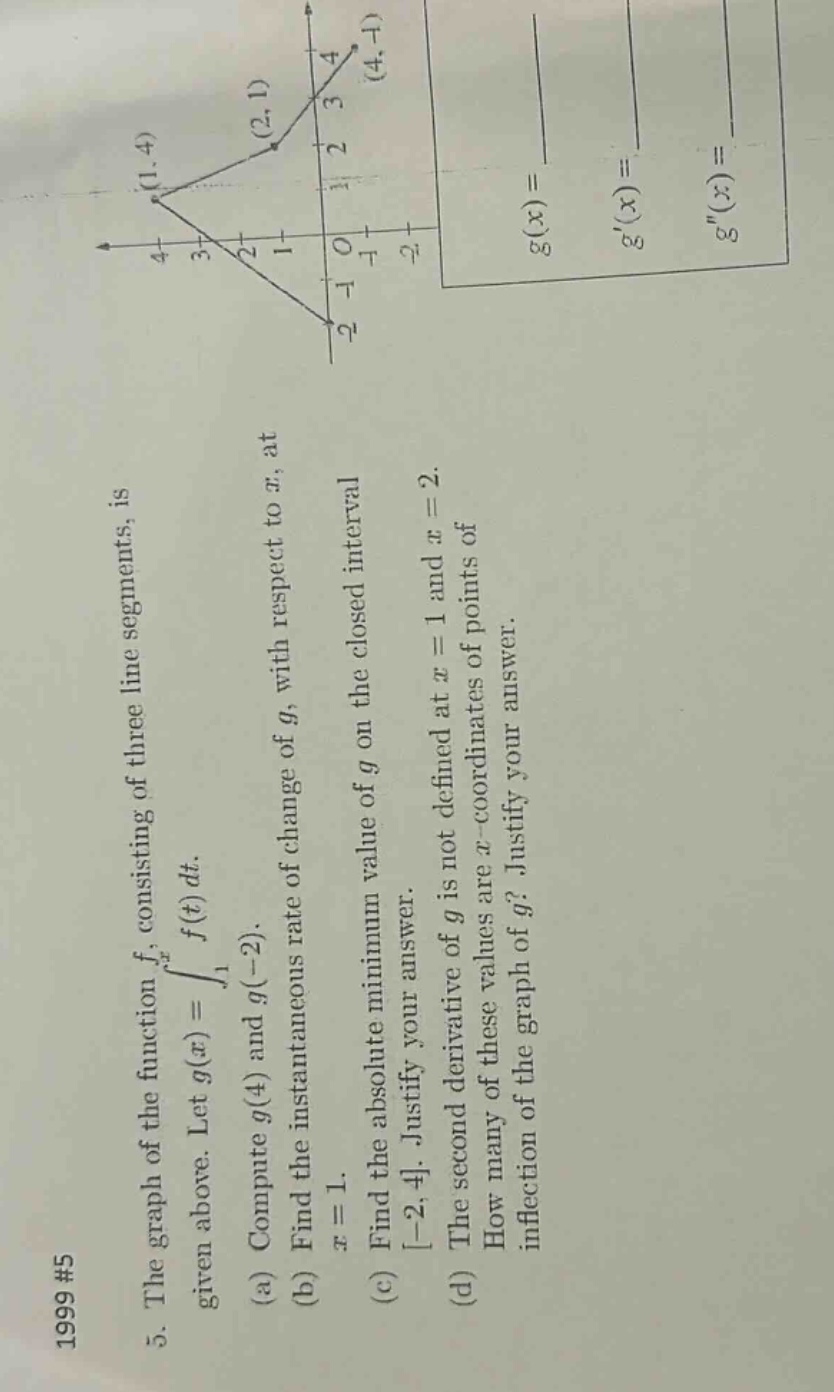
5. the graph of the function f, consisting of three line - segments, is given above. let g(x)=∫1^x f(t)dt. (a) compute g(4) and g( - 2). (b) find the instantaneous rate of change of g, with respect to x, at x = 1. (c) find the absolute minimum value of g on the closed interval - 2,4. justify your answer. (d) the second derivative of g is not defined at x = 1 and x = 2. how many of these values are x - coordinates of points of inflection of the graph of g? justify your answer.
Answer
Explanation:
Step1: Recall the formula for average rate of change
The average rate of change of a function $y = g(x)$ over the interval $[a,b]$ is $\frac{g(b)-g(a)}{b - a}$. Here we want to find the average rate of change of $g$ from $x=-2$ to $x = 4$. We need to find $g(-2)$ and $g(4)$ from the graph.
Step2: Determine $g(-2)$ and $g(4)$ from the graph
From the graph, when $x=-2$, $g(-2)= - 2$ and when $x = 4$, $g(4)=-1$.
Step3: Calculate the average rate of change
The average rate of change is $\frac{g(4)-g(-2)}{4-(-2)}=\frac{-1-(-2)}{4 + 2}=\frac{-1 + 2}{6}=\frac{1}{6}$.
Step4: Recall the definition of instantaneous rate of change
The instantaneous rate of change of $g(x)$ at $x = 1$ is $g^{\prime}(1)$. The slope of the tangent - line to the graph of $y = g(x)$ at $x = 1$ gives $g^{\prime}(1)$. The graph of $g(x)$ is linear on the interval containing $x = 1$. The line passes through $(1,4)$ and $(2,1)$. The slope of the line $m=\frac{y_2-y_1}{x_2 - x_1}=\frac{1 - 4}{2 - 1}=-3$. So $g^{\prime}(1)=-3$.
Step5: Find the absolute minimum of $g(x)$ on $[-2,4]$
By looking at the graph of $g(x)$ on the interval $[-2,4]$, we can see that the lowest point on the graph in this interval occurs at $x = 4$ and $g(4)=-1$. So the absolute minimum value of $g(x)$ on $[-2,4]$ is $-1$.
Step6: Recall the condition for inflection points
An inflection point of a function $y = g(x)$ occurs where $g^{\prime\prime}(x)$ changes sign. A function is linear on each of the three line - segments of its graph. The second - derivative of a linear function is $0$. The second - derivative of $g(x)$ is not defined at the points where the graph of $g(x)$ has a corner. The graph of $g(x)$ has corners at $x=-2,1,2$. But $g^{\prime\prime}(x)$ does not change sign at these points (since $g^{\prime\prime}(x)=0$ on each linear segment). So the number of inflection points of $g(x)$ is $0$.
Answer:
(a) $\frac{1}{6}$ (b) $-3$ (c) $-1$ (d) $0$