graph the function f(x) = cos(x - 2π) + 2.
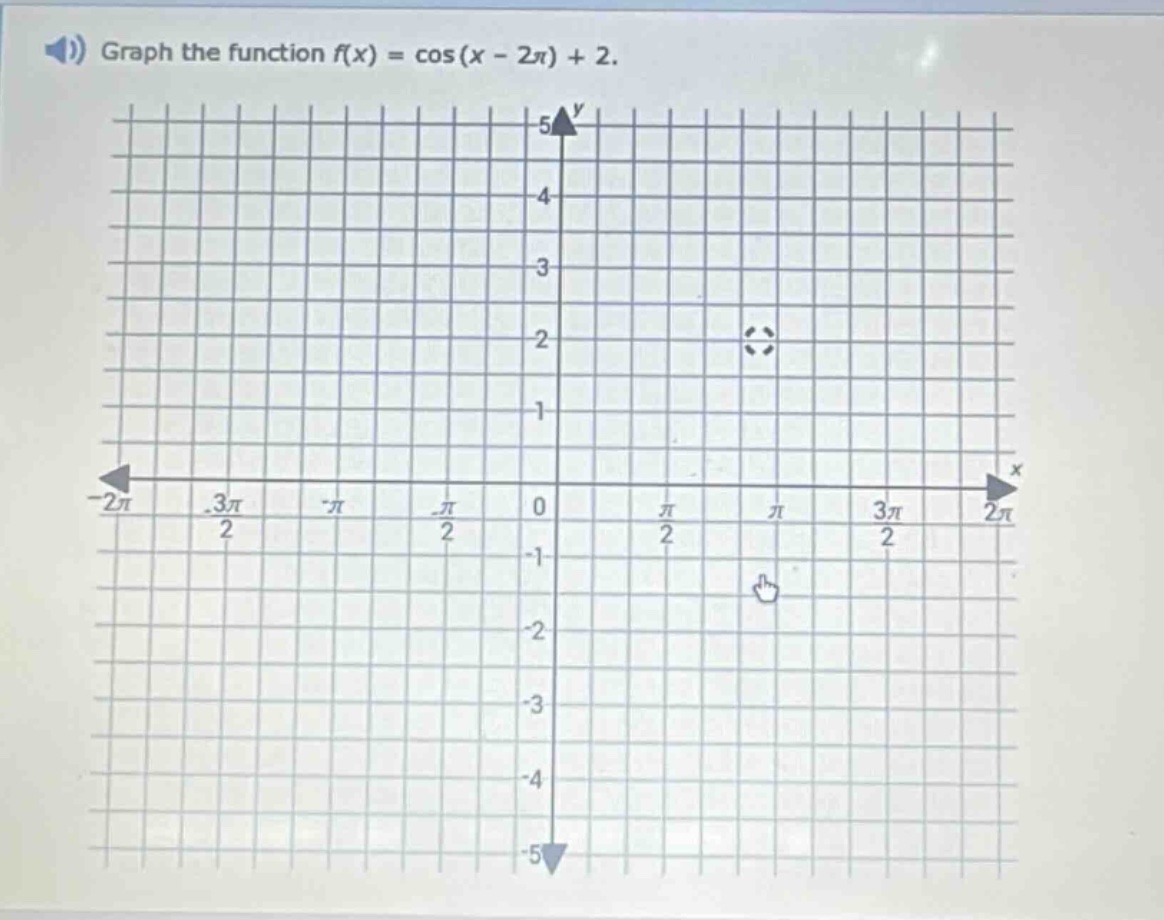
graph the function f(x) = cos(x - 2π) + 2.
Answer
Explanation:
Step1: Recall cosine - function properties
The cosine function (y = \cos(x)) has a period of (2\pi), and (\cos(x - 2\pi)=\cos x) because of the periodicity of the cosine function ((\cos(A - 2k\pi)=\cos A) for any real - number (A) and integer (k)). So, (f(x)=\cos(x - 2\pi)+2=\cos x + 2).
Step2: Determine key points of (y = \cos x)
The standard cosine function (y = \cos x) has key points: when (x = 0), (\cos(0)=1); when (x=\frac{\pi}{2}), (\cos(\frac{\pi}{2}) = 0); when (x=\pi), (\cos(\pi)=- 1); when (x=\frac{3\pi}{2}), (\cos(\frac{3\pi}{2}) = 0); when (x = 2\pi), (\cos(2\pi)=1).
Step3: Shift the key - points vertically
For the function (y=\cos x + 2), we shift the key - points of (y = \cos x) vertically upwards by 2 units.
- When (x = 0), (y=\cos(0)+2=1 + 2=3).
- When (x=\frac{\pi}{2}), (y=\cos(\frac{\pi}{2})+2=0 + 2=2).
- When (x=\pi), (y=\cos(\pi)+2=-1 + 2=1).
- When (x=\frac{3\pi}{2}), (y=\cos(\frac{3\pi}{2})+2=0 + 2=2).
- When (x = 2\pi), (y=\cos(2\pi)+2=1 + 2=3).
Step4: Sketch the graph
Plot the points ((0,3)), ((\frac{\pi}{2},2)), ((\pi,1)), ((\frac{3\pi}{2},2)), ((2\pi,3)) and connect them with a smooth curve. The graph of (y = \cos(x - 2\pi)+2) is a cosine - shaped curve with an amplitude of 1, a period of (2\pi), and a vertical shift of 2 units upwards compared to the graph of (y=\cos x).
To graph it on the given grid:
- Mark the points ((0,3)), ((\frac{\pi}{2},2)), ((\pi,1)), ((\frac{3\pi}{2},2)), ((2\pi,3)) on the coordinate plane.
- Use the periodicity of the cosine function ((T = 2\pi)) to extend the graph to the left and right. The minimum value of (y=\cos(x - 2\pi)+2) is (y = 1) (when (\cos(x - 2\pi)=-1)) and the maximum value is (y = 3) (when (\cos(x - 2\pi)=1)).
The graph is a cosine - wave centered around the line (y = 2) with a period of (2\pi), amplitude of 1.
Answer:
Sketch a cosine - wave with period (2\pi), amplitude 1, centered at (y = 2) passing through the points ((0,3)), ((\frac{\pi}{2},2)), ((\pi,1)), ((\frac{3\pi}{2},2)), ((2\pi,3)) and extending periodically in both directions.