graph the function f(x) = cos(x) + 1.
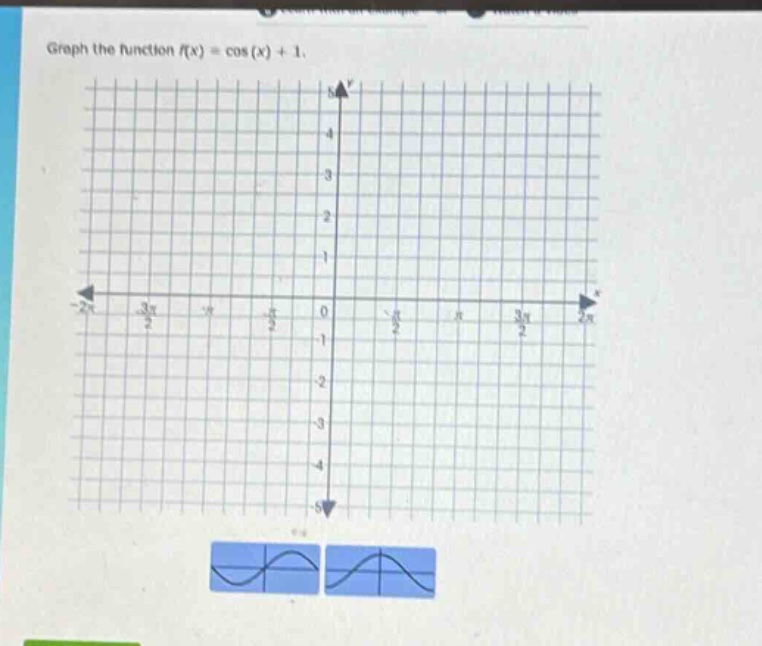
graph the function f(x) = cos(x) + 1.
Answer
Explanation:
Step1: Analyze the function's form.
The function is $f(x) = \cos(x) + 1$. This is $\cos(x)$ shifted vertically by $+1$.
Step2: Determine key characteristics.
Amplitude: $A=1$ (from $\cos(x)$). Period: $T=2\pi$ (from $\cos(x)$). Midline: $y=0+1=1$. Maximum value: $1+1=2$. Minimum value: $1-1=0$.
Step3: Calculate key points for one period, e.g., $[0, 2\pi]$.
$f(0) = \cos(0) + 1 = 1 + 1 = 2 \implies (0, 2)$ $f(\frac{\pi}{2}) = \cos(\frac{\pi}{2}) + 1 = 0 + 1 = 1 \implies (\frac{\pi}{2}, 1)$ $f(\pi) = \cos(\pi) + 1 = -1 + 1 = 0 \implies (\pi, 0)$ $f(\frac{3\pi}{2}) = \cos(\frac{3\pi}{2}) + 1 = 0 + 1 = 1 \implies (\frac{3\pi}{2}, 1)$ $f(2\pi) = \cos(2\pi) + 1 = 1 + 1 = 2 \implies (2\pi, 2)$
Step4: Describe the graph from points.
Plot points. Connect with smooth cosine curve. Extend pattern for domain.
Answer:
The graph of $f(x) = \cos(x) + 1$ is a cosine wave characterized by:
- Amplitude: $1$
- Period: $2\pi$
- Midline: $y=1$
- Maximum value: $2$
- Minimum value: $0$
- Shape: The graph of $y=\cos(x)$ shifted 1 unit upwards.
- Key points for one cycle starting from $x=0$: $(0,2)$ (maximum), $(\frac{\pi}{2},1)$ (midline), $(\pi,0)$ (minimum), $(\frac{3\pi}{2},1)$ (midline), $(2\pi,2)$ (maximum). The graph extends this pattern over its domain. For example, points for the interval $[-2\pi, 0]$ would be $(-2\pi,2)$, $(-\frac{3\pi}{2},1)$, $(-\pi,0)$, $(-\frac{\pi}{2},1)$, $(0,2)$.