graph the function y = -cos(x) + 7 and explain how to find the number of times the gum returns to the wall…
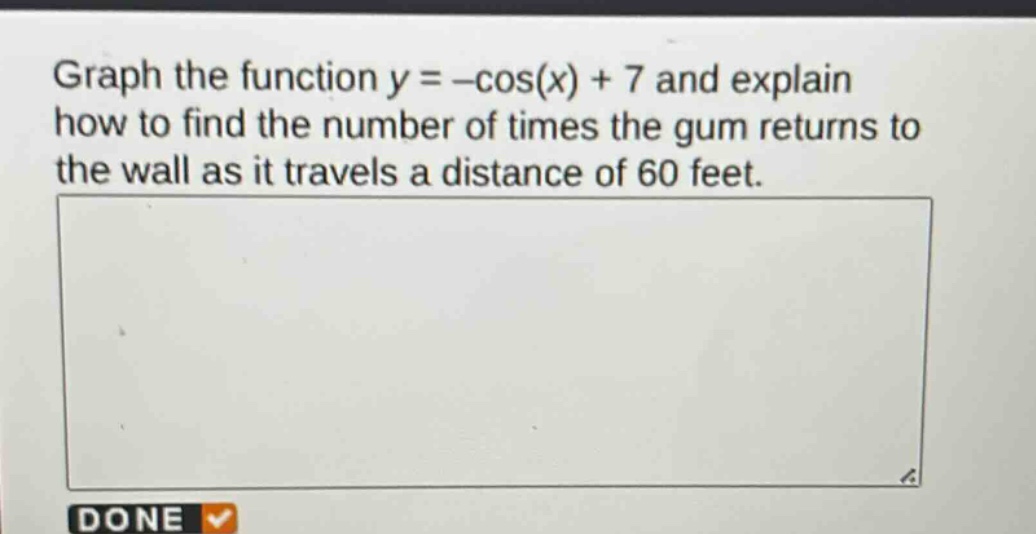
graph the function y = -cos(x) + 7 and explain how to find the number of times the gum returns to the wall as it travels a distance of 60 feet.
Answer
Answer:
- Graph of (y =-\cos(x)+7):
- The general form of a cosine - function is (y = A\cos(Bx - C)+D). For the function (y =-\cos(x)+7), we have (A=- 1), (B = 1), (C = 0), and (D = 7).
- The amplitude (|A|=1). The negative sign in front of (\cos(x)) reflects the graph of (y = \cos(x)) about the (x) - axis.
- The vertical shift (D = 7) moves the entire graph of (y=-\cos(x)) up by 7 units. The period of the function (y = \cos(x)) is (T=\frac{2\pi}{B}), and since (B = 1), the period is (2\pi). We can plot key points:
- When (x = 0), (y=-\cos(0)+7=-1 + 7=6).
- When (x=\frac{\pi}{2}), (y=-\cos(\frac{\pi}{2})+7=0 + 7=7).
- When (x=\pi), (y=-\cos(\pi)+7=1 + 7=8).
- When (x=\frac{3\pi}{2}), (y=-\cos(\frac{3\pi}{2})+7=0 + 7=7).
- When (x = 2\pi), (y=-\cos(2\pi)+7=-1 + 7=6).
- Regarding the gum - problem (assuming a periodic motion related to the cosine function):
- First, we need to establish a relationship between the motion of the gum and the cosine function. If we assume that the motion of the gum is periodic and can be modeled by the given cosine - like function, and the period of the function (y =-\cos(x)+7) is (2\pi).
- However, we need more information about the relationship between the distance the gum travels and the independent variable (x) of the cosine function. If we assume that one - period of the cosine function represents a complete back - and - forth motion of the gum to and from the wall, and we know the distance per period. Let's assume that one period of the motion of the gum corresponds to a distance (d) (which is not given in the problem statement).
- If we knew the distance (d) covered in one period of the motion, then the number of times (n) the gum returns to the wall in a distance of 60 feet would be (n=\frac{60}{d}) (assuming the motion is periodic and the gum returns to the wall at the end of each period). Since the problem does not provide the distance per period, we can only say that if the distance per period is (d), the number of returns (n=\frac{60}{d}).
Explanation:
Step1: Analyze the cosine function for graphing
The function (y =-\cos(x)+7) has amplitude (|A| = 1), is reflected about (x) - axis ((A=-1)) and shifted up 7 units ((D = 7)).
Step2: Identify key points for graphing
Use (x = 0,\frac{\pi}{2},\pi,\frac{3\pi}{2},2\pi) to find corresponding (y) - values.
Step3: Consider the gum - motion problem
Relate the periodic motion of the gum to the cosine function's period. But lack of distance - per - period information limits a definite answer for the number of returns. If distance per period is (d), (n=\frac{60}{d}).