graph the function.\ny = csc x\n\na.\nb.\nc.\nd.
graph the function.\ny = csc x\n\na.\nb.\nc.\nd.
Answer
Explanation:
Step1: Recall the definition of cosecant.
$y = \csc x=\frac{1}{\sin x}$
Step2: Identify vertical asymptotes.
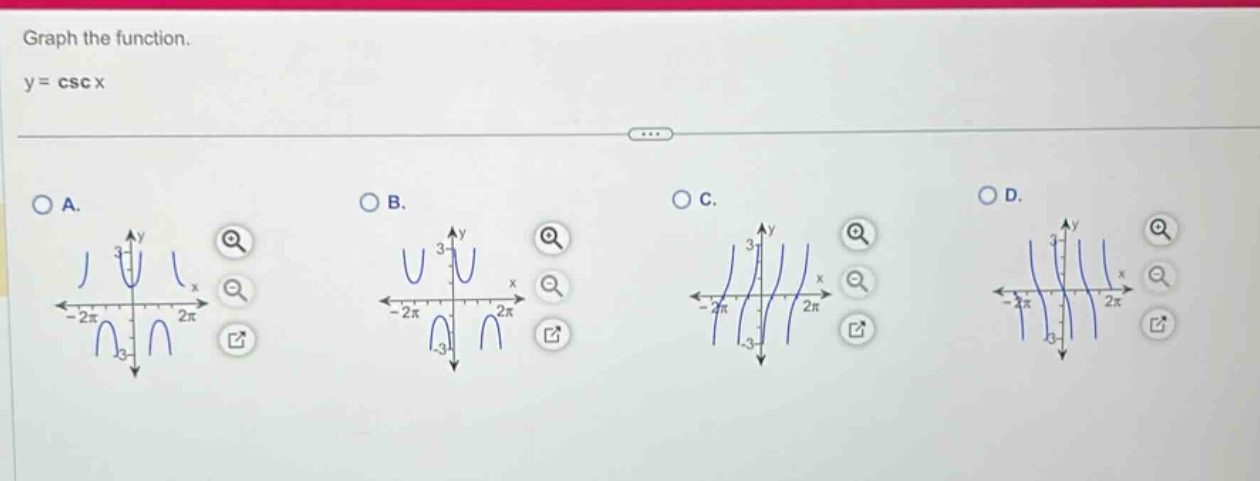
Vertical asymptotes occur where $\sin x = 0$. Since $\sin x=0$ when $x = k\pi$, $k\in\mathbb{Z}$ (where $k$ is an integer), the function $y = \csc x$ has vertical asymptotes at $x=k\pi$.
Step3: Analyze the range.
The range of $\sin x$ is $[- 1,1]$. Since $y=\csc x=\frac{1}{\sin x}$, the range of $y = \csc x$ is $(-\infty,-1]\cup[1,\infty)$. When $\sin x$ approaches $0$ from the positive - side, $\csc x$ approaches $+\infty$, and when $\sin x$ approaches $0$ from the negative - side, $\csc x$ approaches $-\infty$.
Step4: Check the graph shape.
The graph of $y = \csc x$ has U - shaped curves (branches) between consecutive vertical asymptotes.
The correct graph of $y=\csc x$ has vertical asymptotes at $x = k\pi$ ($k\in\mathbb{Z}$) and branches above $y = 1$ and below $y=-1$. The answer is A.
Answer:
A.