the graph below is the function f(x)\nfind lim_{x→2^-} f(x)\nfind lim_{x→2^+} f(x)\nfind lim_{x→2}…
the graph below is the function f(x)\nfind lim_{x→2^-} f(x)\nfind lim_{x→2^+} f(x)\nfind lim_{x→2} f(x)\nfind f(2)\nquestion help: video
Answer
Explanation:
Step1: Analyze left - hand limit
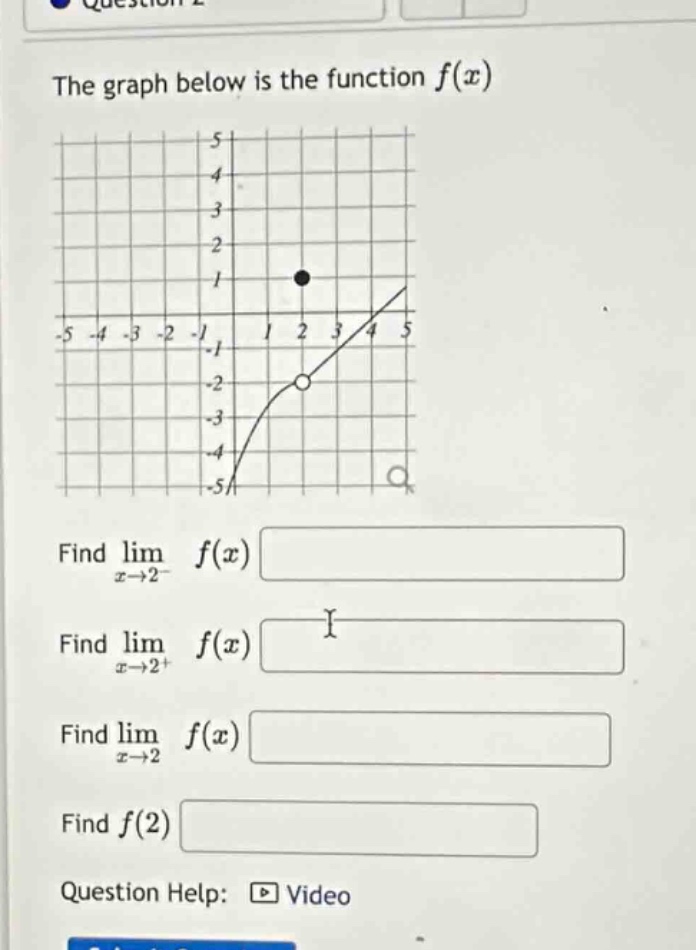
As (x\to2^{-}), we look at the values of the function as (x) approaches 2 from the left side of the graph. Following the curve of the function as (x) gets closer to 2 from the left, the (y) - value approaches - 2. So, (\lim_{x\to2^{-}}f(x)=-2).
Step2: Analyze right - hand limit
As (x\to2^{+}), we look at the values of the function as (x) approaches 2 from the right side of the graph. Following the curve of the function as (x) gets closer to 2 from the right, the (y) - value approaches 1. So, (\lim_{x\to2^{+}}f(x)=1).
Step3: Analyze overall limit
Since (\lim_{x\to2^{-}}f(x)=-2) and (\lim_{x\to2^{+}}f(x)=1), and (\lim_{x\to2^{-}}f(x)\neq\lim_{x\to2^{+}}f(x)), (\lim_{x\to2}f(x)) does not exist.
Step4: Find function value at (x = 2)
The solid dot on the graph at the point ((2,1)) indicates that (f(2)=1).
Answer:
(\lim_{x\to2^{-}}f(x)=-2) (\lim_{x\to2^{+}}f(x)=1) (\lim_{x\to2}f(x)) does not exist (f(2)=1)