the graph of a function f is given. use the graph to estimate the following. (a) all the local maximum and…
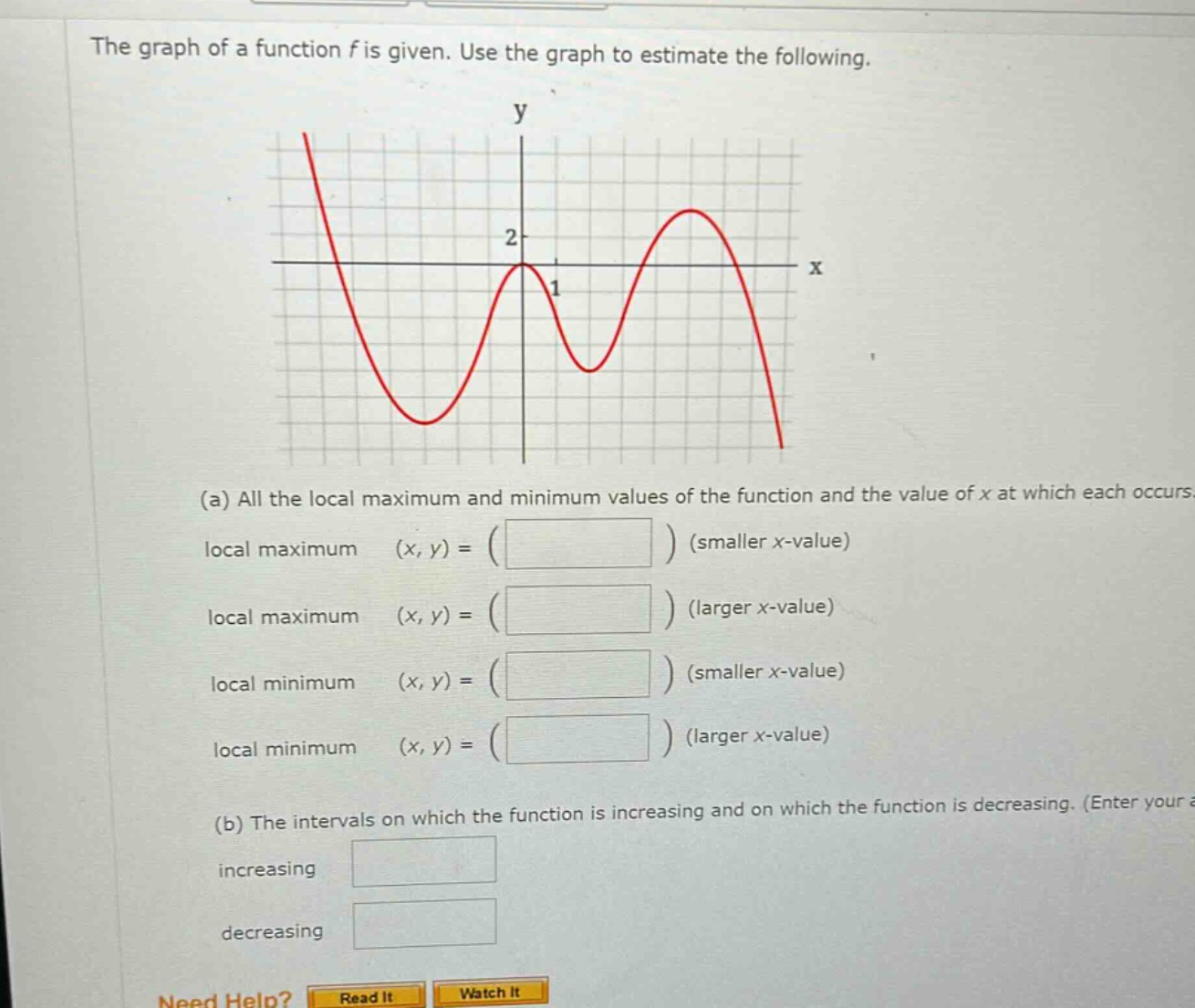
the graph of a function f is given. use the graph to estimate the following. (a) all the local maximum and minimum values of the function and the value of x at which each occurs local maximum (x, y) = ( ) (smaller x - value) local maximum (x, y) = ( ) (larger x - value) local minimum (x, y) = ( ) (smaller x - value) local minimum (x, y) = ( ) (larger x - value) (b) the intervals on which the function is increasing and on which the function is decreasing. (enter your increasing decreasing need help? read it watch it)
Answer
Explanation:
Step1: Identify local maxima
Local maxima are points where the function changes from increasing to decreasing. By observing the graph, the first local - maximum (smaller x - value) occurs at the point where the graph reaches a peak. The x - coordinate is approximately $x = 0$ and the y - coordinate is $y = 1$. The second local - maximum (larger x - value) occurs around $x$ value such that the y - value is approximately $y = 2$.
Step2: Identify local minima
Local minima are points where the function changes from decreasing to increasing. The first local - minimum (smaller x - value) occurs at a point with a negative x - value and a y - value less than 0. Let's say the x - coordinate is approximately $x=-2$ and the y - coordinate is $y = - 1$. The second local - minimum (larger x - value) occurs at a positive x - value with a y - value less than 1, say $x = 2$ and $y=0$.
Step3: Determine intervals of increase and decrease
A function is increasing when the y - values increase as the x - values increase. From the graph, the function is increasing on the intervals $(-2,0)$ and $(2,\infty)$. A function is decreasing when the y - values decrease as the x - values increase. The function is decreasing on the intervals $(-\infty,-2)$ and $(0,2)$.
Answer:
local maximum $(x,y)=(0,1)$ (smaller x - value) local maximum $(x,y)=(4,2)$ (larger x - value) local minimum $(x,y)=(-2,-1)$ (smaller x - value) local minimum $(x,y)=(2,0)$ (larger x - value) increasing: $(-2,0)\cup(2,\infty)$ decreasing: $(-\infty,-2)\cup(0,2)$