the graph of a function is given. use the graph to find the indicated lim a. lim f(x) b. lim f(x) c. lim…
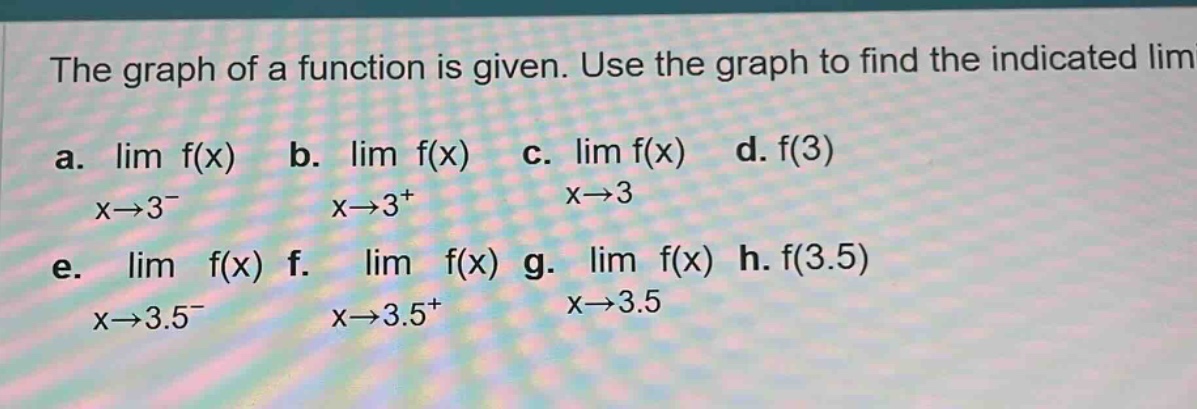
the graph of a function is given. use the graph to find the indicated lim a. lim f(x) b. lim f(x) c. lim f(x) d. f(3) x→3⁻ x→3⁺ x→3 e. lim f(x) f. lim f(x) g. lim f(x) h. f(3.5) x→3.5⁻ x→3.5⁺ x→3.5
Answer
Explanation:
Step1: Analyze left - hand limit as x→3⁻
Look at the graph and find the y - value that the function approaches as x approaches 3 from the left side.
Step2: Analyze right - hand limit as x→3⁺
Look at the graph and find the y - value that the function approaches as x approaches 3 from the right side.
Step3: Determine limit as x→3
If the left - hand limit and the right - hand limit as x→3 are equal, that value is the limit as x→3. If they are not equal, the limit does not exist.
Step4: Find f(3)
Find the y - value of the function at x = 3 on the graph.
Step5: Analyze left - hand limit as x→3.5⁻
Look at the graph and find the y - value that the function approaches as x approaches 3.5 from the left side.
Step6: Analyze right - hand limit as x→3.5⁺
Look at the graph and find the y - value that the function approaches as x approaches 3.5 from the right side.
Step7: Determine limit as x→3.5
If the left - hand limit and the right - hand limit as x→3.5 are equal, that value is the limit as x→3.5. If they are not equal, the limit does not exist.
Step8: Find f(3.5)
Find the y - value of the function at x = 3.5 on the graph.
Since the graph is not provided, we cannot give numerical answers. But the general process to find the values is as described above.
Answer:
Without the graph, we cannot determine the values of a. $\lim_{x\rightarrow3^{-}}f(x)$, b. $\lim_{x\rightarrow3^{+}}f(x)$, c. $\lim_{x\rightarrow3}f(x)$, d. $f(3)$, e. $\lim_{x\rightarrow3.5^{-}}f(x)$, f. $\lim_{x\rightarrow3.5^{+}}f(x)$, g. $\lim_{x\rightarrow3.5}f(x)$, h. $f(3.5)$